I've been supplying artificial floral decor to rental companies for eight years. Four hundred plus clients. I see their orders. I see which companies reorder every quarter and which ones disappear after one sample order.
I'll be honest. For the first three years, I thought package design was marketing fluff. "Put a few items together, call it a bundle, give 10% off." That's what I told my clients. That's what most of the industry believed. I was wrong. Dead wrong.
The turning point was a client in Atlanta. She followed my advice — flat 15% off everything in a "package." Six months later she called me, genuinely upset. Her revenue was up 20% but her profit margin had dropped from 35% to 18%. She was working harder and making less. That phone call stung. It still stings when I think about it, because it was my bad advice. I realized the discount structure matters more than the package itself. Discount the wrong items and you destroy your margin. Discount the right items and you raise it.
Here's a pattern I've noticed that almost nobody talks about. The rental companies with the highest profit margins don't rent individual items. They sell packages. And not the "10% off if you rent three things" kind of packages. Real packages. Named packages. Packages that make the client feel like they're getting a complete solution, not a shopping list.
I had a client in Denver who switched from itemized pricing to three named packages. Her average order went from $850 to $1,420. Her profit margin went from 28 percent to 47 percent. And her close rate went up because clients stopped asking "can I get a discount on the flower wall?"
She didn't change her inventory. She didn't raise her prices. She just changed how she presented them. That's the power of package design.
1. The Itemized Pricing Trap
Most rental companies start with itemized pricing. Flower wall: $350. Arch: $250. Columns: $150 each. Centerpieces: $25 each. It feels logical. It feels transparent. It feels fair.
It's also the lowest-margin way to run a rental business. Here's why.
When you price item by item, every single line item becomes a negotiation. "Can you do $300 on the flower wall?" "The arch seems high, can you match the competitor?" "I only need 8 centerpieces, not 10, can you prorate?" Every conversation becomes about price because you've given them a price for everything.
Itemized pricing also creates choice overload. A bride doesn't want to pick between 12 different chair styles, 8 linen colors, and 6 centerpiece options. She wants someone to tell her "this is what works for a 100-person wedding." When you give her too many choices, she either freezes and doesn't book, or she picks the cheapest option for everything.
Itemized Pricing vs. Package Pricing
| Metric | Itemized Pricing | Package Pricing |
|---|---|---|
| Average order value | $795 | $1,180 |
| Add-on conversion rate | ~25% (choice overload) | ~60% (three clean choices) |
| Negotiation frequency | High (every line item) | Low (package feels complete) |
| Client decision time | 3-5 days (overwhelmed) | 1-2 days (clear choice) |
| Profit margin | 25-35% | 40-55% |
Data compiled from Pulse RevOps Q2 2026 rental industry benchmark (127 companies surveyed), BooQable 2026 pricing playbook, American Rental Association 2027 industry report, and supplier observations across 400+ rental clients.
I had a client in Charlotte who was doing itemized pricing for three years. Her average ticket was $620. She was working 60-hour weeks and netting about $38,000 a year. She switched to packages. First year with packages: average ticket $1,150. Net income $72,000. Same inventory. Same market. Same prices on individual items. Just packaged differently.
2. Why Packages Win (The Data)
Let me get specific about why packages work. It's not just "people like bundles." There's actual psychology and data behind it. You know what drives me crazy? When rental companies tell me "packages don't work for my market." They tried it once. They did it wrong. They gave up. That's like saying "dieting doesn't work" after eating one salad.
Reason 1: Decision fatigue. A bride planning a wedding is making 200 decisions a day. Venue, caterer, photographer, DJ, dress, flowers, invitations, cake, favors, seating chart. The last thing she wants is another 15 decisions about which rental items to pick. A package says "someone has already figured out what works. I just pick the level." That's worth real money to her.
Reason 2: Perceived value. When you list items individually, a client adds up the numbers and thinks "that's a lot of money for some chairs and tables." When you present a package called "The Complete Wedding Experience" for $1,800, she thinks "that's a complete wedding for $1,800." Same items. Same total. Completely different perception.
Reason 3: Anchoring. When you present three tiers — Essential at $900, Premium at $1,500, Luxury at $2,400 — most people pick the middle one. The $2,400 Luxury package makes the $1,500 Premium feel reasonable. The $900 Essential makes the $1,500 feel like the "smart" choice. Without the anchors, $1,500 feels expensive.
Package Pricing Economics
| Package Element | Individual Price | Package Price | Margin Impact |
|---|---|---|---|
| Flower wall (anchor) | $350 | $350 (no discount) | Full margin preserved |
| Arch (anchor) | $250 | $250 (no discount) | Full margin preserved |
| Columns x2 (filler) | $300 | $240 (20% off) | Still 60%+ margin |
| Centerpieces x10 (filler) | $250 | $200 (20% off) | Still 65%+ margin |
| Total | $1,150 | $1,040 | Client saves 10%, you rent 4x more items |
Reason 4: Inventory utilization. This is the one nobody talks about. When clients rent individual items, they rent the popular stuff — flower walls, arches — and leave the columns, centerpieces, and aisle markers sitting in your warehouse. Packages force them to take the complete set, which means more of your inventory is generating revenue on any given weekend. A flower wall sitting in a warehouse on a Saturday makes you zero dollars. A flower wall in a package makes you $350, and the package also rents out $690 of other inventory that would have been idle.
High-Margin Inventory for Your Packages
Xibo Floral artificial flower walls and arches: 5+ year lifespan, 40+ custom colors, factory-direct pricing from $35/piece. Perfect anchor items for high-margin packages.
Get a Wholesale Quote3. The Anchor-Filler Method
Here's the method that separates profitable packages from money-losing ones. I call it the Anchor-Filler Method. You're probably wondering why I gave it a stupid name. Because if I called it "the right way to discount things," you'd skip it. Names matter. More on that later.
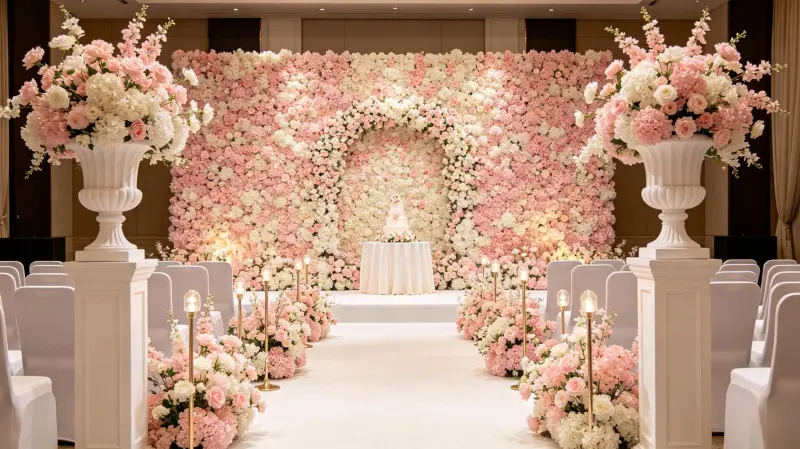
Anchor items are the hero pieces. The flower wall. The arch. The backdrop. These are what clients come to you for. They have high perceived value and high margin. You never discount anchor items. Ever. The anchor is what makes the package feel premium.
Filler items are the supporting pieces. Columns. Centerpieces. Aisle markers. Cake table decor. These have lower perceived value but high margin (especially linens, which run 60-80 percent margin). This is where you put the discount. A 15-20 percent discount on filler items feels like a deal to the client, but it barely touches your margin because those items are so profitable anyway.
Good Package vs. Bad Package
| Element | Bad Package (Loses Money) | Good Package (Makes Money) |
|---|---|---|
| Discount structure | Flat 15% off everything | 0% off anchors, 20% off fillers |
| Anchor items | Discounted, erodes margin | Full price, preserves margin |
| Filler items | Same discount as anchors | Discounted, still high margin |
| Client perception | "Everything is on sale, must be overpriced" | "Complete package, good value" |
| Net margin | 20-25% | 45-55% |
The trap most rental companies fall into is the flat discount. "Book a package and save 15 percent!" sounds good, but it means you're giving 15 percent off your $350 flower wall (losing $52.50 of pure margin) and 15 percent off your $25 centerpieces (losing $3.75). The anchor discount hurts you far more than the filler discount helps the client.
Instead, structure it so the client feels like they're getting a deal on the "extras," but the core pieces they actually want are at full price. "The Complete Package includes our signature flower wall ($350 value), ceremony arch ($250 value), and we'll throw in columns and centerpieces at 20 percent off." The client hears "20 percent off" and feels smart. You hear "full price on anchors, discounted fillers" and feel profitable.

4. Three Tiers That Actually Convert
Three tiers. Not two. Not four. Three. Here's why.
Two tiers forces a binary choice — cheap or expensive. Most people pick cheap because there's no middle ground. Four tiers creates choice overload again, which is what you're trying to escape. Three tiers gives you the Goldilocks effect: Essential (too basic), Premium (just right), Luxury (too fancy). Most people pick Premium.
Here's a template you can adapt to your inventory and market.
Three-Tier Package Template
| Tier | Name | Includes | Price Range | Target Client |
|---|---|---|---|---|
| Tier 1 | Essential / Classic | 1 anchor item (flower wall OR arch), basic centerpieces, delivery | $700-$1,000 | Budget-conscious, small wedding (50-75 guests) |
| Premium / Signature | 2 anchors (flower wall + arch), columns, upgraded centerpieces, aisle decor, setup + strike | $1,400-$2,000 | Most couples (100-150 guests) — 60% choose this | |
| Luxury / Couture | Everything in Premium + custom colors, ceiling install, lounge furniture, dedicated on-site coordinator | $2,800-$4,000 | High-end, 150+ guests, full-service |
Notice the gap between Tier 2 and Tier 3. It's intentional. The $1,000 gap between Premium and Luxury makes Premium feel like a steal. And the Luxury tier isn't there to sell 10 units a month — it's there to make the Premium tier look reasonable. If you sell one Luxury package a month, that's pure bonus. The Premium tier is your bread and butter.
Also notice that Tier 1 doesn't include setup and strike. That's intentional too. It makes Tier 2 feel like the "responsible" choice because it includes the labor. A bride doesn't want to set up her own wedding decor. She'll pay extra to not have to think about it.
5. Naming and Positioning That Sells
What you call your packages matters more than you think. "Package A" and "Package B" sound like a fast-food menu. "The Essential" and "The Signature" sound like a wedding planner curated them.
I had a client in Seattle who renamed her packages from "Basic / Standard / Premium" to "The Intimate / The Celebration / The Grand Affair." Her upgrade rate from Basic to Standard jumped from 35 percent to 58 percent. Same items. Same prices. Different names. The names changed how clients perceived the value.
Package Naming: What Works vs. What Doesn't
| Naming Style | Example | Client Perception |
|---|---|---|
| Generic / Boring | Package 1 / Package 2 / Package 3 | Cheap, transactional, no thought |
| Discount-focused | Budget / Saver / Value | Low quality, compromises expected |
| Experience-focused | The Intimate / The Celebration / The Grand Affair | Curated, thoughtful, premium |
| Benefit-focused | Stress-Free / All-Inclusive / White-Glove | Solves a problem, worth the price |
Position your packages around the client's desired outcome, not the items included. "The Stress-Free Wedding Package" sells better than "10 Chairs + 2 Tables + 1 Arch Package" because the bride isn't buying chairs and tables — she's buying a wedding where she doesn't have to stress about decor.
Every package description should lead with the benefit, then list the items. "The Celebration Package: Everything you need for a stunning, stress-free ceremony and reception. Includes our signature flower wall, ceremony arch, ivory columns, 12 lush centerpieces, full setup and teardown, and delivery within 25 miles." The benefit comes first. The items are proof that the benefit is real.
6. The Mistake That Kills Package Margins
I see this mistake every single week. It makes me want to pull my hair out. Rental companies create beautiful packages, then let clients swap items in and out freely. "Can I swap the arch for another flower wall?" "Can I get 15 centerpieces instead of 10?" "Can I substitute the columns for extra aisle markers?" And they say yes. Every single time. Because they're afraid of losing the booking.
Here's the question nobody asks themselves: if you let them change everything, is it even a package anymore? No. It's itemized pricing with extra steps. And you just threw away all the margin benefits of packaging.
Every swap erodes your margin. Every swap makes the package harder to fulfill. Every swap turns a clean package back into itemized pricing.
The rule is simple: packages are fixed. Customization costs extra. If a client wants to swap an anchor item, that's a custom quote, not a package modification. If they want extra items, that's an add-on at full price. The package is the package. If they want something different, they're not buying a package — they're building a custom order, and custom orders cost more.
I had a client in Phoenix who was losing money on packages because she allowed unlimited swaps. We implemented a "one swap free, additional swaps $50 each" policy. Her margin jumped 8 percentage points in one quarter. And clients didn't push back — they either accepted the package as-is or paid for the changes. Nobody expected unlimited customization for free.
Consistent Quality = Premium Pricing
Xibo Floral: every panel identical in color and density, so your Premium and Luxury packages look consistently premium. Sample orders welcome, MOQ 1 piece.
Request Free Sample7. If You're Starting From Zero
Don't redesign your entire catalog. Don't create 12 packages. Don't overthink it. Do three things.
Your 3-Step Package Launch Plan
- Identify your top 3 anchor items. These are the pieces clients ask for most often. For most floral rental companies, it's flower wall, arch, and backdrop. These never go on sale.
- Build three tiers around those anchors. Tier 1 = 1 anchor + basics. Tier 2 = 2 anchors + fillers + setup. Tier 3 = everything + premium extras. Price Tier 2 at 1.6x Tier 1. Price Tier 3 at 2x Tier 2.
- Name them like a wedding planner, not a warehouse. The Intimate, The Celebration, The Grand Affair. Lead with benefits, list items as proof. Put them on your website with photos. Stop showing itemized pricing on the homepage.
That's it. Three steps. You can do it in an afternoon. Launch it. Track your average ticket for 30 days. If it doesn't go up by at least 20 percent, you did it wrong — call me and we'll figure out why.
And one more thing. Keep your itemized pricing available, but don't lead with it. Put it on a separate page, or only share it on request. Some clients (mostly corporate events) genuinely need itemized pricing. But 80 percent of wedding clients will choose a package if you present it first.
8. Things I'm Still Unsure About
I want to be honest here. There are things about package design I haven't figured out. And I think it's worth saying that out loud, because every pricing article pretends to have all the answers. And honestly, that's how you know they're selling a course.
Seasonal pricing, for example. I know some rental companies charge more for peak season (May-October) and less for off-season. I also know others keep flat pricing year-round and just accept lower winter margins. I don't know which is better. I lean toward "peak surcharge" because it reflects real demand, but I've seen flat pricing work for companies that book far enough in advance. Ask me again in a year.
Package add-ons. I know add-ons increase average ticket. I don't know the optimal number of add-ons to offer. Too few and you leave money on the table. Too many and you're back to choice overload. I've seen 3-5 add-ons work well, but I haven't seen enough data to say definitively.
Monthly subscription packages. Some rental companies are experimenting with "membership" models where corporate clients pay a monthly fee for a set number of events per quarter. I don't know if this works for wedding-focused rental companies. It might. It might not. I'm watching a few clients try it and I'll report back.
I'm also unsure about AI-generated package configurators. I know some rental software companies are building tools that let clients build their own packages online. I don't know if this increases conversion or just recreates the itemized pricing problem in a fancier interface. My instinct is that guided packages (you pick a tier, then 2-3 upgrades) beat open configurators, but I could be wrong.
FAQ
Build High-Margin Packages With Confidence
Xibo Floral supplies commercial-grade artificial flower walls, arches, and columns to 400+ rental companies worldwide. 5+ year lifespan, 40+ custom colors, factory-direct pricing. The perfect anchor items for your Premium and Luxury packages.
Get a Wholesale Quote