Destination weddings fail on florals when couples ship fresh flowers across borders: customs delays, wilting in transit, local labor costs 2–3× higher, and zero control over what arrives. Travel-friendly artificial flowers solve all four at once — they pack flat or fold, ignore heat, humidity and salt air, reuse across multiple wedding events, and cost a fraction of destination-priced fresh florals (Wedding Forward, 2026; Luminflora, 2026). This guide covers the destination challenges, the real-fresh vs artificial comparison, travel-ready packing, per-destination strategies, and the 2026 fabric and paper floral trends.
Silk flowers are now the default for destination décor: they are lightweight, flexible, and cost-effective, and modern silk is polyester-based fabric engineered for realistic color and texture (Luminflora, 2026). In 2026, fabric florals stopped trying to imitate real flowers — they lean into texture, fashion, and artistry, and have become one of the biggest style movements in modern weddings (My Wedding Mag, 2026).

Why Destination Weddings Break Floral Plans
Fresh flowers are the first casualty of a destination wedding. Four structural problems hit every couple who tries to bring or buy real blooms abroad:
- Border trouble. Fresh plant material is restricted or quarantined in many countries. Customs delays can destroy a bouquet that must arrive on a specific date.
- Transit damage. Heat, humidity, and cramped cargo space wilt or bruise fresh flowers. What arrives rarely matches the inspiration photo.
- Local cost inflation. Destination venues quote 2–3× home-market prices for florals — wedding vendors in tourist economies price for a one-time visitor, not a repeat customer.
- Zero rehearsal. You cannot preview the flowers before the wedding day. With fresh florals, the risk shows up at the ceremony, not in advance.
The result: couples either overspend on local florals or arrive to find wilted, substitute arrangements. Artificial flowers remove all four variables — no customs, no wilting, no price inflation, and a full preview before you leave home.
Why Travel-Friendly Artificial Flowers Win
For destination weddings, the comparison is not close. Here's the side-by-side (industry data + Xibo Floral product data):
| Dimension | Fresh Flowers | Travel-Friendly Artificial | Destination Impact |
|---|---|---|---|
| Transport | Quarantine risk, wilts in transit, date-locked shipping | Packs flat, folds, survives delays | Artificial eliminates border and transit risk |
| Weather tolerance | Heat, humidity, salt air kill blooms | UV-stabilized, waterproof, fade-resistant | Safe on beaches and open-air venues |
| Reuse | Single use, per-event cost every time | Reusable across welcome dinner, ceremony, reception | One purchase covers the whole wedding weekend |
| Local labor | Needs local florist + setup crew | 2-person install in 30–60 minutes | Cuts destination labor costs sharply |
| Preview | Cannot preview before arrival | Full look verified before you fly | Zero surprises on wedding day |
| Total cost | $600–$1,200 per event + local markup | $200–$500 once, reusable | 60–70% cost savings across the weekend |
Source: Wedding Forward destination floral analysis (2026), Luminflora silk flower guide (2026), Yingsheng Wedding faux floral ROI data (2026), Xibo Floral factory pricing data.
The cost reality: fresh floral backdrops run $600–$1,200 per use, plus destination markup and skilled setup labor (Yingsheng Wedding, 2026). A travel-friendly artificial wall costs $200–$500 once, installs in 30–60 minutes with two people, and reuses across the welcome dinner, ceremony, and reception — total destination floral spend drops 60–70%.
The Travel-Ready Decor Checklist
Not every artificial floral decor travels well. Six properties separate travel-ready pieces from warehouse furniture (industry standards + Xibo Floral factory QC):
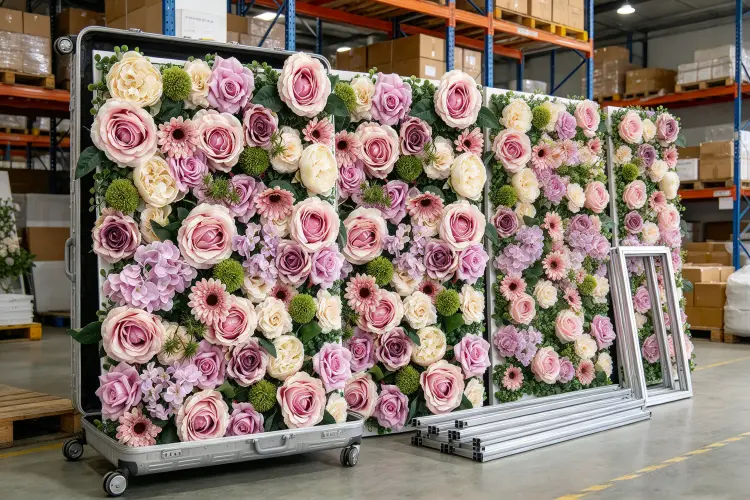
- Flat-pack or foldable. Walls and arches that fold flat fit in standard checked luggage or a small cargo box. Fixed-frame pieces that cannot fold add shipping cost and breakage risk.
- Modular panels. Panel-based walls (4x6 ft or 4x8 ft units) assemble on site with a 2-person crew. Solid one-piece installations require local labor — which defeats the cost advantage.
- Lightweight materials. Silk-blend and coated-polyester petals weigh far less than foam-and-glue builds. Lightweight is the difference between "ship it" and "carry it on."
- UV-stabilized and waterproof. Beach ceremonies need flowers that ignore sun, salt air, and spray. UV-stabilized silk and foam-and-silk mixes hold color in outdoor conditions (Wayfair product data, 2026).
- Crush-proof packaging. Petals that are wire-fixed (not glue-only) survive packing and unpacking without shedding. Wire-stem fixing is non-negotiable for travel.
- Easy setup hardware. Aluminum or steel frame kits with labeled panels install in 30–60 minutes. Hardware that needs tools or expertise erases the labor savings.
Packing rule: walls travel as flat panels in wheeled cases (max 23 kg per case), flowers arrive pre-attached on wire stems, and the setup crew needs only the frame kit — no glue, no scissors, no florist tape.
Destination Scenarios: Beach, Mountain, Desert, Europe
Each destination type stresses flowers differently. Here's the per-scenario playbook (Xibo Floral destination fleet data + industry guides):
| Destination | Core Risk | Best Artificial Choices | Setup Note |
|---|---|---|---|
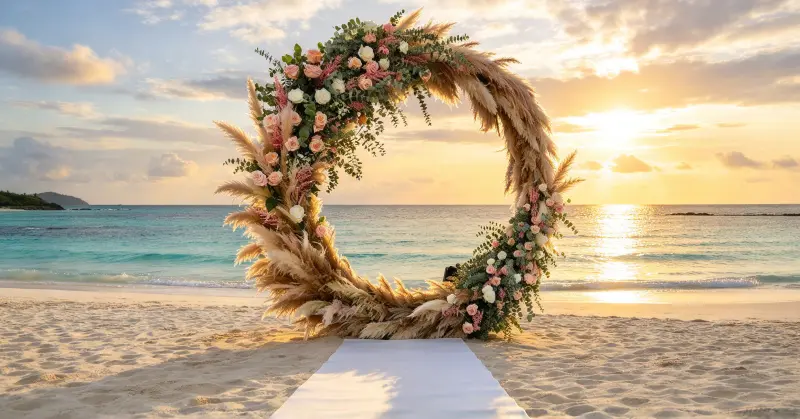
| Beach (Caribbean, Mexico, Bali) | Salt air, wind, UV, humidity | UV-stabilized silk walls, waterproof vines, pampas grass accents | Anchor frames against wind; skip lightweight freestanding pieces |
| Mountain (Alps, Aspen, Rockies) | Cold, rain, altitude logistics | Dense silk walls, evergreen-themed arrangements, indoor-first designs | Build inside, move to ceremony site; pack extra panels for repair |
| Desert (Sedona, Morocco, Palm Springs) | Extreme heat, dust, low humidity | Colorfast silk with deep pigments, terracotta and rust palettes | Use heavy bases; dust before ceremony photos |
| European towns (Tuscany, Santorini, Provence) | Venue rules, narrow access, listed buildings | Compact modular arches, table decor that packs in hand luggage | Confirm venue install rules early; modular pieces pass narrow doorways |
Source: Xibo Floral destination rental fleet data, industry destination wedding guides (2026), Wayfair outdoor artificial product data (2026).
2026 Destination Wedding Trends: Fabric, Paper & Sculptural Florals
Destination couples in 2026 are not choosing artificial flowers because they are cheaper — they choose them because the look has gone mainstream. Three trends define the season (industry trend reports, 2026):
- Fabric florals as a style movement. Couples are replacing traditional florals with fabric-based alternatives that lean into texture, fashion, and artistry — no longer trying to imitate real flowers perfectly (My Wedding Mag, 2026).
- Paper flower decor. One of the hottest 2026–2027 trends: sculptural paper blooms, from oversized freestanding pieces to intricate realistic table accents. Eco-friendly, highly customizable, and shockingly travel-light (Wedding Forward, 2026).
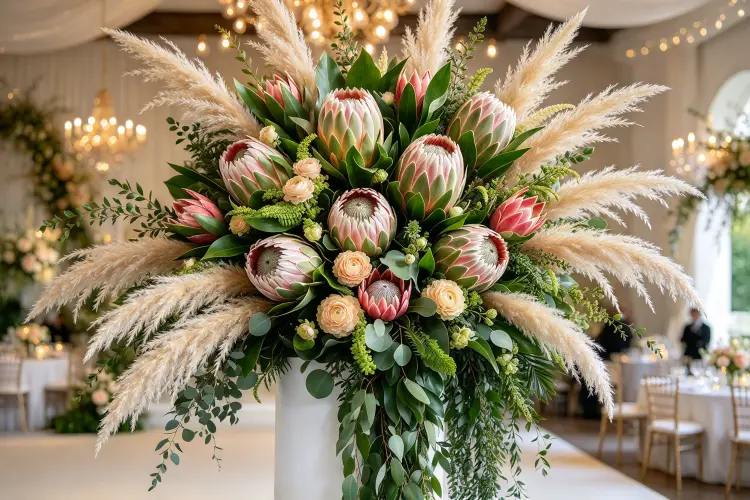
- Sculptural and architectural florals. 2026–2027 florals take on sculptural roles — proteas, ornamental artichokes, ranunculus, anemones, dahlias, and intense green foliage compositions (Cyber Master, 2026). Silk versions of these sculptural blooms photograph as architectural art.
What this means for your décor: the 2026 destination look is texture-forward — pampas grass with silk peonies and roses for boho arches (Luminflora, 2026), terracotta and sage canopies for outdoor venues (Trandyvilla, 2026), and oversized sculptural blooms as statement pieces. All of it travels better in silk than in fresh.
Budget & Sourcing Essentials
Destination floral budgets work differently. Here's where the money actually goes, and how to control it (industry pricing data + Xibo Floral factory pricing):
- Buy once, use three times. The same wall serves the welcome dinner, ceremony, and reception. Budget one purchase against three events, and the 60–70% savings vs fresh appear immediately.
- Ship flat, save freight. Flat-pack modular panels ship as standard cargo instead of temperature-controlled floral freight. Freight savings alone often exceed 50% of total logistics cost.
- Skip local florist markup. Destination floral quotes include tourist-economy markup. Factory-direct artificial decor at 30–50% below retail removes the markup entirely.
- Keep spare panels at cost. Order 10–15% extra panels for travel repair. At factory cost, spares are cheap insurance against transport damage.
- Budget a 2-person setup crew. At $200–$500 per wall with a 30–60 minute install, labor is a rounding error compared to fresh-floral setup costs (Yingsheng Wedding, 2026).
Factory-Direct Destination Wedding Decor
Flat-pack modular silk walls, UV-stabilized and waterproof, 25–35 fpsm density, wire-fixed petals. Factory-direct at 30–50% below retail with spare panels at cost.
Request a Free Sample