- Why Restaurants Need Permanent Floral Decor
- The Psychology: Flowers Sell the Experience
- Safety First: Fire Codes & Food-Safe Materials
- Artificial vs. Fresh: The Restaurant Cost Math
- 6 High-Impact Placements in Restaurants & Hotels
- 2026–2027 Hospitality Floral Trends
- The Procurement Checklist for Hospitality Buyers
- 7 Costly Hospitality Floral Mistakes
- FAQ
Walk into any restaurant that people photograph, talk about, and return to — and you'll find flowers. Not because the owner loves gardening, but because florals are one of the cheapest ways to make a dining room feel alive, expensive, and memorable. The hospitality industry has figured this out: commercial applications — hotels, restaurants, offices, spas, and event venues — now account for 58% of the artificial flower market (Alibaba Seller Central, 2026).
But hospitality is not retail. A restaurant lobby, dining room, or hotel corridor has different rules: fire codes, food-safety expectations, daily wear from staff and guests, heat from kitchens, and the constant pressure of a design that must look as good on month six as it did on day one. Get the materials wrong and a fire inspector can stop your opening. Get the placement wrong and the decor works against your atmosphere instead of for it.
This guide covers the psychology of florals in hospitality, the fire and food-safety rules that decide which flowers you're allowed to use, the cost math that makes artificial flowers the obvious choice for restaurants and hotels, the placements that actually drive guest experience, and the mistakes that quietly make a venue feel cheap.
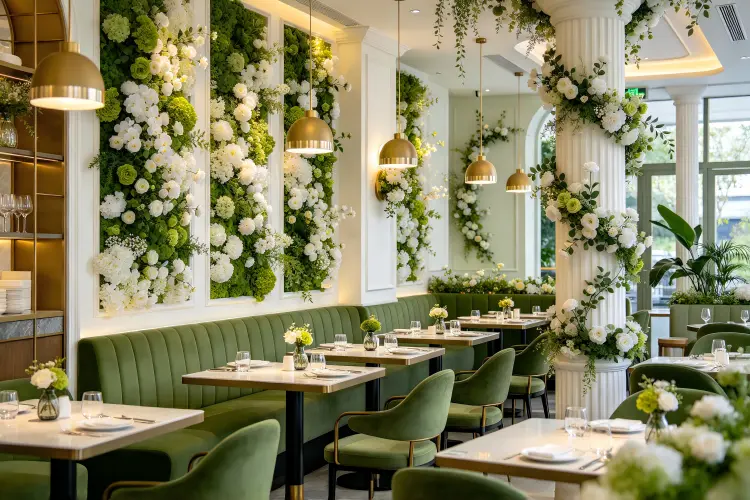
Why Restaurants Need Permanent Floral Decor
Guests don't remember the soup. They remember the room. Study after study shows that a memorable atmosphere is what drives repeat visits, longer dwell time, and social sharing — the three numbers that actually pay a restaurant's rent (Nordblooms, 2026).
Repeat visits. A room that feels fresh and alive gives customers a reason to come back. A room that looks tired makes them look for the next venue. Floral decor keeps a dining space feeling intentional and cared-for, without the daily maintenance that fresh flowers demand.
Longer dwell time. Terrapin Bright Green research found that 36% of guests spend time in biophilic lobbies compared to only 25% in conventional ones — a 44% increase in dwell time (Nordblooms, 2026). Longer dwell time means more courses, more drinks, and a bigger check. In hospitality, every minute a guest stays is revenue.
Social sharing. Hotels using large artificial plants for lobby visuals saw a 15% increase in guest photos and social media shares (Tomorrow.ie, 2025). Every shared photo is free advertising with your venue in the frame. In the age of "Instagrammable" venues, a beautiful floral moment is a marketing channel, not just decor.
Consistency. Fresh flowers decline mid-week. A preserved or artificial installation looks equally impressive on arrival day and eighteen months later (Nordblooms, 2026). Guests checking in on a Tuesday see the same quality as guests checking in on a Saturday — because the installation doesn't wilt.
The Psychology: Flowers Sell the Experience
Hospitality is the business of feeling. The research on what florals do to a guest's perception is remarkably consistent:
| Research Finding | Statistic | Source | Hospitality Application |
|---|---|---|---|
| Guests rate hotel aesthetics higher with greenery | +23% aesthetics rating | Tomorrow.ie / hotel design studies | Add greenery to lobbies and corridors |
| High-quality artificial plants lift lobby satisfaction | +40% lobby satisfaction | Journal of Hospitality Design (2021) | Invest in premium faux over cheap fresh |
| Biophilic lobby dwell time increase | 44% more dwell time | Terrapin Bright Green | Floral features keep guests in the space |
| Biophilic & wellness hotels revenue | +108% RevPAR | Terrapin Bright Green via Nordblooms | Biophilic design is a revenue driver |
| Large artificial plants boost guest photos | +15% social shares | Tomorrow.ie (2025) | Create a photo moment in the lobby |
| Commercial applications market share | 58% of market | Alibaba Seller Central (2026) | Commercial-grade products designed for venues |
| Natural materials reduce cortisol | Neurological effect | Terrapin Bright Green | Calmer guests stay longer, spend more |
| Fresh flower weekly maintenance cost | €2,000+/year | Tomorrow.ie (2025) | Artificial eliminates plant care budget |
Source: Tomorrow.ie (2025), Journal of Hospitality Design (2021), Terrapin Bright Green, Nordblooms (2026), Alibaba Seller Central (2026).
The biophilia effect in dining. Natural elements reduce cortisol — the stress hormone — and trigger the reward chemistry that makes people feel comfortable and generous. In a restaurant, a relaxed guest orders more, stays longer, and tips better. In a hotel, a calm guest writes better reviews and books again. Flowers are the cheapest biophilic element you can install.
The first-impression rule. The lobby or entrance is the first touchpoint between a venue and its guests. High-end artificial plants positioned strategically through entrance areas establish an atmosphere of luxury and attention to detail before guests even complete check-in (Fanhua Crafts, 2026). First impressions set the price anchor for everything that follows.
Safety First: Fire Codes & Food-Safe Materials
Here's the part most décor guides skip: in hospitality, the fire inspector decides what you're allowed to hang. This is not optional, and it's not negotiable — it's the difference between a beautiful opening and a delayed one.
The fire code reality. The CFPA-E Guideline No. 09:2023 (Fire Safety in Restaurants) states that all materials used to decorate premises, including artificial flowers, should be inherently flame retardant or treated so as not to produce a sustained flame or melt and drip when a small pilot flame is applied (CFPA Europe, 2023). Fire and Rescue NSW advises keeping decorative materials at least one metre from heaters, and following venue rules and candle maker's instructions (D& B Florique, 2026).
The four fire references that come up most often (Silks Are Forever, 2026):
| Standard | What It Tests | When You Need It | What It Costs to Ignore |
|---|---|---|---|
| NFPA 701 | Flame propagation of textiles & fabrics | Fabric floral walls, drapes, textile-based displays | Fire inspection failure, delayed opening |
| ASTM E84 | Surface burning characteristics of materials | Wall coverings, large installations | Non-compliance citations |
| California State Fire Marshal | State-level registration & approval | California venues, national chains standardizing | Ineligible for CA projects |
| NFPA 705 | Field flame test of textiles in place | On-site verification during inspection | Removal of non-compliant decor |
Source: Silks Are Forever fire code guide (2026), CFPA-E Guideline No. 09:2023, Botanicblossoms fire-retardant guide (2026).
The food-safety angle. In dining areas, decor must not shed petals, dust, or fibers onto food. Premium artificial flowers are made from fabric materials that hold their shape without shedding — unlike some low-grade foam or paper products. Request food-contact-safe products for dining room placements, and never place loose stems where they can fall into plates.
The open-flame rule. Candlelit restaurants are beautiful — and dangerous for florals. Keep all floral arrangements at least one metre from candles, heaters, and open flames (D& B Florique, 2026; Bucks Fire and Rescue, 2026). If you use candles on tables, either skip table florals entirely or use low, fire-retardant arrangements that can't reach the flame. Fire-retardant treatment is not a license to place flowers on a candle table — it's a safety net, not permission.
Ask for documentation. A supplier claiming "fire retardant" without documentation is not compliant. Request the actual test report (NFPA 701 Method 1 or ASTM E84), verify the report covers your exact product and intended use, and keep it on file for your fire risk assessment (Silks Are Forever, 2026; D& B Florique, 2026). Venues in the UK must include all decorative elements in their Fire Risk Assessment and maintain clear, unobstructed escape routes at all times (Bucks Fire and Rescue, 2026).
Artificial vs. Fresh: The Restaurant Cost Math
Restaurants run on margins of 3–5%. Every recurring cost is under constant attack. Fresh flowers are one of the most brutal recurring costs in hospitality — and the easiest to eliminate without losing the effect.
| Cost Factor | Fresh Flowers | Artificial Flowers | Winner |
|---|---|---|---|
| Replacement cycle | Every 3–7 days | Years (dust every 2–4 weeks) | Artificial |
| Annual cost (single restaurant) | $12,000–$36,000 | $500–$3,000 (one-time) | Artificial |
| Labor | Daily care, weekly florist visits | Staff dusting, minimal | Artificial |
| Consistency | Wilt by mid-week, varies | Perfect every day | Artificial |
| Allergies for staff & guests | Pollen triggers reactions | Hypoallergenic | Artificial |
| Kitchen heat tolerance | Wilt faster near kitchen | Unaffected by heat (check flame rating) | Artificial |
| Seasonal availability | Limited to in-season blooms | Any flower, any season | Artificial |
| Washability | Cannot be washed | Wipe-clean, reusable | Artificial |
Source: Tomorrow.ie plant care cost data (2025), Xibo Floral factory pricing data, industry hospitality floral cost surveys. Fresh flower programs in hospitality commonly run $1,000–$3,000/month per venue for moderate installations.
The math, plain: A restaurant spending $1,500/month on fresh flowers pays $18,000/year. Over five years, that's $90,000 on flowers that wilt. The same restaurant can install $5,000–$8,000 of premium artificial florals across the whole venue, refresh them seasonally for free, and dust them twice a month. Five-year saving: roughly $82,000 per venue. For a chain with 10 locations, that's $820,000.
And the effect is better. Premium artificial flowers are indistinguishable from fresh at arm's length, they don't wilt mid-week, and they photograph beautifully — which is what guests actually share. The money you save isn't a compromise; it's an upgrade.
6 High-Impact Placements in Restaurants & Hotels
Where you put florals in a hospitality venue decides whether they work. These are the six highest-return placements, ranked by guest impact.
1. Entrance / Lobby (Highest Impact)
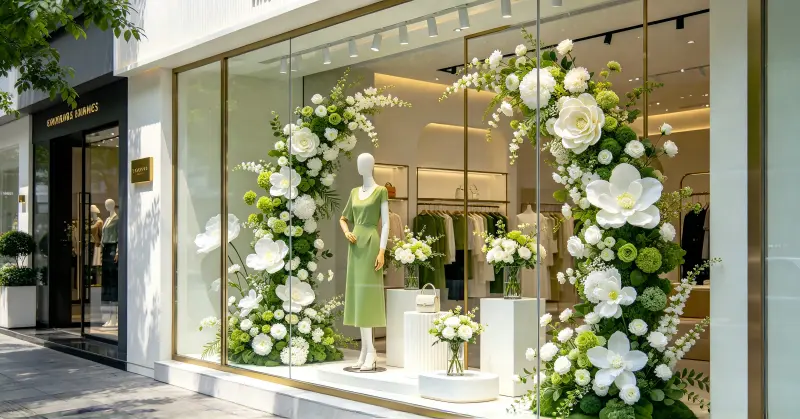
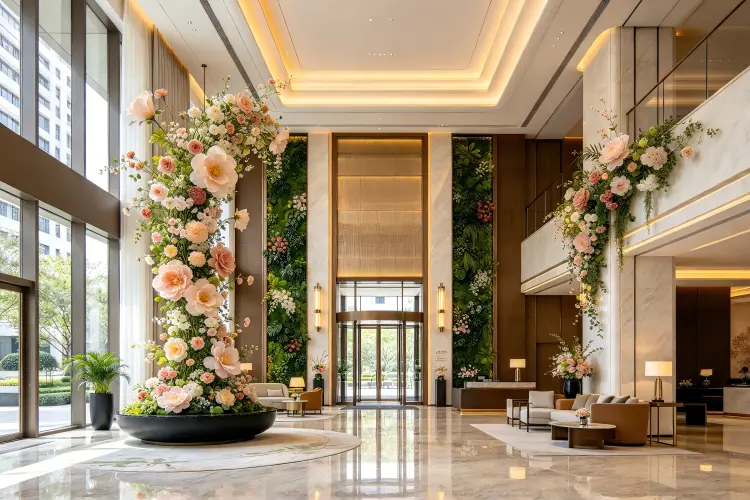
The lobby is the first thing every guest sees — and the moment that sets the price anchor for the whole stay. A preserved statement installation (large-scale roses, a hydrangea arch, or a sculptural mixed arrangement) creates the arrival moment that defines the property (Nordblooms, 2026). Unlike fresh flowers that decline mid-week, this installation looks equally impressive eighteen months later. It becomes part of the venue's identity, not a weekly rotation.
2. Dining Room Walls & Columns
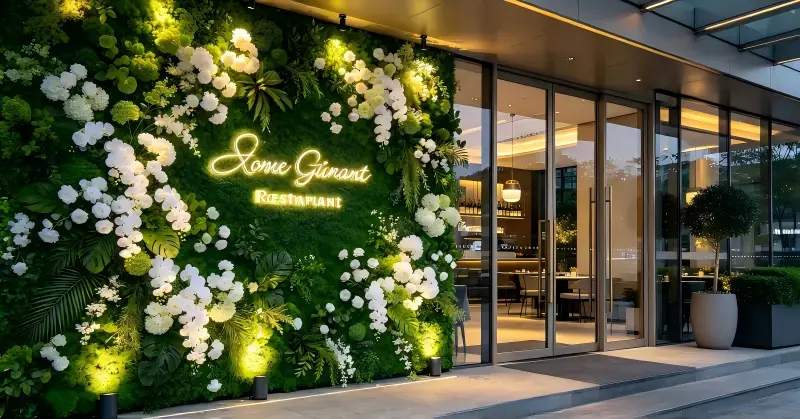
Wall and column installations bring the biophilia effect into the eating space without taking table space. Vertical floral panels, framed arrangements, or moss-and-flower walls add texture and depth to a dining room and create natural focal points. This is where commercial buyers prioritize washability and consistent quality across large orders (Alibaba Seller Central, 2026).
3. Bar & Counter Areas
The bar is a social zone where guests linger. Florals here soften the hard surfaces of a bar, add color to a space often dominated by bottles, and create a more inviting first impression. Low arrangements that don't block service sightlines or reach into drink prep zones work best — check food-contact rules for counter placements.
4. Private Dining Rooms
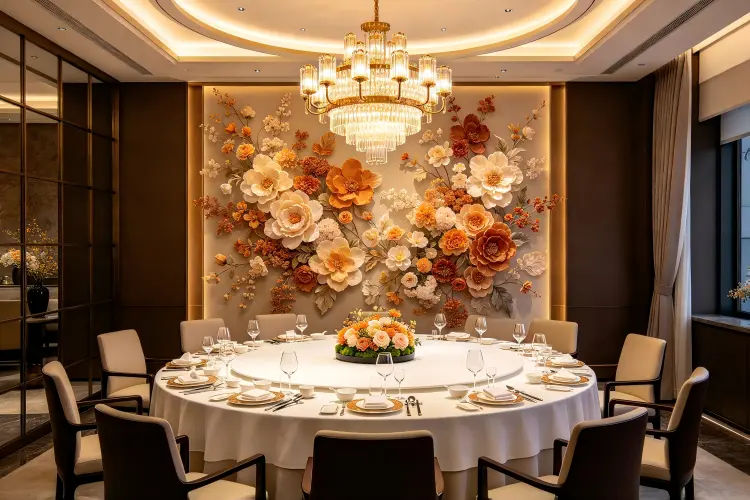
Private dining is where venues charge the highest prices per guest — and where design matters most. A statement floral wall or ceiling feature in a private room justifies premium pricing and gives guests something to photograph. Since these rooms are used less frequently than the main dining area, permanent florals deliver their effect over years with zero maintenance.
5. Corridors & Transition Spaces
Hotel and restaurant corridors are the forgotten spaces — but guests walk through them constantly. Large statement pieces (artificial olive trees, towering palms, floral pedestals) add vertical interest to spacious areas and guide guest movement (Fanhua Crafts, 2026). Corridor florals also break up the monotony that makes hotels feel institutional.
6. Restrooms & Service Areas
As with retail, restrooms are the ultimate "attention to detail" signal in hospitality. A small arrangement in a restroom tells guests the venue cares about everything. This is one of the cheapest quality upgrades available — and one guests notice more than almost anything else.
2026–2027 Hospitality Floral Trends
The hospitality floral design world is moving in clear directions. These are the trends shaping 2026–2027 (Nordblooms, 2026; AngloChinese Florist, 2026; Hy-Vee, 2026):
| Trend | What It Means | Why It Matters | How to Implement |
|---|---|---|---|
| Statement Scale & Permanence | Large preserved installations designed once around the space | Lobbies moving toward permanent features with no weekly deliveries | One oversized statement piece per lobby, not many small ones |
| Sculptural Compositions | Free-flowing, asymmetrical arrangements as room focal points | Symmetry is out, intentional mismatch is in | Asymmetrical installations, architectural statement pieces |
| Complex Color Depth | Warm sunset hues: coral, amber, peach, terracotta | Palettes warming dramatically across hospitality design | Layered warm tones instead of single-color schemes |
| Textural Innovation | Blending florals with dried elements, rattan, woven grasses | Enhanced longevity and multidimensional texture | Mixed-material arrangements, tactile surfaces |
| Immersive Ceiling Features | Large-scale installations overhead, dramatic arches | Creating layered, experiential environments | Hanging installations over bars or center tables |
| Biophilic Wellness | Natural materials as stress-reduction design | Biophilic hotels record 108% higher RevPAR | Greenery integrated throughout, not just at entrance |
Source: Nordblooms hospitality design trends (2026), AngloChinese Florist 2026 interior fusion analysis, Hy-Vee sculptural florals trend analysis (2026), Terrapin Bright Green biophilic research.
Commercial-Grade Artificial Flowers for Restaurants & Hotels
Fire-retardant (NFPA 701 / ASTM E84 documented), washable, and UV-stabilized artificial flowers and floral walls for hospitality venues. Custom brand colors, MOQ 10 panels, 7–10 day production. Built for restaurants and hotels replacing $18K/year fresh flower programs.
Request Hospitality Wholesale Catalog & Fire DocumentationThe Procurement Checklist for Hospitality Buyers
Buying florals for a restaurant or hotel is different from buying for your home. Before you commit to a supplier, verify these seven points:
- Fire documentation exists and covers your product. Request the actual NFPA 701 or ASTM E84 test report, verify it covers the exact product and intended use, and keep it on file for your Fire Risk Assessment (Silks Are Forever, 2026).
- Food-contact safety for dining areas. Confirm the material won't shed petals, dust, or fibers onto food. Fabric-based premium florals hold shape without shedding.
- Washability. Hospitality florals get dusty and occasionally touched. Wipe-clean, reusable materials are a commercial-buyer priority (Alibaba Seller Central, 2026).
- UV stability (if near windows). Sunlight fades non-UV-stabilized florals within 1–3 months. Request UV-stabilized materials for window placements.
- Consistent quality across large orders. For chains, confirm color consistency batch to batch — a pink that shifts between locations looks unprofessional.
- Custom brand colors. Commercial buyers increasingly require florals matched to brand identity and campaign palettes (Alibaba Seller Central, 2026).
- Rental-friendly construction. If you rotate designs between venues, confirm shape retention after multiple uses.
7 Costly Hospitality Floral Mistakes
Mistake 1: Buying non-fire-retardant florals
This is the expensive one. A fire inspection failure can delay your opening, force removal of decor, and trigger fines. The CFPA-E guideline is clear: all decorative materials in restaurants must be inherently flame retardant or treated. Never accept a supplier's verbal "fire retardant" claim without the actual test report covering your exact product.
Mistake 2: Placing florals near candles or heaters
Fire-retardant treatment is a safety net, not permission. Keep all florals at least one metre from candles, heaters, and open flames (D& B Florique, 2026). If you run candlelit tables, skip table florals or use low, retardant arrangements that can't reach the flame.
Mistake 3: Using cheap, visibly artificial flowers
Cheap artificial flowers have flat colors, shiny plastic textures, and visible seams — and they scream "budget venue." Guests photograph what looks premium and ignore what looks fake. The gap between cheap and premium artificial florals is enormous, and in hospitality, display quality is perceived brand quality. Premium florals are indistinguishable from fresh at arm's length.
Mistake 4: Scattering many small arrangements
Twenty small vases read as clutter; one large statement piece reads as design. The 2026 trend is statement scale and permanence — one oversized installation per space, designed around the room, instead of many forgettable accents (Nordblooms, 2026).
Mistake 5: Ignoring the kitchen heat factor
Florals near kitchen pass-throughs and heat vents face heat, humidity, and grease. Fresh flowers wilt faster; non-rated artificial materials can warp or discolor. Specify heat-tolerant, wipe-clean materials for any placement within kitchen proximity, and confirm the flame rating applies.
Mistake 6: Buying without fire documentation, then hoping
Fire inspectors don't accept hope. UK venues must include all decorative elements in their Fire Risk Assessment and keep escape routes clear (Bucks Fire and Rescue, 2026). Verify documentation before purchase, not when the inspector arrives.
Mistake 7: Static decor that never changes
Even permanent installations need seasonal refresh. Swap accent colors, add seasonal stems, restyle the entrance quarterly. Guests who return need to see something new — the venue that looks exactly the same in December as it did in July reads as stagnant, not consistent.
FAQ
Source Fire-Retardant Hospitality Florals Factory Direct
Commercial-grade artificial flowers, floral walls, and statement installations for restaurants and hotels. NFPA 701 / ASTM E84 documented, washable, UV-stabilized, custom brand colors. MOQ 10 panels, 7–10 day production. Built for venues replacing $18K/year fresh flower programs.
Browse Hospitality Floral Collection