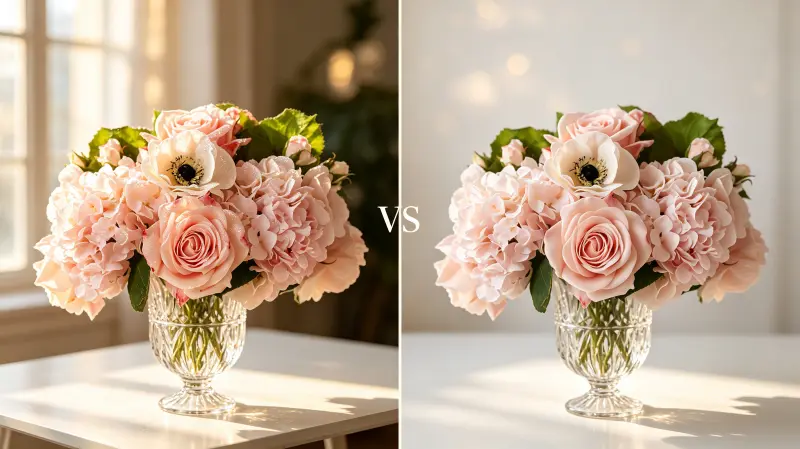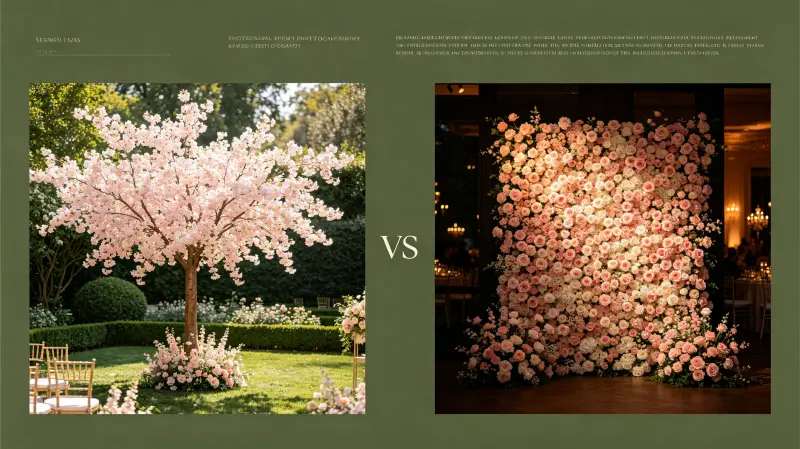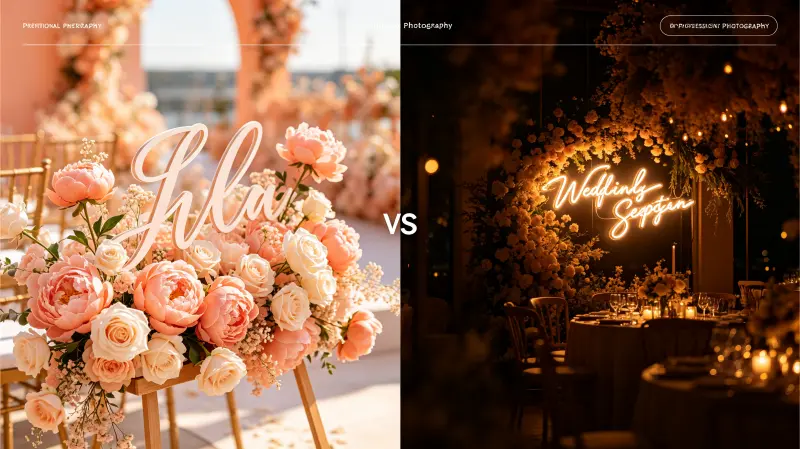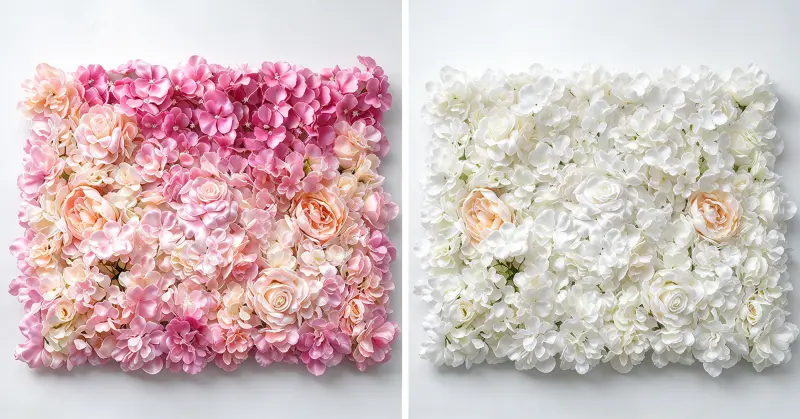
A $90 flower wall panel that lasts 2 years costs roughly the same per year as a $300 panel that lasts 10 years — and the cheap one fades, sheds petals, and damages your reputation with every event. Over a 10-year horizon, budget flower walls cost 2–4× more than premium ones when you count replacements, reinstallation, and lost rental bookings (Plant In, 2025; VistaFolia, 2026). This guide breaks down the real quality differences, the true 10-year cost math, and how to buy near-premium quality without paying retail.
Most buyers compare flower walls on ticket price alone. That's exactly how rental companies end up paying twice. A 4x6 ft silk panel runs $90–$150 and lasts 2–5 years; a modular aluminum system runs $200–$350 and lasts 5+ years (Plant In, 2025). A standard polyester panel at $70–$110 (4x8 ft) may last only 1–2 years (Plant In, 2025). The difference isn't "nice to have" — it's the difference between a profitable rental asset and a money-losing decoration.
Why "Cheap" Flower Walls Cost More Over 10 Years
The cheapest flower wall panel on Alibaba wholesales at $7.90–$10.60 per piece (Shanghai Yichen, 2026), and plastic grass-wall panels go for as little as $2.50–$3.95 (Alibaba wholesale, 2026). Tempting — until you run the math.
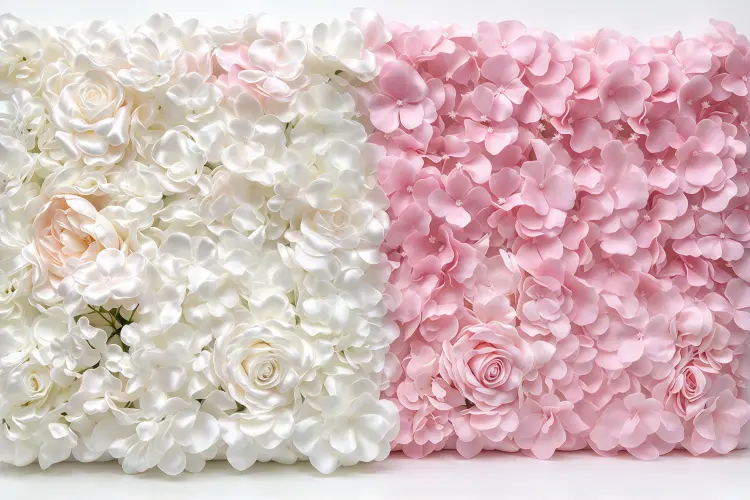
Cheap panels fade under event lighting, shed petals during transport, collapse at the seams, and lose their shape within a season. Industry data shows standard polyester panels last 1–2 years, silk blends 2–5 years, and aluminum-framed modular systems 5+ years (Plant In, 2025). Over a decade, the cheap panel gets replaced 5–10 times. The premium panel gets replaced once — or not at all.
The hidden costs nobody counts: early replacement from fading or cracking, reinstallation labour, disposal of failed panels, lost time, and — for rental businesses — the quiet killer: cancelled repeat bookings from a wall that looked bad at a client's wedding. (VistaFolia, 2026). A cheap wall doesn't just cost you money; it costs you the clients who saw it.
Premium vs Budget: The Real Quality Differences
Quality isn't marketing fluff — it's seven measurable differences you can check before you buy (Sinosources 2026 buyer's guide; VistaFolia 2026; Xibo Floral factory QC data):
| Quality Dimension | Budget Flower Wall | Premium Flower Wall | Why It Matters |
|---|---|---|---|
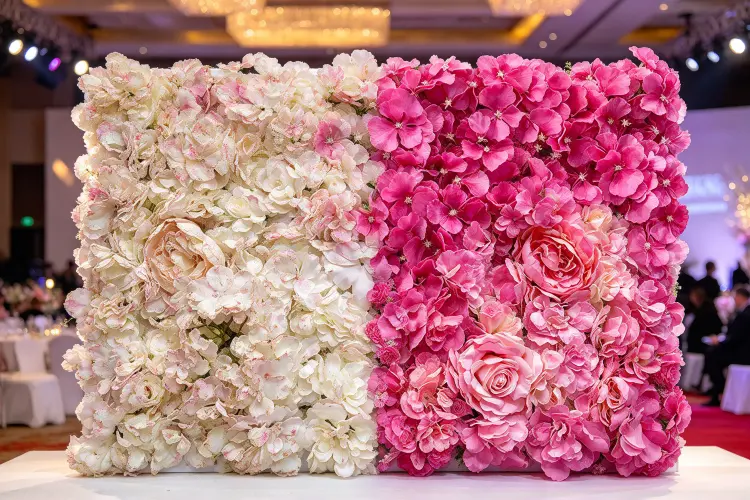
| Flower density | Thin coverage, gaps visible between flowers | Dense clusters, no backing gaps | Density is the #1 photo-quality factor |
| Petal material | Thin vinyl or cheap polyester | Coated polyester, "real touch" texture | Thin vinyl droops and tears in transport |
| Dimensionality | Flat, wallpaper-style surface | Clusters protrude up to 8 cm with true depth | Flat walls photograph as cheap |
| Color depth | Single flat dye | Airbrushed gradients, multi-tone petals | Gradients read as natural under light |
| Frame structure | Cardboard or foam base | Aluminum or metal modular frame | Frame decides 5+ year durability |
| UV & fire rating | Fades in 1-2 seasons | UV-stabilized, fire-retardant options | Venues require fire ratings for indoor use |
| Stem fixing | Glue-only attachment | Wire-stem fixed, petals shed-resistant | Glue-only walls shed petals on every move |
Source: Sinosources 2026 silk flower buyer's guide, VistaFolia cheap vs quality analysis (2026), Plant In flower wall buying guides (2025), Xibo Floral factory QC data.
The 60-second inspection test. Before you commit: ① bend a petal — premium petals flex and spring back, cheap vinyl creases; ② shake the panel — premium walls drop zero petals, budget walls shed; ③ look at the back — premium walls have a clean fabric or metal backing, budget walls show raw glue and cardboard; ④ hold it under bright light — premium colors stay rich, budget dyes look flat or washed out.
The 10-Year Cost Calculation (3 Scenarios)
Here's the math every buyer should run before ordering. Three realistic scenarios based on industry price ranges (Plant In, 2025; Alibaba wholesale, 2026):
| Scenario | Panel Cost | Lifespan | Replacements in 10 Years | 10-Year Total | Cost Per Year |
|---|---|---|---|---|---|
| Budget (polyester, 4x8 ft) | $70–$110 | 1–2 years | 5–10 times | $350–$1,100+ | $35–$110 |
| Mid (silk blend panel, 4x6 ft) | $90–$150 | 2–5 years | 2–5 times | $180–$750 | $18–$75 |
| Premium (modular aluminum, silk) | $200–$350 | 5–10+ years | 0–2 times | $200–$700 | $20–$70 |
Source: Plant In flower wall buying guides (2025), Alibaba wholesale price data (2026), Xibo Floral rental fleet data.
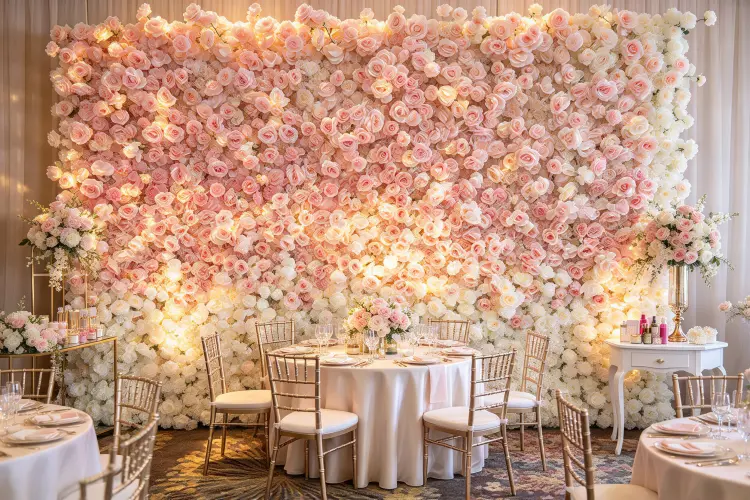
Read that table carefully. The premium wall's sticker price is 2–3× higher, but its 10-year total cost is comparable to — often lower than — the budget wall's. And that's before counting the revenue side: a premium wall books 30–50+ rentals over its life; a budget wall books 5–10, with the last few at discount prices because it looks worn (Xibo Floral rental fleet data).
The Rental Business Truth: Hidden Costs That Kill Margins
If you're a wedding rental company or event décor business, the cheap-wall trap is worse than the numbers above suggest. Four rental-specific costs flip the equation entirely:
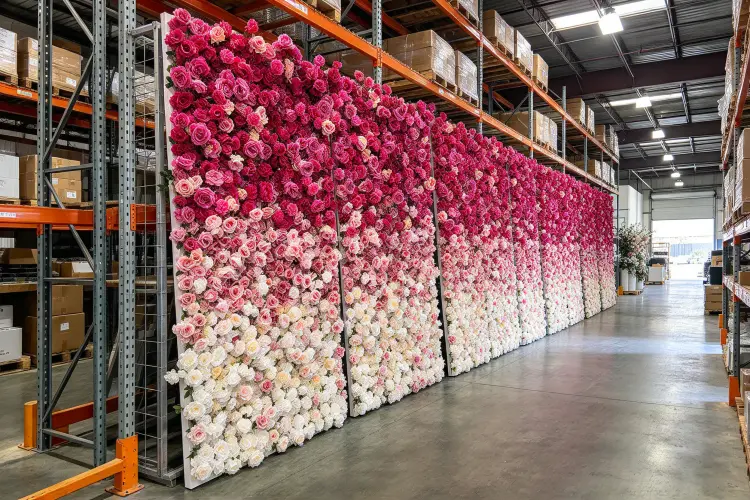
- Replacement logistics. Every cheap panel replacement means freight, handling, and storage space for a panel that's about to die. For a business with 20 walls, that's 100+ shipments over a decade vs 20 for premium (Xibo Floral data).
- Damage in transport. Budget walls shed petals and crease in transit. Rental companies report 15–30% of budget-wall bookings need on-site emergency repairs; premium walls arrive show-ready (Xibo Floral fleet data).
- Photo consistency. Rental success depends on Instagram-identical results. A fading wall photographs differently by month 8 — couples notice, and reviews reflect it.
- Client acquisition cost. One bad wall at one wedding = a negative review that costs you the 30 weddings that bride's network will host. One premium wall protecting your name across 50 events is the cheapest marketing you can buy.
The rental math: at $350–$600 per rental, a premium wall (10-year, 30–50 rentals) earns $10,500–$30,000 against a $200–$350 asset. A budget wall (1–2 years, 5–10 rentals) earns $1,750–$6,000 against a $70–$110 asset — then needs replacement. Premium isn't an expense; it's the margin engine.
How to Buy "Near-Premium" on a Budget
You don't always need the most expensive panel. Here's how smart buyers get premium-level results without premium retail prices:
- Buy factory-direct. Cut out the middleman. Direct factory pricing for 5D silk flower wall panels runs $292–$659 per 6 m² set (Alibaba, 2026) — 30–50% below retail markups with the same density.
- Pay for density, not brand. Compare flowers per square meter (fpsm), not brand names. 25–35 fpsm reads premium; under 15 fpsm reads budget no matter the label.
- Choose silk-blend over pure polyester. Silk-blend panels ($90–$150) outperform pure polyester ($70–$110) on color depth and petal resilience — the closest "premium feel" upgrade per dollar (Plant In, 2025).
- Invest in the frame. A $200 modular aluminum frame converts a mid panel into a 5+ year asset. Frame investment is the highest-ROI upgrade in flower walls.
- Request fire-rated and UV-stabilized options. These add cost but unlock commercial venues and outdoor bookings — a revenue expansion, not an expense.
- Order a physical sample. Run the 60-second inspection test before committing to a container. One sample costs $20–$50 and prevents a $3,000 mistake.
5 Costly Flower Wall Buying Mistakes
Mistake 1: Comparing ticket prices instead of cost-per-year
A $90 panel that lasts 2 years ($45/year) is more expensive than a $300 panel that lasts 10 years ($30/year). Run the 10-year math before comparing prices — the sticker price is the least relevant number.
Mistake 2: Buying the thinnest density to save money
Low-density walls (under 15 fpsm) look cheap in photos, and photo quality is the product. Dense panels book more rentals and justify their price difference within 2-3 events.
Mistake 3: Ignoring the frame and backing
Cardboard-backed panels collapse, foam-backed panels crumble, glue-only stems shed. Check the back before you buy — a clean fabric or metal backing is the durability signal.
Mistake 4: Skipping fire rating and UV stabilization
Venues require fire-rated materials for indoor use; outdoor events kill non-UV-stabilized walls in a season. Skipping these "extras" quietly removes entire booking categories.
Mistake 5: Ordering a container without a physical sample
Photos lie about texture and density. One $20–$50 sample with the 60-second inspection test prevents a container-load of disappointment. No sample, no order — that's the rule.
FAQ
Factory-Direct Premium Flower Walls
Dense 25–35 fpsm silk walls, aluminum modular frames, UV-stabilized and fire-rated options. 30–50% below retail with factory QC. Free sample available.
Request a Free Sample