Artificial vs Fresh Flowers: The Great Debate
For event planners, rental business owners, and couples planning a wedding, the choice between artificial (silk/faux) flowers and fresh (real) flowers is one of the most consequential decisions in decor planning. Fresh flowers offer unmatched natural beauty and fragrance, but they wilt, are expensive, and can only be used once. Artificial flowers have improved dramatically in quality — modern high-end silk flowers are nearly indistinguishable from real in photos — and they offer massive cost savings through reuse. This guide provides an unbiased, data-driven comparison across 7 critical dimensions: cost, appearance, durability, logistics, environmental impact, allergen considerations, and best use cases. By the end, you'll know exactly which option is right for your specific situation.
Xibo Floral: Commercial-Grade Artificial Flowers for Events
Real-touch silk technology, UV-stabilized colors, reinforced frames. Flower walls, arches, centerpieces, hanging installations. $15-180 wholesale, MOQ 1, free samples. Designed for 50+ rentals.
Request Free Samples & CatalogCost Comparison: Upfront & Long-Term
| Cost Factor | Fresh Flowers | Artificial Flowers | Winner |
|---|---|---|---|
| Upfront cost (per wedding) | $1,500-5,000+ (average $2,000) | $200-800 (if buying) or $300-1,200 (if renting) | Artificial |
| Cost per use (rental business) | $1,500-5,000 every single event | $30-100 per use (amortized over 50+ uses) | Artificial (90% savings) |
| Labor cost (arrangement) | $200-800 (florist time, 4-8 hours) | $0-100 (pre-made, 30-60 min setup) | Artificial |
| Waste cost | $0 (but $2,000 thrown away after event) | $0 (reused 50+ times) | Artificial |
| Storage cost | N/A (discarded after event) | $10-50/month (storage bins/unit) | Fresh (no storage) |
| Price volatility | High (seasonal, weather, holiday spikes up to 40%) | Stable (factory pricing, no seasonal spikes) | Artificial |
| 5-year total cost (10 events/yr) | $75,000-250,000 | $2,000-8,000 (initial) + $600-3,000 (storage/maintenance) | Artificial (95% savings) |
Key insight: For a single one-time event (e.g., your own wedding), fresh flowers cost $1,500-5,000 while artificial costs $200-800 to buy or $300-1,200 to rent — artificial saves 50-70%. For a rental business doing 10+ events/year, the savings are astronomical: artificial costs 90-95% less over 5 years because the same inventory is reused 50+ times. Hidden cost of fresh: Florists mark up flowers 300-500% (wholesale rose $0.50 → retail $2-3). You're paying for the florist's expertise, but also for massive waste. With artificial, you pay once and reuse.
Appearance & Realism
Fresh Flowers: Natural Beauty
- Advantages: Unmatched natural beauty, subtle color variations (no two blooms identical), natural fragrance, organic movement in breeze, real texture and depth. Close-up inspection always reveals "realness."
- Disadvantages: Wilt and droop within 4-8 hours (especially in heat >75°F / 24°C), petals bruise and brown at edges, inconsistent bloom size/shape, limited color palette (only what's in season), flowers may be closed or past peak on event day.
- Photo performance: Excellent in natural light. Can look dull in dim venue lighting. Fragrance doesn't translate to photos but adds to guest experience.
Artificial Flowers: Modern Realism
- Advantages: Perfect blooms every time (no wilting, no bruising), consistent color and size, available in any color year-round (including colors that don't exist in nature — navy blue, black, metallic), looks identical from 3+ feet and in photos, no fragrance (benefit for allergy sufferers), stays perfect throughout entire event (ceremony + reception + after-party).
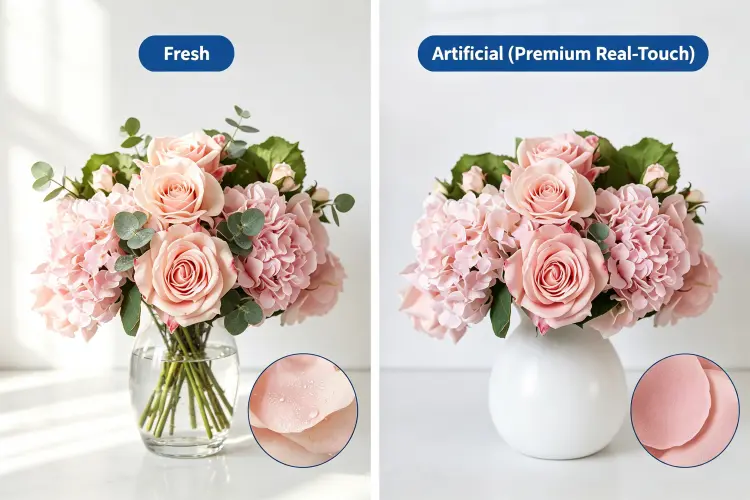
- Disadvantages: Close-up inspection (6 inches or less) can reveal artificial nature — but this is rare at events where guests are 1-3 feet away. Cheap artificial flowers (dollar store, $1-2 per stem) look obviously fake. High-quality "real-touch" silk flowers ($3-10 per stem) are nearly indistinguishable. No natural fragrance (some people miss this).
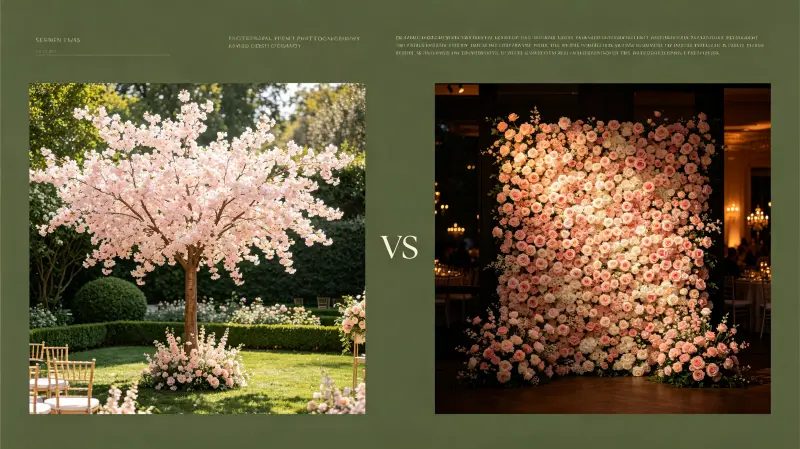
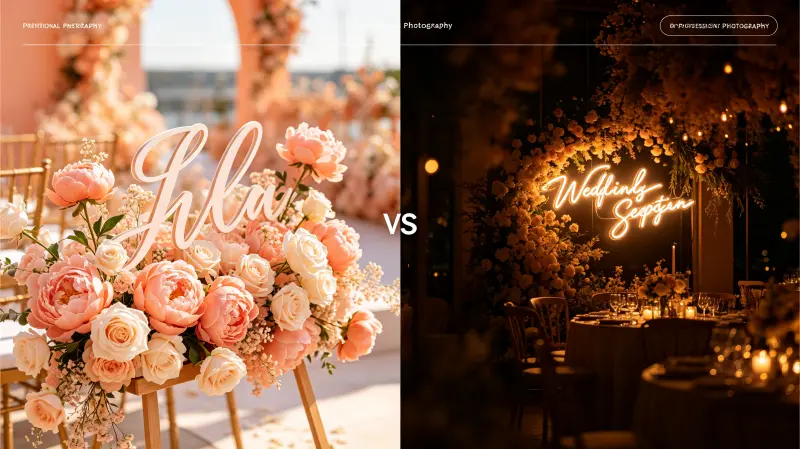
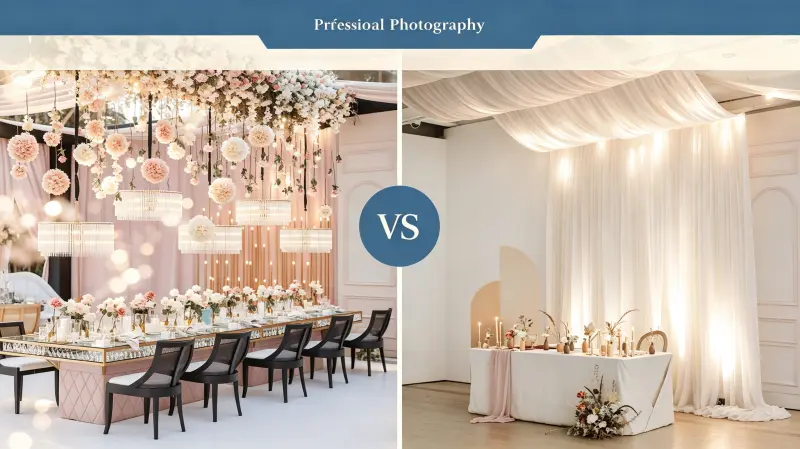
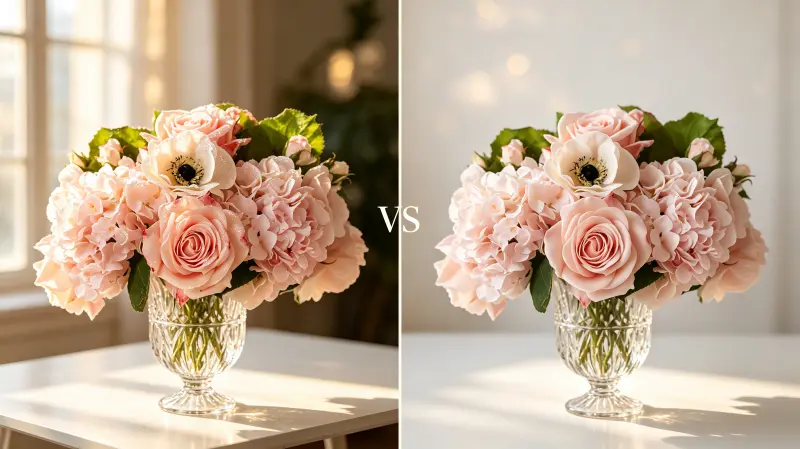
- Photo performance: Excellent — actually better than fresh in many cases because blooms are perfect and colors are vibrant. Professional photographers often can't tell artificial from fresh in photos. 90% of guests can't tell the difference at events.
Realism Levels of Artificial Flowers
| Quality Tier | Cost per Stem | Realism | Best For |
|---|---|---|---|
| Economy (dollar store) | $0.50-1.50 | Obviously fake (shiny plastic, uniform color) | Kids' parties, craft projects,远距离悬挂装饰 |
| Standard silk | $1.50-3.00 | Good from 3+ feet, noticeable up close | Budget events, background decor, large installations |
| Premium silk / real-touch | $3.00-8.00 | Very realistic, hard to distinguish from 1+ foot | Weddings, centerpieces, close-up decor, rental inventory |
| Luxury / museum-grade | $8.00-25.00 | Nearly identical to fresh, even up close | High-end weddings, luxury events, showroom displays |
Bottom line on appearance: Premium real-touch artificial flowers ($3-8/stem) are 90-95% as realistic as fresh flowers in photos and from normal viewing distance. The 5-10% difference only matters if: (1) Guests will be sniffing/inspecting flowers up close (rare). (2) You want natural fragrance (can add with room sprays or diffusers). (3) You're a purist who values "real" over "perfect." For 90% of events and 99% of rental businesses, premium artificial is visually indistinguishable and more reliable.
Durability, Reuse & Storage
Fresh Flowers: Single-Use Only
- Lifespan: 4-8 hours at room temperature without water, 1-3 days with proper water/care. By end of a 12-hour wedding day, many blooms are drooping, petals dropping, edges browning.
- Reuse: Essentially zero. Some couples donate flowers to nursing homes after the wedding (nice gesture, but no financial return). Cannot be stored and reused for another event.
- Storage: N/A — discarded after event. If you want to keep bouquet, must press/dry flowers (degrades appearance significantly) or resin-preserve ($100-300 per bouquet).
- Damage risk: High. Petals bruise during transport, stems break, heat causes wilting, cold (<40°F / 4°C) damages tropical flowers. 10-20% of fresh arrangements show visible damage by end of event.
Artificial Flowers: 50+ Uses
- Lifespan: 3-10 years with proper care. Commercial-grade (Xibo Floral quality) lasts 50-100+ event uses. Even budget artificial lasts 10-20 uses.
- Reuse: The #1 advantage. Same flower wall, arch, or centerpieces can be rented out 50+ times. Each use generates revenue with zero additional flower cost. This is the entire business model of decor rental companies.
- Storage: Store in plastic bins ($10-30 each) in cool, dry, dark area. Avoid direct sunlight (fades colors over 200+ hours) and extreme heat (>100°F / 38°C, can soften glue). Hanging items store best on hooks. Flat items (flower wall panels) stack between tissue paper.
- Damage risk: Low. Flowers don't wilt, bruise, or brown. Possible damage: loose flowers (re-glue in 2 minutes), bent frames (straighten by hand), crushed petals during poor transport (prevent with proper packing). 2-5% of artificial items show minor damage per event, easily repaired.
Durability Scorecard
| Factor | Fresh | Artificial (Premium) |
|---|---|---|
| Number of uses | 1 | 50-100+ |
| Lifespan | 4-8 hours (event day) | 3-10 years |
| Heat resistance (>85°F / 29°C) | Poor (wilts in 1-2 hours) | Excellent (UV-stabilized) |
| Cold resistance (<40°F / 4°C) | Poor (tropical flowers damaged) | Excellent |
| Transport durability | Fragile (petals bruise, stems break) | Durable (minor bending only) |
| Repairability | Cannot repair (replace entire bloom) | Easy (re-glue, reshape, replace individual stems) |
| Storage required | None (discarded) | Bins + climate-controlled space |
Why 500+ Rental Businesses Choose Artificial
One $300 flower wall generates $15,000-25,000 in rental revenue over its lifespan (50 rentals × $300-500). Fresh flower wall would cost $300-800 every single time. That's the difference between profit and loss.
See Our Commercial-Grade CollectionSetup, Transport & Logistics
Fresh Flower Logistics
- Ordering: Must order 1-2 weeks in advance. Florist sources from wholesalers, who source from farms (often overseas). Chain is fragile — weather, shipping delays, or quality issues can ruin your order.
- Timing: Flowers are typically delivered 1-2 days before event. Must be kept in water, in cool area (60-65°F / 15-18°C), away from direct sun and fruit (ethylene gas from fruit accelerates wilting).
- Arrangement: Florist spends 4-8 hours arranging bouquets, centerpieces, arches, and installations. Labor cost: $50-150/hour. Large installations (flower walls, arches) require on-site construction by florist team (2-4 hours, $200-800 labor).
- Transport: Must be transported in water, in climate-controlled vehicle, carefully secured. Large arrangements require vans or trucks. Cannot be laid flat (petals crush). Transport damage: 5-15% of arrangements.
- Setup: On-site setup 2-4 hours before event. Must keep arrangements watered until event start. Outdoor events in heat require misting and shade. Setup team must handle gently.
- Teardown: Flowers are discarded (or donated). No storage needed. Teardown is fast (30-60 min) but wasteful — $2,000+ of flowers goes to compost/trash.
Artificial Flower Logistics
- Ordering: Order anytime, no advance planning needed (if you own inventory). For rental businesses, inventory is always ready. For one-time buyers, 1-2 week shipping from China or 2-3 days from local suppliers.
- Timing: No time sensitivity. Can be stored for months/years and still look perfect. No need to coordinate delivery with event date. Can set up day before event without any degradation.
- Arrangement: Pre-made products (flower walls, arches, centerpieces) require zero arrangement — just assemble frame and place. DIY artificial arrangements take 1-2 hours (vs 4-8 for fresh). No floral skills needed.
- Transport: Transport in plastic bins, can be stacked, no water needed, no climate control. Fits in car/SUV (vs van/truck for fresh). Transport damage: <2% with proper packing.
- Setup: Fast — 30-90 minutes for full wedding decor (vs 2-4 hours for fresh). Flower walls: assemble panels on frame (15-30 min). Arches: place pre-flowered sections (10-20 min). Centerpieces: unbox and place (5 min). Can set up day before event (stays perfect overnight).
- Teardown: Disassemble, pack into bins, transport to storage. 30-90 minutes. Inventory is reused for next event — zero waste. Cleaning: quick dusting between rentals (5-10 min per item).
Logistics Comparison
| Logistics Factor | Fresh Flowers | Artificial Flowers |
|---|---|---|
| Advance ordering | 1-2 weeks required | No advance needed (owned inventory) |
| Setup time (full wedding) | 2-4 hours | 30-90 minutes |
| Teardown time | 30-60 min (discard) | 30-90 min (pack for storage) |
| Transport vehicle | Van/truck (climate-controlled) | Car/SUV (bins) |
| Setup day before event? | No (wilts overnight) | Yes (stays perfect) |
| Skill required | Professional florist | Anyone (pre-made products) |
| Transport damage rate | 5-15% | <2% |
Environmental Impact
Fresh Flowers: The Hidden Environmental Cost
The cut flower industry has significant environmental impacts that most consumers don't consider:
- Carbon footprint: 80% of cut flowers sold in US/EU are grown in Colombia, Ecuador, Kenya, or Netherlands. Air-freighting roses from Colombia to Miami generates ~0.9 kg CO2 per dozen roses. A $2,000 wedding flower order = 200-400 dozen stems = 180-360 kg CO2 (equivalent to driving 450-900 miles / 700-1,400 km).
- Water usage: One rose requires ~2 gallons (7.5 liters) of water to grow. A wedding with 300 stems = 600 gallons (2,270 liters) of water. In water-scarce growing regions (Kenya, parts of South America), this is a significant strain.
- Pesticides: Cut flower farms use 2-3x more pesticides per acre than food crops (flowers aren't regulated as food). Workers in developing nations face health risks from pesticide exposure.
- Waste: $2,000 of flowers = 50-100 lbs (23-45 kg) of organic waste after the event. Most goes to landfill (produces methane as it decomposes anaerobically). Composting is better but still requires transport and processing.
- Packaging: Each shipment uses plastic sleeves, boxes, foam, and ice packs. Most is single-use and non-recyclable.
Artificial Flowers: Reuse = Lower Long-Term Impact
- Manufacturing: Silk flowers are made from polyester (plastic) and wire. Production has environmental cost (plastic manufacturing, factory emissions). A $300 flower wall contains ~2-3 kg of plastic and metal.
- Reuse advantage: The key environmental benefit is reuse. One artificial flower wall used 50 times replaces 50 fresh flower walls (each generating 180-360 kg CO2). Over 50 uses, artificial saves 9,000-18,000 kg CO2 compared to fresh. The manufacturing carbon cost is paid back after 1-2 uses.
- End of life: Artificial flowers eventually wear out (3-10 years). They can be: (a) Reused for craft projects, (b) Donated to schools/theaters, (c) Recycled (some facilities accept polyester textiles), (d) Landfilled (least ideal, but only once per 50 uses vs 50 times for fresh).
- No water, no pesticides, no air freight: After initial manufacturing and shipping, artificial flowers require zero ongoing resources. Fresh flowers require water, pesticides, and air freight for every single event.
Environmental Verdict
For one-time use: Fresh flowers have lower upfront environmental impact (biodegradable, no plastic manufacturing). But the water, pesticides, and air freight are significant.
For 5+ uses (rental business, multiple events): Artificial is clearly more sustainable. Reuse eliminates the repeated carbon, water, and pesticide costs of fresh flowers. After 2 uses, artificial has lower total environmental footprint. After 50 uses, it's not even close.
Best eco-option: Rent artificial (maximizes reuse per item) or buy secondhand artificial (extends product life). For one-time events where artificial isn't feasible, choose locally grown, in-season fresh flowers (eliminates air freight) and donate/compost after use.
Best Use Cases: When to Choose Which
Choose Fresh Flowers When:
- It's your own wedding and budget is unlimited ($3,000+ for flowers)
- You value natural fragrance as part of the sensory experience
- Event is indoors with temperature control (65-75°F / 18-24°C)
- You want specific seasonal blooms (peonies in May, dahlias in September)
- Guests will be very close to flowers (head table centerpieces at elbow level)
- You're hosting a single event and won't reuse decor
- You have a professional florist you trust and budget for their expertise
- The event is in a cool season (fall/winter) — fresh lasts longer
Choose Artificial Flowers When:
- You're a rental business owner (reuse = profit)
- Budget is limited ($500-1,500 for all decor)
- Event is outdoors or in hot weather (>80°F / 27°C) — fresh wilts
- You want setup the day before (no day-of stress)
- You need specific colors not available in fresh flowers (navy, black, metallic)
- You want consistency across multiple events (same look every time)
- You or guests have severe pollen allergies
- You want to keep decor as a memento (lasts years vs days)
- You're doing DIY decor (artificial is easier, no floral skills needed)
- You plan to resell or reuse decor after the event
Hybrid Approach (Best of Both Worlds)
Many planners and couples use a hybrid strategy:
- Artificial for: Large installations (flower walls, arches, hanging decor) — these are expensive in fresh and benefit from reuse. Background decor where guests aren't close.
- Fresh for: Bouquets, boutonnieres, corsages (close-up, personal, fragrance matters). Head table centerpieces (guests are close). Cake flowers (edible/real preferred).
Hybrid cost example: Artificial arch ($150-300 buy or $100-200 rent) + artificial flower wall ($200-500 buy or $150-400 rent) + fresh bouquets/centerpieces ($500-1,000) = $850-1,700 total. vs all fresh: $2,000-4,000. Saves 50-60% while keeping fresh for personal/close-up items. This is the fastest-growing trend in wedding decor (2024-2026 data: 35% of weddings now use hybrid floral, up from 12% in 2019).
FAQ
At most events, no — 90% of guests cannot distinguish premium artificial flowers ($3-8/stem) from fresh, especially from 1+ foot away. Studies of wedding guests show that only 5-10% notice artificial flowers when asked directly, and most of those only after being told to look closely. Factors that give artificial away: (1) Cheap quality (dollar store flowers — shiny plastic, uniform coloring). (2) Perfect uniformity (real flowers have natural variations; high-quality artificial mimics this, cheap doesn't). (3) No fragrance (but most guests don't expect strong flower fragrance at events). (4) Touch (if guests actually touch the flowers, they'll feel the difference — but touching decor is socially uncommon at formal events). Bottom line: Invest in premium real-touch artificial flowers and place them where guests are 1+ foot away, and virtually no one will know. Professional photographers regularly shoot artificial flowers without realizing they're not fresh.
One-time event (buying artificial): Save 50-75%. Fresh: $1,500-5,000. Artificial (buy): $300-1,200. Savings: $1,000-3,800.
One-time event (renting artificial): Save 40-60%. Fresh: $1,500-5,000. Artificial rental: $500-2,000. Savings: $500-3,000.
Rental business (10 events/year): Save 90-95%. Fresh flowers for 10 events: $15,000-50,000. Artificial inventory (one-time purchase): $2,000-5,000. Annual savings: $13,000-45,000. Over 5 years: $65,000-225,000 savings.
Hidden savings with artificial: (1) No florist labor ($200-800/event saved). (2) No rush delivery fees. (3) No replacement cost for damaged blooms. (4) Can set up day before (no day-of stress, potential venue savings). (5) Resell artificial after use (recover 30-50% of cost). Real example: A Texas bride spent $2,800 on fresh flowers for her 2023 wedding. Her sister married in 2024, bought a $600 artificial flower wall + $200 in artificial centerpieces = $800 total. Both weddings received compliments on flowers. Sister saved $2,000 and sold the artificial decor afterward for $400 (net cost $400).
No — premium artificial flowers actually photograph better than fresh in many situations. Reasons: (1) Perfect blooms — no wilting, no bruising, no closed buds. Every flower is at peak "bloom" in every photo. (2) Consistent color — no uneven fading or color variation. (3) Vibrant in any lighting — artificial colors are saturated and don't wash out in dim venue lighting (fresh flowers can look dull in warm/yellow indoor light). (4) No movement blur — artificial flowers stay still, fresh flowers move in AC/breeze (minor but noticeable in close-up shots). (5) All-day consistency — flowers look identical in ceremony photos (2pm) and reception photos (8pm). Fresh flowers degrade over the day. When artificial might look bad in photos: (1) Direct flash very close (can create shiny reflection on cheap plastic petals — premium real-touch has matte finish). (2) Macro/extreme close-up shots (can see fabric texture — but these are rare in wedding photography). (3) Cheap quality (obviously fake in any photo). Pro tip: Ask your photographer to shoot artificial flowers with natural light or soft diffused light (not direct flash), and they'll look stunning. 95% of wedding photos are taken at 3+ feet distance, where artificial is indistinguishable.
Yes — artificial flowers are significantly better for allergy sufferers. Fresh flowers produce pollen (especially lilies, sunflowers, daisies, chrysanthemums, baby's breath) that can trigger hay fever symptoms: sneezing, runny nose, itchy eyes, congestion. For guests with severe pollen allergies, a flower-heavy event can be miserable. Artificial flowers produce zero pollen. They're hypoallergenic by nature. This is a major advantage for: (1) Brides/grooms with allergies (don't want to spend your wedding sneezing). (2) Guests with known allergies (grandparents, children, anyone with asthma). (3) Events in peak allergy season (spring/summer). (4) Indoor events with poor ventilation (pollen accumulates indoors). Note: Some people are allergic to floral scents/essential oils, not just pollen. Artificial flowers have no fragrance, so they avoid this issue too. If you want fragrance at your event, use candles, diffusers, or room sprays (which can be turned off near allergy-sensitive guests). Fresh flower low-pollen options: Roses, tulips, hydrangeas, peonies (lower pollen than lilies/daisies). But even low-pollen fresh flowers still produce some pollen and can trigger sensitive individuals.
Yes, with some considerations. UV-stabilized artificial flowers (Xibo Floral standard) are designed for outdoor use and resist fading for 200+ hours of direct sun exposure (enough for 20-40 outdoor events). Non-UV artificial flowers fade noticeably after 20-50 hours of direct sun (1-3 outdoor events). Wind: Artificial flowers don't blow away like fresh petals, but lightweight arrangements can tip over. Use weighted bases, sandbags, or secure to structures. Flower walls on frames are very wind-resistant. Rain: Brief rain is fine — silk dries quickly and colors don't run. Heavy/prolonged rain can: (a) Weigh down arrangements (waterlogged silk), (b) Soften glue over time (if repeatedly soaked), (c) Cause rust on metal frames if not powder-coated. After rain, let items dry completely before storing to prevent mold. Temperature: Artificial handles heat much better than fresh (no wilting at 90°F+). Cold is also fine (no freezing damage). Best outdoor uses: Ceremony arches, flower walls, hanging installations, large centerpieces. Avoid very small delicate arrangements in high wind. For rental businesses: Mark outdoor-use items separately and inspect after each outdoor event. UV-stabilized items cost 10-20% more but last 5-10x longer outdoors — worth the investment if you do outdoor events.
Ready to Switch to Artificial? Start with Free Samples
Xibo Floral: premium real-touch artificial flowers, UV-stabilized, commercial-grade for 50+ rentals. Free samples (pay shipping only). Flower walls, arches, centerpieces, hanging decor, signs, hoops, trees. $15-180 wholesale, MOQ 1, worldwide shipping.
Request Free Samples & Wholesale Catalog