Introduction
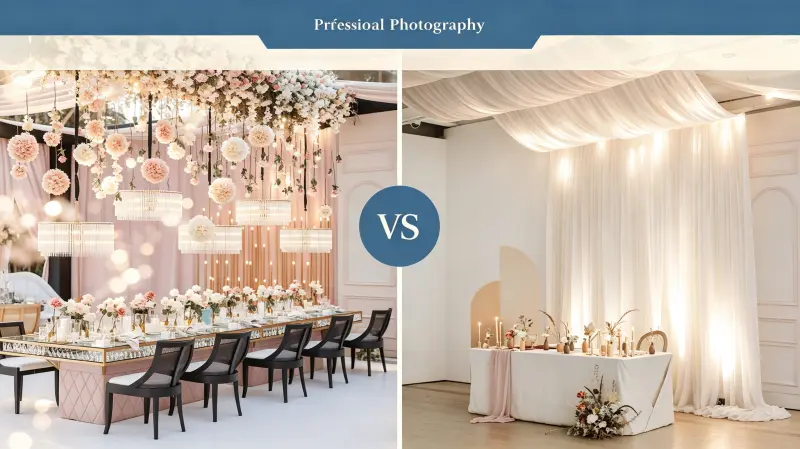
Hanging flowers and fabric draping are the two most popular ceiling decor options for events — but they serve very different purposes and budgets. Fabric draping transforms a room's architecture (hiding ugly walls, creating intimacy), while hanging flowers add romance, color, and Instagram-worthy focal points. Many event professionals use both, but if you're choosing one, this guide breaks down the cost, visual impact, setup complexity, and best-use scenarios for each. By the end, you'll know exactly which option (or combination) fits your event and budget.
Wholesale Hanging Flowers from $8-45/unit
Xibo Floral manufactures commercial-grade hanging garlands, flower balls, and cascading sprays. MOQ 1 piece, 50+ reuse lifespan, custom colors. Free samples available.
Request Wholesale PricingQuick Overview
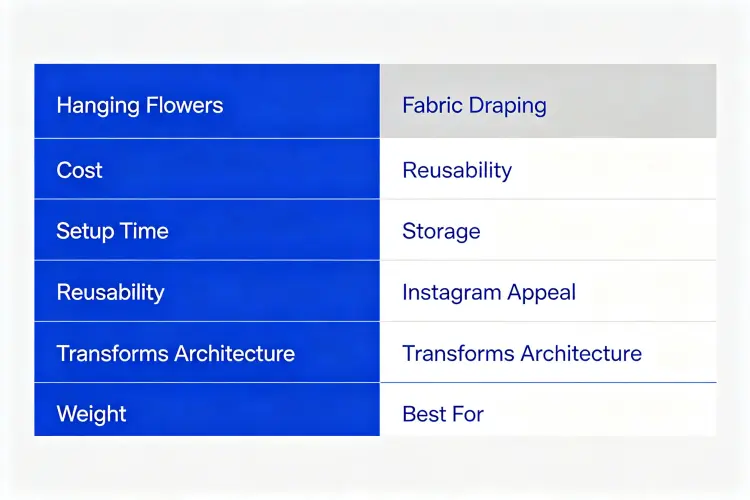
| Factor | Hanging Flowers | Fabric Draping |
|---|---|---|
| Typical cost (per event) | $300-2,000 | $500-3,500 |
| Setup time (standard room) | 2-4 hours | 4-8 hours |
| Reusability | 50+ uses (artificial) | 100+ uses (if well-maintained) |
| Storage space | Small (bins) | Large (rolling racks) |
| Instagram appeal | Very High | Medium |
| Transforms room architecture | No (adds accents) | Yes (hides walls/ceilings) |
| Weight | Light (4-16 oz/unit) | Heavy (10-50 lbs per panel) |
| Best for | Romance, focal points, photos | Room transformation, hiding flaws |
Cost Comparison
Initial Investment (Buying)
| Item | Hanging Flowers (Artificial) | Fabric Draping |
|---|---|---|
| Products (standard room: 20 units) | $400-900 (wholesale) | $800-2,500 (fabric + hardware) |
| Hanging hardware | $50-150 (hooks, line) | $300-800 (pipes, stands, clips) |
| Transport/storage | $50 (plastic bins) | $200-500 (rolling rack, garment bags) |
| Total initial investment | $500-1,100 | $1,300-3,800 |
Rental Costs (Per Event)
- Hanging flowers rental: $300-2,000/event depending on quantity. A typical 20-unit installation rents for $500-800.
- Fabric draping rental: $500-3,500/event depending on room size. A standard ballroom (4 walls + ceiling swags) rents for $1,500-2,500.
- Cost per use (if buying): Hanging flowers = $10-22/use (50 uses). Fabric draping = $13-38/use (100 uses). Both become very cheap per use after the first 5-10 events.
Key insight: Hanging flowers have a lower barrier to entry ($500 vs. $1,300 minimum). For rental businesses, hanging flowers reach break-even after 1-2 rentals; fabric draping takes 3-5 rentals. But fabric draping commands higher rental prices, so total revenue potential is higher.
Visual Impact & Photo Appeal
Hanging Flowers
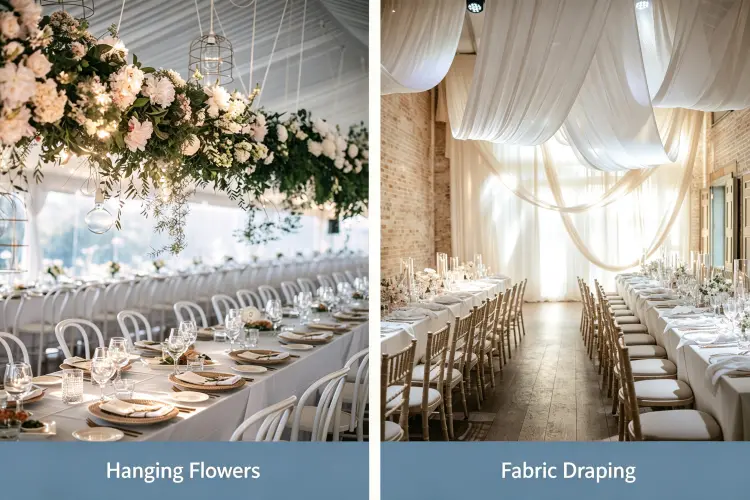
- Creates focal points: A cluster of hanging flower balls above a dance floor or head table draws the eye and creates a "wow" moment
- Adds color and texture: Flowers bring organic texture, depth, and color that fabric can't match
- Photographs beautifully: Flowers look stunning in professional photos — soft bokeh, natural texture, romantic mood. This is the #1 reason brides choose hanging flowers
- Instagram-friendly: Guests take photos under flower installations and share them. Hanging flowers are one of the most "Instagrammable" decor elements
- Limitations: Doesn't hide ugly walls or ceilings. If the venue has bad architecture, flowers alone won't fix it. Best as an accent, not a room transformation
Fabric Draping
- Transforms the entire room: Draping can turn a gym, community hall, or bare ballroom into an elegant event space. Hides cinder block walls, fluorescent lights, and ugly ceilings
- Creates intimacy: Draping lowers the visual ceiling, making large rooms feel cozy and intimate. Critical for venues with 20+ ft ceilings
- Provides backdrop: Draped walls serve as a clean, elegant backdrop for the entire event — behind the head table, ceremony altar, or photo booth
- Lighting canvas: Fabric draping reflects and diffuses light beautifully. Uplighting on draped walls creates a dramatic, luxurious effect that flowers alone can't achieve
- Limitations: Can look plain or boring without flowers, lighting, or other accents. White/ivory draping alone can feel like a hospital or tent. Needs complementary elements
Setup & Transport
Hanging Flowers Setup
- Assess ceiling and install hooks/hardware (30 min)
- Pre-cut fishing line to desired lengths (15 min)
- Hang flowers one by one, adjusting heights (1-2 hours for 20 units)
- Step back, balance, and adjust (30 min)
- Total: 2-4 hours for 1-2 people
Transport: 2-3 plastic bins fit in a standard car trunk. No special vehicle needed. Flowers are durable — no wrinkling or creasing concerns.
Fabric Draping Setup
- Build pipe and drape framework (stands, crossbars) — 1-2 hours
- Hang fabric panels, ensuring even height and no wrinkles (1-2 hours)
- Add ceiling swags or canopy (1-2 hours, requires 2 people + lift)
- Steam or smooth out wrinkles (30-60 min)
- Add lighting and accents (30 min)
- Total: 4-8 hours for 2-3 people
Transport: Requires a van, truck, or large SUV. Rolling garment racks, pipe bags, and hardware bins. Fabric must be hung during transport to prevent wrinkles (or steamed on-site). Much more logistically complex.
Reusability & Long-Term Value
| Factor | Hanging Flowers (Artificial) | Fabric Draping |
|---|---|---|
| Lifespan | 5-7 years (50+ uses) | 8-10 years (100+ uses) |
| Maintenance between uses | Dust with feather duster (5 min) | Steam/iron wrinkles (30-60 min), wash as needed |
| Damage risk | Low — petals may loosen, easy to repair | Medium — stains, tears, burns from lights |
| Storage | Plastic bins, 4-6 sq ft floor space | Rolling rack, 15-25 sq ft floor space |
| Color flexibility | Buy different colors for different themes | White/ivory works for 90% of events; colored fabric limits versatility |
| Cost per use (50 uses) | $10-22 | $13-38 (amortized over 100 uses = $6.50-19) |
Key insight: Both are excellent long-term investments. Fabric draping has a longer lifespan but higher maintenance (steaming every use). Hanging flowers are virtually zero-maintenance — just dust and store. For rental businesses, both pay for themselves within 2-5 events and generate pure profit thereafter.
Best Uses by Venue Type
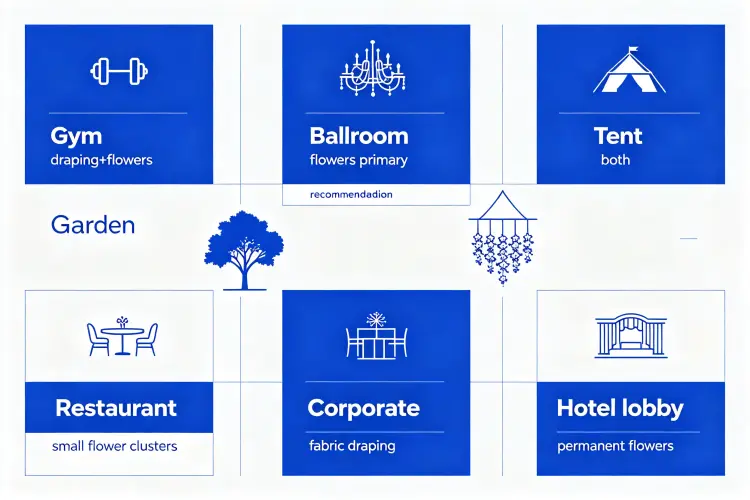
| Venue Type | Best Option | Why |
|---|---|---|
| Bare gym / community hall | Fabric draping (essential) + flowers (accent) | Draping hides ugly walls and transforms the space; flowers add romance |
| Elegant ballroom (good architecture) | Hanging flowers (primary) | Room already looks good; flowers add focal points without covering architecture |
| Outdoor tent | Both (draping for tent poles, flowers for ceiling) | Draping hides tent poles and frame; flowers add color and romance |
| Garden / outdoor venue | Hanging flowers (from trees/pergolas) | Natural setting doesn't need draping; flowers complement greenery |
| Restaurant / intimate space | Hanging flowers (small clusters) | Limited ceiling space; flowers add impact without overwhelming |
| Corporate event / conference | Fabric draping (branded backdrop) | Clean, professional look; draping creates branded photo backdrop |
| Hotel lobby / commercial | Hanging flowers (permanent installation) | Long-term visual impact, zero maintenance, Instagram-friendly |
Save 70-90% by Sourcing Direct from Factory
Xibo Floral hanging flowers cost $8-45/unit wholesale vs. $30-100+ retail. 4000sqm factory, 500+ rental business clients. MOQ 1 piece, free samples, 7-15 day production.
Get Wholesale CatalogHow to Combine Both for Maximum Impact
The most luxurious events use both hanging flowers and fabric draping — they complement each other perfectly. Here's how to combine them:
- Use draping as the foundation: Drape the walls and/or ceiling first. This creates a clean, elegant canvas and hides any venue flaws.
- Add flowers as the "jewelry": Hang flower clusters or garlands in front of or through the draping. The neutral fabric makes flower colors pop.
- Focus flowers at key moments: Concentrate hanging flowers above the ceremony altar, head table, or dance floor — the areas that get photographed most. Use draping everywhere else.
- Layer for depth: Hang draping at one height, then hang flowers at a lower height in front of it. This creates depth and dimension that neither achieves alone.
- Budget split recommendation: 60% draping, 40% flowers for a full room transformation. 30% draping, 70% flowers for a venue that's already nice.
Example combined budget (standard ballroom): Draping (4 walls + ceiling swags) = $1,800 rental. Hanging flowers (30 units, dance floor cluster + aisle) = $800 rental. Total = $2,600. This creates a luxury look that clients will pay $4,000-6,000 for at retail.
FAQ
Both are profitable, but with different profiles. Hanging flowers: Lower investment ($500-1,100), faster break-even (1-2 rentals), higher profit margin (80%+ per rental after break-even), but lower per-rental revenue ($300-2,000). Fabric draping: Higher investment ($1,300-3,800), slower break-even (3-5 rentals), still high margin (75%+), but higher per-rental revenue ($500-3,500). Most successful rental businesses offer both — they're complementary, not competing. A client who rents draping often adds flowers, increasing average order value by 40-60%. Start with hanging flowers (lower risk), then add draping once you have consistent bookings.
Yes, but carefully. The pipe and drape framework (metal poles) can support flower weight — use zip ties or S-hooks attached to the crossbars, not the fabric itself. Each crossbar typically supports 20-50 lbs depending on span. Hanging flowers weigh 4-16 oz each, so you can safely hang 20-40 flowers from a standard crossbar. Never hang flowers from the fabric itself — it will stretch, tear, or pull down the panel. Always attach to the metal framework behind the fabric. For ceiling swags, hang flowers from the same support cables that hold the swag.
Both options have workarounds. For hanging flowers: Use freestanding display stands (metal poles with a base), or hang from existing structures (chandeliers, curtain rods, pipe and drape). For fabric draping: Pipe and drape systems are freestanding — no ceiling or wall attachment needed. They use weighted bases and vertical poles. This is actually the #1 advantage of fabric draping: it works in ANY venue, even those with strict "no attachment" policies. If ceiling attachments are prohibited, pipe and drape + flowers hung from the drape framework is the best solution.
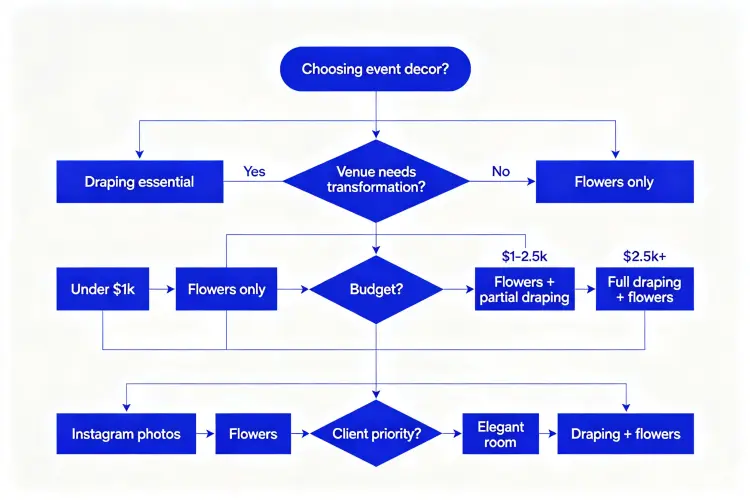
Ask these 3 questions: (1) Does the venue need transformation? If it's a gym, hall, or has ugly walls → fabric draping is essential. If it's already beautiful → flowers only. (2) What's the budget? Under $1,000 → hanging flowers only. $1,000-2,500 → flowers + partial draping (backdrop only). $2,500+ → full draping + flowers. (3) What's the client's priority? If they want Instagram-worthy photos → flowers. If they want an elegant, transformed room → draping + flowers. Most brides want both, but budget dictates the mix. Start with the venue assessment — it determines 80% of the decision.
Hanging flowers are trending UP — driven by Instagram/Pinterest demand for "floating garden" and "cloud of flowers" aesthetics. 2026-2027 wedding trends favor organic, garden-inspired decor, and hanging flowers are the centerpiece. Fabric draping is stable — it's a timeless staple that never goes out of style, but it's not "trending" (it's a baseline expectation at premium events). The fastest-growing segment is COMBINED installations: draping + hanging flowers + lighting, sold as a "luxury ceiling package." Rental businesses offering this package see 2-3x higher average order values compared to selling either element alone.
Yes, but it's rarely worth the time. DIY hanging flowers require: artificial flower stems ($50-150), floral wire ($10), hot glue ($10), and 5-10 hours of labor. Total DIY cost: $70-170 for 20 units, vs. $400-900 wholesale from Xibo Floral. You save $330-730 but spend 5-10 hours. At $25/hour opportunity cost, that's $125-250 in labor — so net savings are only $80-480. More importantly, wholesale commercial-grade flowers look better and last longer (50+ uses vs. 10-20 for DIY). For rental businesses, the time is better spent marketing and booking events. For a one-time DIY bride, it can make sense if you're crafty and on a tight budget.
Ready to Add Hanging Flowers to Your Inventory?
Xibo Floral supplies 500+ rental businesses and event planners worldwide. Commercial-grade hanging garlands, flower balls, and cascading sprays from $8-45/unit. MOQ 1 piece, 50+ reuse lifespan, custom colors, fire-retardant options. 4000sqm factory, 7-15 day production, free samples available.
Request Wholesale Quote & Free Samples