When you're sourcing artificial flower walls from China, the quality gap between suppliers can be shocking. A wall that looks lush and premium in Alibaba photos might arrive sparse, flimsy, or made with cheap plastic backing that tears after one event. For rental businesses, wedding planners, and event companies, this isn't just disappointing — it directly costs you money in replacements, lost bookings, and damaged reputation.
After reviewing dozens of top Alibaba suppliers (including 8-year verified factories like Qingdao Irand and Chongqing Floson), we've compiled the exact 7-step quality verification process professional B2B buyers use before placing bulk orders. These are the checks that separate commercial-grade rental walls from disposable decor.
Why Quality Directly Impacts Your Rental Profit
For event rental businesses, flower wall quality is a profit decision, not just an aesthetic one:
- Rental lifespan: Commercial fabric-backed walls handle 50+ rentals; budget versions fail after 5-10 uses
- Setup efficiency: Well-made rolling walls hang in 15-30 minutes with zero gaps; cheap ones sag, curl, or don't line up
- Photogenic quality: Dense, layered flowers photograph beautifully and generate referrals
- Transport durability: Quality fabric backing rolls and unrolls repeatedly without damage
- Resale value: Premium walls hold 60-70% of their value if you ever rotate inventory
7-Step Quality Verification Checklist

This is the #1 quality differentiator and the most commonly misrepresented in product photos. Top-tier Alibaba suppliers like Yiwu Fuyi achieve 4.9/5 ratings specifically because of their full, dense coverage.
How to inspect:
- Hold the sample up to a window or light source — if you can see large patches of backing through the flowers, density is too low
- Run your hand across the surface — quality walls have 3D depth with flowers at different heights
- Count flower heads per section: commercial grade = 300+ heads per square meter
- Check for "bald spots" at edges and corners — cheap manufacturers skimp where they think you won't notice
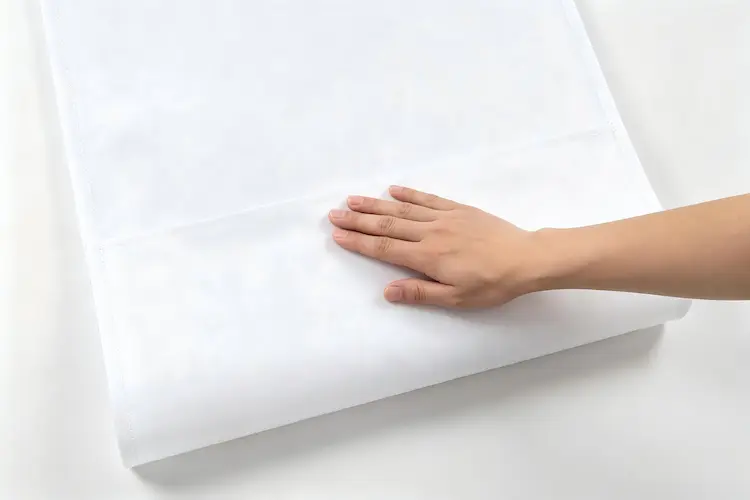
The backing is the structural foundation of your flower wall. For rolling fabric-backed walls (the preferred format for rental businesses), the backing material determines everything from setup ease to lifespan.
What to check on fabric backing:
- Material weight: quality fabric backing feels substantial (180-250gsm), not thin like a bed sheet
- Edge reinforcement: look for double-stitched hems and reinforced rod pockets that won't tear
- Flex test: roll it tightly and unroll — premium fabric bounces back flat without creases
- Attachment method: flowers should be individually tied or wired to the fabric, not just glued
- No plastic mesh backing — grid-style backings are for cheap panel walls, not commercial rolling walls
Step 3: Evaluate Flower Material & Realism
Cheap artificial flowers have a distinct "plastic shine" that reads as fake in photos and in person. Premium silk flowers, like those used by top Alibaba suppliers, have subtle color gradients and matte finishes.
Quality indicators:
- Petal color gradient: real-looking flowers are darker at the base, lighter at the petal edges
- Texture: silk fabric petals have a soft, matte finish, not shiny plastic
- Color fastness test: rub a petal firmly with a white cloth — no color should transfer
- UV resistance: ask for UV-stabilized specs if you'll use walls outdoors
- No chemical smell: cheap materials often have a strong plastic odor that lingers at events
Step 4: Test Workmanship & Durability
How the flowers are assembled and finished determines how well the wall holds up to repeated setup, takedown, and transport.
Workmanship checks:
- Tug test: gently pull 5-10 random flowers — none should come loose or fall off
- No loose threads or glue drips visible along edges
- Stems are secure but flexible, not brittle plastic that snaps
- Corners and hanging points are reinforced with extra fabric
- The entire wall hangs straight — if it twists or curls at the edges, workmanship is poor
- Zipper quality (for multi-panel systems): zippers should align smoothly and not pull flowers loose
Step 5: Verify Size & Specification Accuracy
A common cost-cutting tactic among Chinese suppliers is making walls slightly smaller than advertised. A wall listed as 8ft × 8ft might actually be 7.5ft × 7.5ft — that's 12% less product for the same price.
Always measure:
- Width and height at multiple points, not just one spot
- Rolling walls: full extended length, not rolled diameter
- Custom sizes: compare against your exact specifications
- Consistency: if ordering multiple walls, measure each one — batch variation is a quality red flag
- Weight: commercial 8×8 rolling walls typically weigh 5-8kg; significantly lighter means thinner materials
Step 6: Check Packaging & Shipping Protection
Even the highest quality wall arrives damaged if packaging is bad. For international ocean freight (25-45 day transit), proper packaging isn't optional — it's essential.
Good packaging standards:
- Rolling walls are rolled around a sturdy tube (not folded in half — folding creates permanent creases)
- Each wall individually wrapped in OPP plastic bag for moisture protection
- Outer carton: 5-layer corrugated cardboard, not thin 3-layer
- End caps or corner protection for tube-rolled items
- Carton weight under 20kg to avoid rough handling damage
- Sample packaging quality matches what you'd expect for bulk — if samples arrive beat up, bulk will be worse
Step 7: Order a Sample Before Committing to Bulk
This is the non-negotiable rule of international sourcing. Every professional buyer we've worked with orders samples from 2-3 factories before choosing a supplier. The small sample cost saves thousands in bad bulk orders.
Smart sample strategy:
- Order a full 1m × 1m section, not just a small swatch — you need to see real density and backing
- Test it like you would use it: hang it, roll it, transport it, set it up at an event
- Photograph it under event lighting — how it looks on camera matters more than office lighting
- Compare side by side: order from 2-3 suppliers and rank them on density, material, workmanship, packaging
- Keep the winning sample as your "golden sample" — use it as the quality standard for bulk
- Ask if sample cost is refundable against a bulk order (many suppliers offer this)
7 Red Flags That Mean "Walk Away"
After evaluating dozens of Alibaba suppliers, these are the warning signs that consistently correlate with poor quality:
How Xibo Floral Controls Quality at Every Step
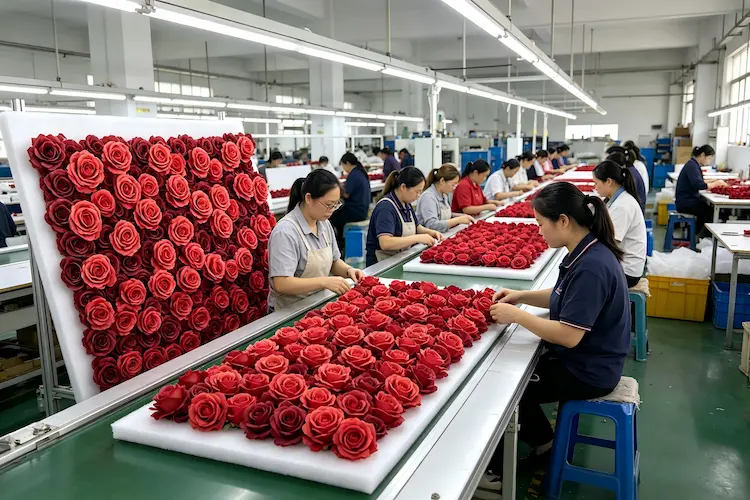
Our 4-stage QC process:
- Incoming material inspection: Every batch of silk fabric, flower components, and backing material is inspected for weight, color consistency, and quality before production starts
- In-process line checks: Team leads inspect each workstation throughout assembly — no flower goes by without being checked for secure attachment
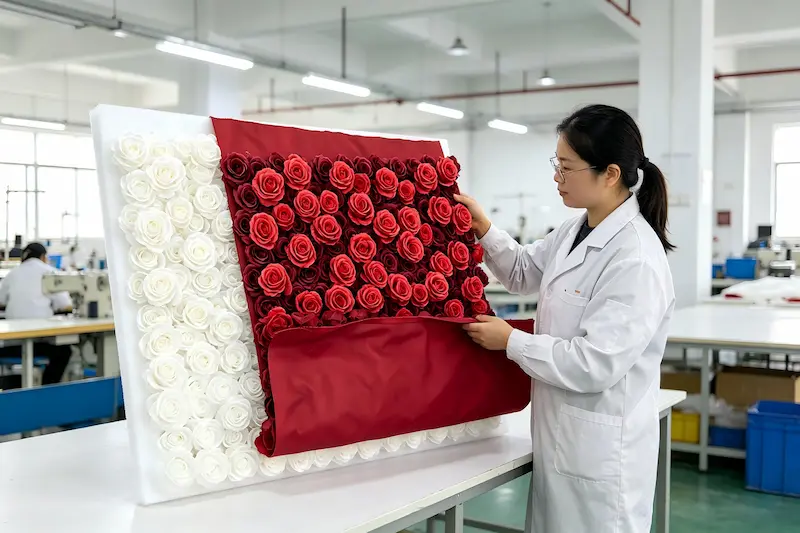
- 100% finished product inspection: Every completed wall gets a full quality check — density, workmanship, size, and appearance — before packaging
- Pre-shipment photo confirmation: We send photos of every finished order before it leaves the factory, so you can approve or flag issues before it ships
Additional quality guarantees:
- Sample retention program: We keep a reference sample from every production batch to ensure consistency across reorders
- Spare flower heads included: Every shipment includes 5-10% extra replacement flowers for on-site repairs
- Sample-first policy: We always recommend ordering a sample first — and sample cost is 100% deductible from your first bulk order
Order Your Quality Sample Today
Test our commercial-grade fabric-backed flower wall quality firsthand. 1m sample ships in 3-7 days via DHL, and sample cost is fully deductible from your first bulk order.
Request a Sample