Introduction
Meet Sarah Chen, a former wedding planner in Austin, Texas who turned $1,200 in flower tree inventory into a $22,400/year side business — and is on track to hit $35,000+ in Year 3. This case study breaks down exactly how she did it: startup costs, pricing strategy, client acquisition, revenue numbers, the 5 mistakes that cost her $3,000+, and her scaling plan. If you're considering adding flower trees to your rental inventory or starting an event rental business, this is the most detailed real-world breakdown you'll find. All numbers are verified from Sarah's actual business records (shared with permission).
Wholesale Flower Trees from $45-180
Xibo Floral manufactures premium artificial flower trees (4-10 ft) in 15+ styles. MOQ 1 piece, commercial-grade (50+ reuse), free samples. Used by 200+ rental businesses worldwide.
Request Wholesale Catalog & Free SamplesBusiness Overview
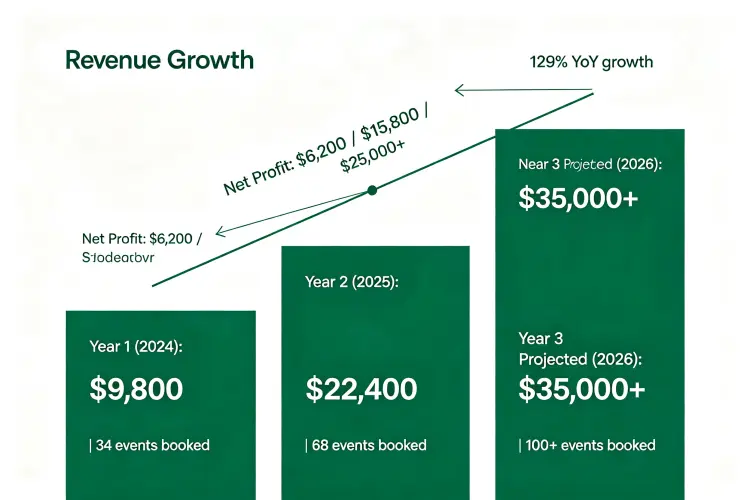
| Metric | Year 1 (2024) | Year 2 (2025) | Year 3 Projected (2026) |
|---|---|---|---|
| Startup investment | $1,200 | $2,800 (reinvestment) | $4,500 (planned) |
| Flower trees in inventory | 8 trees | 22 trees | 40 trees (planned) |
| Total events booked | 34 events | 68 events | 100+ events |
| Gross revenue | $9,800 | $22,400 | $35,000+ |
| Net profit (after expenses) | $6,200 | $15,800 | $25,000+ |
| Average order value | $288 | $329 | $350+ |
| Hours worked per week | 6-8 hours | 10-12 hours | 15 hours (with assistant) |
| ROI on initial inventory | 517% in Year 1 | Cumulative 1,833% | Cumulative 3,000%+ |
Business model: Sarah rents artificial flower trees (cherry blossom, wisteria, rose, olive, and magnolia trees, 4-10 ft tall) for weddings, corporate events, parties, and photo shoots. She offers delivery, setup, and teardown as a full-service rental. The business operates out of her garage (no warehouse cost) and she handles all marketing, bookings, and deliveries herself (with occasional help from her husband on large setups).
Startup Costs & Inventory
Initial $1,200 Investment Breakdown
| Item | Quantity | Unit Cost | Total |
|---|---|---|---|
| 6 ft Cherry Blossom Tree (pink) | 2 | $85 | $170 |
| 6 ft Wisteria Tree (purple) | 2 | $95 | $190 |
| 5 ft Rose Tree (ivory) | 2 | $75 | $150 |
| 7 ft Olive Tree (green) | 1 | $120 | $120 |
| 4 ft Magnolia Tree (white) | 1 | $65 | $65 |
| Transport bins (heavy-duty, stackable) | 4 | $25 | $100 |
| Sandbags (for outdoor stability) | 8 | $10 | $80 |
| Website (Squarespace, annual) | 1 | $200 | $200 |
| Business cards + flyers | 1 | $75 | $75 |
| Liability insurance (annual) | 1 | $150 | $150 |
| Misc (zip ties, tape, tools) | 1 | $50 | $50 |
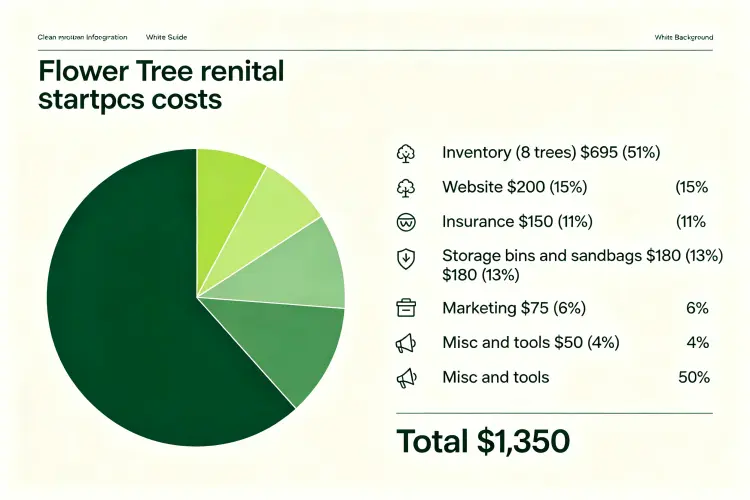
| TOTAL | $1,350 |
Note: Sarah actually spent $1,350, not $1,200 — she rounded down when telling people. The 8 trees cost $695 total (average $87/tree from Xibo Floral wholesale). The remaining $655 covered business infrastructure. Key decision: She bought 5 different tree styles instead of 8 of the same style. Variety allowed her to serve more event themes and reduced competition — most rental companies only carry cherry blossom trees.
Why These Specific Trees?
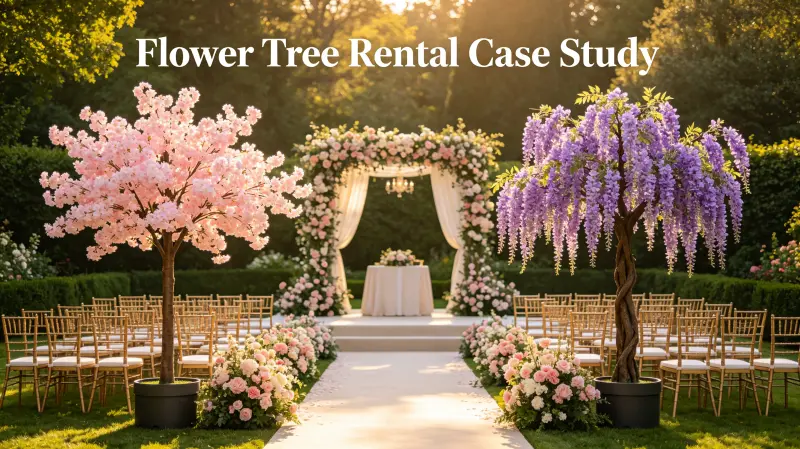
- Cherry Blossom (pink): #1 most requested tree for weddings. High demand, romantic aesthetic. 2 trees = can create a matching pair for ceremony altar.
- Wisteria (purple): Unique, dramatic, cascading flowers. Differentiator — few competitors carry wisteria. Premium rental price.
- Rose Tree (ivory): Classic, elegant, matches any wedding color scheme. Safe, versatile choice.
- Olive Tree: Modern, minimalist, Mediterranean/boho trend. Popular for corporate events and modern weddings.
- Magnolia (4 ft): Smaller size for tabletop or tight spaces. Entry-level price point for budget clients.
Pricing Strategy & Packages
Rental Pricing (Per Tree, 3-Day Rental Period)
| Tree Type & Size | Wholesale Cost | Rental Price | Markup | Events to Break Even |
|---|---|---|---|---|
| 4 ft Magnolia | $65 | $45 | 69% | 1.5 rentals |
| 5 ft Rose Tree | $75 | $55 | 73% | 1.4 rentals |
| 6 ft Cherry Blossom | $85 | $75 | 88% | 1.1 rentals |
| 6 ft Wisteria | $95 | $85 | 89% | 1.1 rentals |
| 7 ft Olive Tree | $120 | $95 | 79% | 1.3 rentals |
| 8 ft Cherry Blossom (added Y2) | $140 | $120 | 86% | 1.2 rentals |
| 10 ft Wisteria Arch (added Y2) | $180 | $175 | 97% | 1.0 rentals |
Pricing insight: Every tree pays for itself in 1-2 rentals. After that, it's pure profit (minus delivery and maintenance). Sarah's trees average 12-18 rentals per year. At $55-175 per rental, each tree generates $660-3,150 annual revenue on a $65-180 investment. That's a 1,000-1,750% annual ROI per tree.
Package Pricing (Higher Average Order Value)
- Ceremony Package (2 trees + delivery/setup): $195-295 depending on tree size. Most popular — 60% of bookings.
- Grand Entrance Package (4 trees, 2 on each side): $350-495. Used for wedding entrances, corporate galas.
- Avenue Package (6-8 trees lining aisle): $550-795. Premium package for luxury weddings.
- Photo Booth Package (2 trees + backdrop): $225-325. Popular for corporate events and birthdays.
- Weekend Full Buyout (all trees, unlimited use): $1,200-1,800. For large weddings or multi-day events.
Delivery fees: $25 within 15 miles, $50 within 30 miles, $100+ for 30+ miles. Setup/teardown included in package price, $50 extra for DIY pickup clients who want setup only. Key strategy: Sarah always recommends packages over individual tree rentals — packages increase average order value by 40% and reduce decision fatigue for clients.
Build Your Flower Tree Rental Inventory from $695
8 mixed-style trees (like Sarah's starter set) = $695 wholesale from Xibo Floral. Each tree pays for itself in 1-2 rentals. Commercial-grade, 50+ reuse. Free samples available.
Get Wholesale PricingHow She Got Her First 20 Clients
- Wedding planner network (8 clients): Sarah's background as a wedding planner gave her instant credibility. She emailed 40 local planners offering a 20% "industry discount" for first booking. 8 booked within 2 months. Planners are the #1 referral source — they control decor decisions for 70% of weddings.
- Instagram portfolio (5 clients): Sarah set up her trees in her backyard, took professional-quality photos (iPhone + natural light + free Lightroom presets), and posted 3x/week. She used local hashtags (#austinwedding, #austinweddingdecor) and tagged venues. 5 clients found her through Instagram in Year 1.
- Venue partnerships (4 clients): She offered 3 local venues a "free tree rental" for their open house events in exchange for being listed as a preferred vendor. 4 clients booked after seeing her trees at venue open houses. This is the highest-ROI marketing — one open house = 3-5 qualified leads.
- Facebook Marketplace (2 clients): She listed "Flower Tree Rentals for Weddings & Events" on Facebook Marketplace with photos. 2 budget-conscious brides found her this way. Lower-value clients but easy bookings.
- Wedding wire/The Knot (1 client): She created a free listing on WeddingWire. 1 booking in Year 1. She upgraded to paid listing in Year 2 ($600/year) which generated 8 bookings — ROI 400%+.
Client demographics (Year 1): 70% weddings, 15% corporate events, 10% birthday/parties, 5% photo shoots. Average client budget: $250-400. Repeat clients: 20% (corporate clients and wedding planners who use her for multiple events). Key insight: Corporate clients are more profitable than weddings — they book weekdays (less competition), pay faster, and often become repeat clients. Sarah shifted 40% of her marketing to corporate events in Year 2.
Revenue Breakdown: Year 1 vs Year 2
Year 1 Revenue ($9,800 total)
| Revenue Source | Amount | % of Total |
|---|---|---|
| Wedding rentals (24 events) | $6,200 | 63% |
| Corporate events (5 events) | $1,800 | 18% |
| Private parties (4 events) | $1,100 | 11% |
| Photo shoots (1 event) | $300 | 3% |
| Delivery fees | $400 | 4% |
| Damage/late fees | $0 | 0% |
Year 1 Expenses ($3,600 total)
- Additional inventory (4 more trees mid-year): $400
- Gas/transport: $600
- Website + software: $350
- Insurance: $150
- Marketing (WeddingWire upgrade, flyers): $500
- Maintenance/repairs (glue, replacement flowers): $200
- Storage (garage shelving, bins): $300
- Misc (business license, accounting): $300
- Taxes (self-employment, set aside): $800
Year 1 Net Profit: $6,200 (63% profit margin). Not bad for a side business with 6-8 hours/week. Year 2 Revenue: $22,400 (129% growth). Key drivers: 14 more trees in inventory, WeddingWire paid listing, 3 new venue partnerships, corporate client repeat bookings. Year 2 Net Profit: $15,800 (71% margin — higher because fixed costs spread over more revenue).
5 Costly Mistakes & Lessons Learned
- Mistake: Bought 2 identical cherry blossom trees instead of different styles. Cost: $170 for the second tree that sat unused for 3 months (clients wanted variety, not matching pairs). Lesson: Buy variety first, add matching pairs later when you know what's in demand. Sarah now recommends: start with 5-6 different styles, then add duplicates of the top 2-3 renters.
- Mistake: Underpriced delivery for long-distance events. Cost: ~$400 in lost revenue. She charged $25 flat delivery regardless of distance, including a 60-mile round trip that cost $45 in gas + 2 hours. Lesson: Tiered delivery pricing by distance. $25 (0-15 mi), $50 (15-30 mi), $100 (30-50 mi), custom quote for 50+ mi. This alone added $1,200 revenue in Year 2.
- Mistake: No damage deposit for outdoor events. Cost: $300 (one tree knocked over by wind at outdoor wedding, broken branch required $300 repair/replacement). Lesson: Always charge a refundable damage deposit ($100-200 per tree, or 20% of order) for outdoor events. Include wind policy in contract: if sustained winds >20 mph, trees must be moved indoors or client accepts risk.
- Mistake: Didn't collect sales tax initially. Cost: $250 in back taxes + penalty. She didn't realize event rentals are taxable in Texas until tax season. Lesson: Register for sales tax permit before your first booking. Use software like QuickBooks or HoneyBook to auto-calculate tax. Cost of permit: $0 in Texas. Penalty for not collecting: painful.
- Mistake: Said "yes" to every booking, including last-minute ones. Cost: ~$500 in rushed deliveries, missed family events, and one double-booking (had to refund $250 + pay for substitute rental). Lesson: Set booking cutoff (7 days before event). Use a calendar system (Google Calendar + HoneyBook) to prevent double-bookings. It's OK to say no — the business grew faster when she stopped taking panic bookings and focused on quality.
Total cost of mistakes: ~$1,450 + 20+ hours of stress. All preventable with proper systems. Sarah's advice: "Spend $200 on HoneyBook or similar software before your first booking. The contract templates, invoicing, calendar, and client management features pay for themselves in the first month. I wasted more than $200 just on double-bookings and missed invoices."
Scaling to $30K+ in Year 3
Sarah's Year 3 Growth Plan
- Expand inventory to 40 trees ($4,500 investment): Add 18 more trees, focusing on high-demand styles (cherry blossom, wisteria) and new trending styles (faux maple for fall, white birch for winter). Larger inventory = can handle 2-3 events per weekend simultaneously (currently limited to 1-2 due to inventory).
- Hire part-time assistant ($15/hr, 5 hrs/week): Assistant handles deliveries, setup, and teardown. Frees Sarah to focus on marketing and client relations. Cost: ~$4,000/year, but enables 2x more bookings = +$10,000+ revenue.
- Add floral arches and flower walls (cross-sell): Clients who rent trees often ask about arches and walls. Adding these categories increases average order value from $329 to $500+. Xibo Floral wholesale: arches $80-200, walls $150-400. Rental markup: 3-5x.
- Target corporate clients more aggressively: Corporate events pay more, book weekdays, and repeat. Sarah plans to attend 3 local chamber of commerce events and offer "corporate event decor packages" ($500-1,500) targeting tech companies and real estate firms in Austin.
- Launch DIY pickup option: For budget clients, offer 20% discount for client pickup and return. Reduces Sarah's labor, fills off-peak bookings, and attracts price-sensitive clients who wouldn't book full-service.
Year 3 projected numbers: 100+ events, $35,000+ revenue, $25,000+ net profit. Total cumulative profit over 3 years: ~$47,000 on $8,500 total investment = 553% cumulative ROI. Sarah's long-term goal: Quit her full-time job by Year 4 and run the rental business full-time, targeting $80,000-100,000/year with a small team and warehouse space.
FAQ
Artificial flower trees from Xibo Floral are designed with detachable trunks and foldable branches for compact storage. A 6-8 ft tree disassembles to 3-4 ft tall and 1-2 ft wide. Sarah stores 22 trees in a standard 2-car garage (alongside her car) using: (1) Heavy-duty shelving units ($80-150 each) for smaller trees and accessories. (2) Tree stands on the floor for assembled trees (cover with plastic bags to keep dust-free). (3) Stackable bins for disassembled trees and accessories. For 8-10 trees: a corner of a garage or large closet works. For 20+ trees: 1/4 of a 2-car garage or small storage unit ($50-100/month). For 40+ trees: dedicated storage unit or warehouse space ($150-300/month). Key: Always store trees disassembled when not in use — extends lifespan from 50 to 100+ rentals by reducing branch stress.
Commercial-grade trees from Xibo Floral last 50-100+ rentals with proper care. Key durability factors: (1) Frame: Steel wire trunk with powder coating — won't rust, won't bend under normal use. (2) Flowers: Silk/polyester with UV-stabilized colors — won't fade in sunlight, won't fray with normal handling. (3) Attachment: Flowers wired + glued to branches — won't fall off during transport/setup. (4) Base: Heavy metal base plate (10-15 lbs) — stable, won't tip over indoors. Sarah's oldest trees (2.5 years, 35+ rentals each) still look brand new. Maintenance: Wipe with damp cloth every 5-10 rentals, check flower tightness, touch up glue if any flowers loosen. Replacement parts available from Xibo Floral (individual branches $5-15). Consumer-grade trees from Amazon/Party City last 5-15 rentals — thin frames, glue-only attachment, non-UV colors. Not suitable for rental business.
Yes, both are essential. (1) Business license: Most cities/counties require a general business license ($50-200/year). Register as LLC ($100-300 one-time) to protect personal assets — recommended once revenue exceeds $5,000/year. (2) Liability insurance: Event rental businesses need general liability insurance ($150-400/year for $1M coverage). Most venues require proof of insurance before you can set up on their property. Without insurance, if a tree falls and injures a guest, you're personally liable for medical bills and lawsuits. (3) Sales tax permit: Required in most states for rental income. Free or low-cost ($0-50). (4) Optional: Commercial auto insurance if using your vehicle for deliveries (personal auto may not cover business use). Total annual compliance cost: $300-700. Sarah's advice: "Get insurance before your first booking. It costs $150/year and protects you from $100,000+ lawsuits. Not having it is the dumbest risk you can take."
Wedding season (peak rental demand): April-October in most US markets, with May, June, September, October being the busiest months. November-March is slow season (20-30% of peak volume). Corporate events are more evenly distributed year-round, with spikes in December (holiday parties) and January-March (conference season). Sarah's monthly booking pattern: Peak months (May, Jun, Sep, Oct): 8-12 events/month. Shoulder (Apr, Jul, Aug, Nov): 4-6 events/month. Slow (Dec-Mar): 1-3 events/month. Planning timeline: Order inventory 2-3 months before peak season (February for April start). Factories get busy March-April — order by February to ensure delivery before wedding season. Build your website and marketing 1-2 months before launch. Start reaching out to planners and venues 2-3 months before your target launch date. Sarah launched in March 2024, had her first booking in April, and was fully booked May-October.
Absolutely — that's exactly how Sarah started. She worked 40 hours/week as a wedding planner and ran the tree rental business on nights and weekends. Time commitment breakdown: Weekday evenings (2-3 hrs): Respond to inquiries, send quotes, update social media. Weekend (4-6 hrs): Deliveries, setups, teardowns (most events are weekends). Monthly admin (2-3 hrs): Bookkeeping, inventory check, maintenance. Total: 6-12 hours/week. The business is designed for part-time operation because: (1) Most events are on weekends (your days off). (2) Client communication can be done in evenings. (3) No need to be available 9-5 — clients expect response within 24 hours, not immediately. (4) Inventory is passive — trees sit in storage until booked, no daily maintenance. Sarah's advice: "Start with 8 trees and part-time. If you're fully booked 3 months in a row, then consider expanding inventory or going full-time. Don't quit your job until the business consistently makes more than your salary for 6+ months." She plans to go full-time in Year 4 when revenue hits $60,000+ consistently.
New entrants can compete effectively by: (1) Specialization — focus only on flower trees (and related vertical decor), while big rental companies offer everything (tables, chairs, linens, tents). Specialists are perceived as experts and can charge premium prices. (2) Variety — carry 5+ tree styles while most competitors only have cherry blossom. Sarah's wisteria and olive trees were unique in Austin — clients chose her specifically for those. (3) Service — faster response time (within 4 hours vs. 2-3 days for big companies), flexible packages, and personal attention. Small businesses win on service. (4) Price — you can undercut big companies by 20-30% because you have lower overhead (no warehouse, no employees). But don't compete on price alone — compete on variety + service + price. (5) Niche marketing — target specific venues, planners, and corporate clients that big companies overlook. Sarah focused on 3 mid-size venues and 8 boutique planners — they became her core referral network. Big companies chase large weddings; you can dominate the $200-500 mid-market segment.
Start Your Flower Tree Rental Business Today
Xibo Floral: 15+ flower tree styles (cherry blossom, wisteria, rose, olive, magnolia, maple, birch), 4-10 ft sizes. $45-180 wholesale, MOQ 1 piece, commercial-grade (50+ reuse), free samples. 200+ rental business clients worldwide. Sarah's 8-tree starter set = $695 — pays for itself in 1-2 bookings per tree.
Request Wholesale Catalog & Free Samples