Introduction
Planning a wedding ceremony structure? Flower arches, chuppahs, and mandaps all create a stunning focal point — but they serve different cultural purposes, have distinct designs, and vary dramatically in cost and setup. This guide breaks down all three so you can choose the right structure for your ceremony, whether you're a bride planning your own wedding or a rental business expanding your inventory.
Wholesale Ceremony Structures from $85-300
Xibo Floral manufactures flower arches, chuppah frames, and mandap decor at factory-direct prices. MOQ 1 piece, 50+ reuse lifespan. Free samples available.
Request Wholesale PricingWhat Are They? Quick Overview
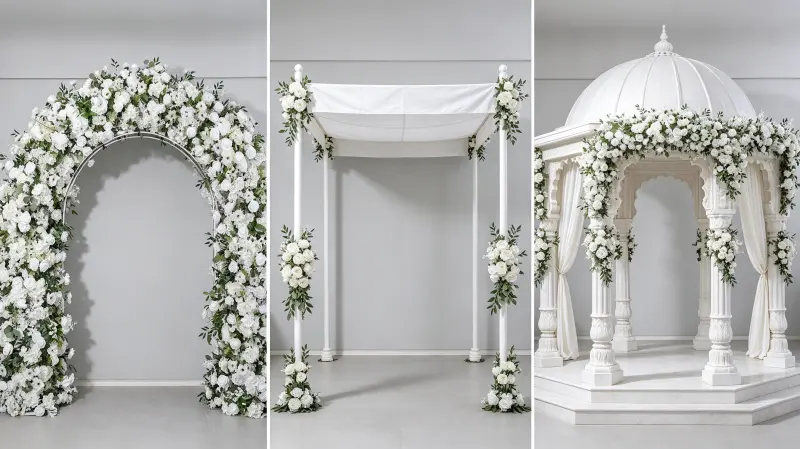
Flower Arch
A curved or geometric frame decorated with flowers and greenery. The most popular ceremony structure worldwide. No religious significance — purely decorative. Used across all cultures and wedding styles.
Chuppah
A Jewish wedding canopy with four poles and a cloth top. Symbolizes the home the couple will build together. The couple stands under it during the ceremony. Traditionally open on all four sides. Often decorated with flowers, fabric, or greenery.
Mandap
A Hindu wedding pavilion, typically square with four pillars and a canopy. More elaborate than a chuppah, often with detailed carvings, fabric draping, and floral decor. The ceremony (including the seven steps) takes place inside the mandap.
Side-by-Side Comparison Table
| Dimension | Flower Arch | Chuppah | Mandap |
|---|---|---|---|
| Origin | Secular/Western | Jewish tradition | Hindu tradition |
| Shape | Curved, hexagonal, or round | Square/rectangular canopy | Square pavilion, often domed |
| Typical size | 7-8ft tall, 5-6ft wide | 8-10ft tall, 8x8ft | 10-12ft tall, 10x10ft+ |
| Wholesale frame cost | $40-120 | $100-300 | $300-800 |
| Fully decorated cost | $85-250 | $200-500 | $500-1,500 |
| Rental price | $200-600 | $400-1,000 | $800-2,500 |
| Setup time | 15-30 min | 30-60 min | 2-4 hours |
| Reusability | 50+ uses | 50+ uses (frame) | 50+ uses (frame) |
| Best for | All wedding types, photo focus | Jewish/interfaith weddings | Hindu/Indian weddings |
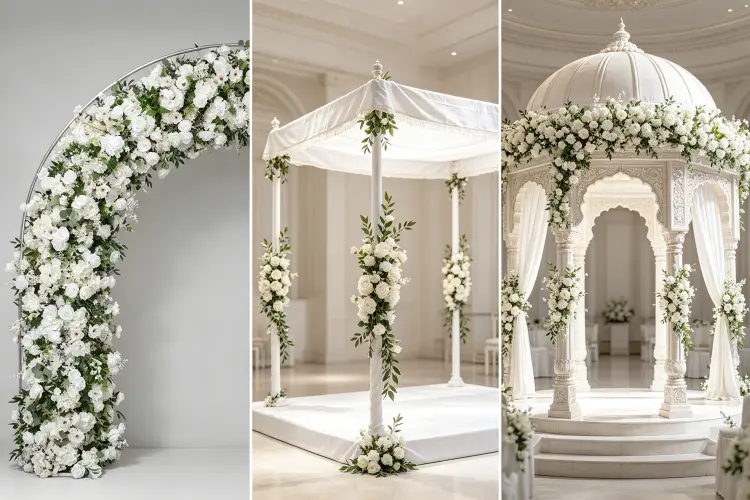
Flower Arch: Details & Best Use
Design Characteristics
- Curved top (classic), hexagonal (modern), or round/moon gate (trending)
- Open structure — no top cover, guests can see through
- Flowers typically concentrated on one side (asymmetrical) or top center
- Greenery base with focal flowers (peonies, roses, hydrangeas)
- Available as roll-up fabric, panel, or freestanding frame
Cultural Context
No religious or cultural significance. The flower arch is a purely decorative element adopted from Western wedding traditions. It's now used globally across all cultures — Christian, secular, interfaith, and even as a decorative element alongside chuppahs and mandaps.
Best For
- Couples who want a photo-worthy backdrop without religious constraints
- Outdoor ceremonies (wind-resistant if properly weighted)
- Rental businesses serving diverse clientele (most universally requested)
- Budget-conscious couples ($85-250 wholesale vs. $400+ for chuppah/mandap)
- Indoor and outdoor venues of all sizes
Pros
- Lowest cost and fastest setup
- Most versatile — works with any wedding style
- Lightweight and easy to transport
- Highest rental demand (60% of ceremony structure rentals)
Cons
Chuppah: Details & Best Use
Design Characteristics
- Four vertical poles supporting a square or rectangular cloth canopy
- Open on all four sides (symbolizes hospitality and an open home)
- Canopy traditionally made of tallit (prayer shawl), but modern versions use fabric, flowers, or greenery
- Poles often decorated with flowers, fabric wraps, or greenery garlands
- Size: typically 8x8ft or 10x10ft, 8-10ft tall
Cultural Context
The chuppah is a sacred element of Jewish wedding tradition. It represents the home the couple will build together — open on all sides to symbolize hospitality. The couple stands under the chuppah during the entire ceremony, including the seven blessings (sheva brachot) and the breaking of the glass. Some couples use a family tallit as the canopy for added meaning.
Best For
- Jewish weddings (Orthodox, Conservative, Reform, Reconstructionist)
- Interfaith weddings where one partner is Jewish
- Couples who want a canopy structure with meaning
- Indoor ceremonies (provides a defined sacred space)
- Rental businesses in areas with significant Jewish populations
Pros
- Deep cultural and religious significance
- Canopy provides shade for outdoor ceremonies
- Creates an intimate, defined ceremony space
- High rental value ($400-1,000 per event)
Cons
Mandap: Details & Best Use
Design Characteristics
- Square or rectangular pavilion with four ornate pillars
- Often has a domed or pyramid-shaped canopy top
- Pillars may be carved wood, fiberglass, or metal with intricate designs
- Extensive decoration: fabric draping, flower garlands, hanging florals, lights
- Size: typically 10x10ft to 12x12ft, 10-12ft tall
- May include additional elements: mandap chairs, fire pit (agni kund), decorative pots
Cultural Context
The mandap is the sacred pavilion where Hindu wedding ceremonies take place. The four pillars represent the four Vedas (ancient Hindu scriptures) and the four stages of life. The ceremony — including the kanyadaan (giving away the bride), agnipuja (fire worship), and saptapadi (seven steps) — all take place inside the mandap. It's the most elaborate and significant structure in an Indian wedding.
Best For
- Hindu, Jain, or traditional Indian weddings
- Multi-day Indian wedding celebrations (often used for multiple events)
- Couples wanting a grand, luxurious ceremony structure
- Large venues (mandaps need significant floor space and ceiling height)
- High-end rental businesses specializing in South Asian weddings
Pros
- Most visually impressive and luxurious
- Highest rental value ($800-2,500 per event)
- Essential for Hindu/Indian weddings (non-negotiable)
- Can be reused for multiple events during a wedding weekend
Cons
How to Choose the Right One
For Couples Planning a Wedding
- Start with your culture/religion. If you're Jewish, you need a chuppah. If you're Hindu, you need a mandap. If you're secular or Christian, a flower arch is the standard choice.
- Consider your venue. Outdoor venues with wind work better with flower arches (lower profile). Large ballrooms can accommodate mandaps. Smaller venues suit chuppahs or arches.
- Set your budget. Flower arch rental: $200-600. Chuppah: $400-1,000. Mandap: $800-2,500. Buy wholesale and reuse/donate after: $85-1,500.
- Think about photos. Flower arches photograph best as a backdrop. Chuppahs create intimate framing. Mandaps are grand but can overwhelm small spaces in photos.
- Interfaith option: Many interfaith couples use a chuppah with flower arch elements, or a flower arch with a cloth canopy. You can blend traditions.
For Rental Businesses
- Start with flower arches. Highest demand, lowest cost, fastest ROI. Buy 3-5 different styles (round, hex, curved) before investing in chuppahs or mandaps.
- Add chuppahs if: Your market has a significant Jewish population, or you serve interfaith weddings. A basic chuppah frame + fabric costs $150-300 wholesale, rents for $400-1,000.
- Add mandaps if: You're in a market with a large South Asian community (e.g., New Jersey, California, Texas, Toronto, London). Mandaps have the highest profit margin but require the most investment.
- Offer combo packages: "Ceremony structure + flower wall + aisle decor" packages rent for $1,000-3,000 and increase average order value.
Source All Three from One Factory
Xibo Floral manufactures flower arches, chuppah frames, and mandap decor. Wholesale from $85-1,500. MOQ 1 piece, custom sizes and colors available. 7-15 day production.
Get Wholesale CatalogCan You Combine Them?
Yes — and many couples do. Here are popular combinations:
- Chuppah + Flower Arch: Use a chuppah frame with flower-decorated poles and a floral garland as the canopy. Blends Jewish tradition with modern floral aesthetic.
- Mandap + Flower Walls: Place flower walls behind or beside the mandap for added grandeur. Common in luxury Indian weddings.
- Flower Arch + Draping: Add sheer fabric draping to a flower arch to create a chuppah-like canopy. Budget-friendly compromise.
- Mandap + Hanging Florals: Hang flower balls or garlands from the mandap canopy for a lush, layered look.
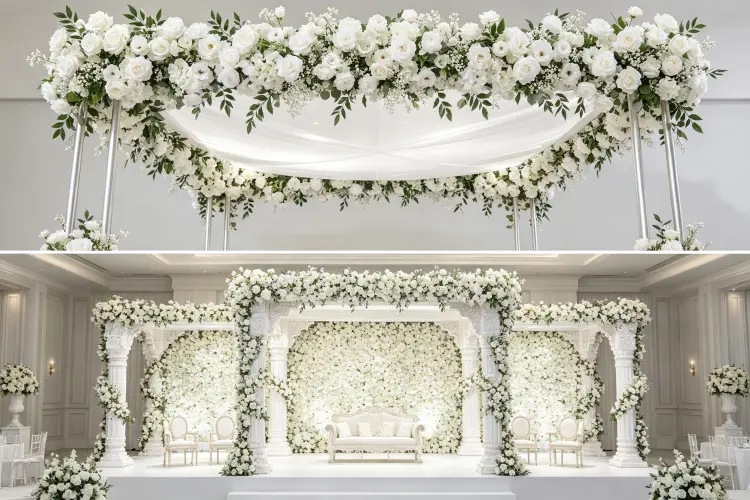
Cost & Sourcing Guide
| Structure | DIY Materials | Wholesale (Xibo Floral) | Rental (Average) | Florist (Fresh) |
|---|---|---|---|---|
| Flower Arch | $100-300 | $85-250 | $200-600 | $800-2,000 |
| Chuppah (decorated) | $200-500 | $200-500 | $400-1,000 | $1,500-3,500 |
| Mandap (decorated) | $500-1,200 | $500-1,500 | $800-2,500 | $3,000-8,000 |
Sourcing tip: Buy frames and artificial decor from China wholesale (Xibo Floral) and save 50-70% vs. local suppliers. All three structures are reusable 50+ times with proper care. For rental businesses, buying wholesale pays for itself after 1-3 rentals.
FAQ
Not traditionally — a chuppah requires four poles and a canopy (cloth or tallit), and it must be open on all sides. A flower arch has a curved top and no canopy. However, many modern interfaith couples use a chuppah frame decorated with flowers (which looks similar to a flower arch but has the required four-pole canopy structure). If you need a halachically valid chuppah, consult your rabbi — most require a proper canopy, not just a flower arch.
Flower arch: 6x6ft footprint, needs 8ft ceiling height minimum. Chuppah: 8x8ft to 10x10ft footprint, needs 10ft ceiling. Mandap: 10x10ft to 12x12ft footprint (sometimes larger with seating), needs 12ft+ ceiling. Always measure your venue before ordering. For outdoor, add 2-3ft around each side for guest seating and photographer space.
Flower arches are by far the most popular — they represent about 60% of ceremony structure rentals because they're used across all wedding types. Chuppahs are about 15-20% (concentrated in Jewish communities). Mandaps are about 10-15% (concentrated in South Asian communities). For a new rental business, start with 3-5 flower arches, then add chuppahs and mandaps based on local demand.
Yes — artificial flowers are increasingly popular for chuppahs and mandaps. They look identical to fresh in photos, don't wilt during multi-day Indian wedding celebrations, and can be reused for future events. Many rental companies exclusively use artificial flowers for their chuppah and mandap inventory. The only exception is ultra-orthodox Jewish weddings where fresh flowers may be preferred for tradition, but this is rare.
Flower arch: $150 wholesale cost / $350 average rental = pays for itself in 1 rental. 50 rentals = $17,500 revenue, $17,350 profit. Chuppah: $350 wholesale / $700 average rental = pays for itself in 1 rental. 50 rentals = $35,000 revenue, $34,650 profit. Mandap: $1,000 wholesale / $1,500 average rental = pays for itself in 1 rental. 50 rentals = $75,000 revenue, $74,000 profit. All three have exceptional ROI — the key is matching inventory to local demand.
For outdoor: flower arches work best (wind-resistant if weighted). Chuppahs need weighted bases and the canopy should be secured (can blow in wind). Mandaps are generally not recommended outdoors unless fully secured and sheltered. For indoor: all three work well. Mandaps need high ceilings (12ft+). Chuppahs and flower arches work in standard 8-10ft ceiling venues. Always check venue height restrictions before ordering.
Ready to Source Ceremony Structures?
Xibo Floral manufactures flower arches, chuppah frames, and mandap decor at factory-direct prices. $85-1,500 wholesale, MOQ 1 piece, custom sizes/colors, 7-15 day production. 4000sqm factory, 500+ rental business clients worldwide. Free samples available.
Request Wholesale Quote & Samples