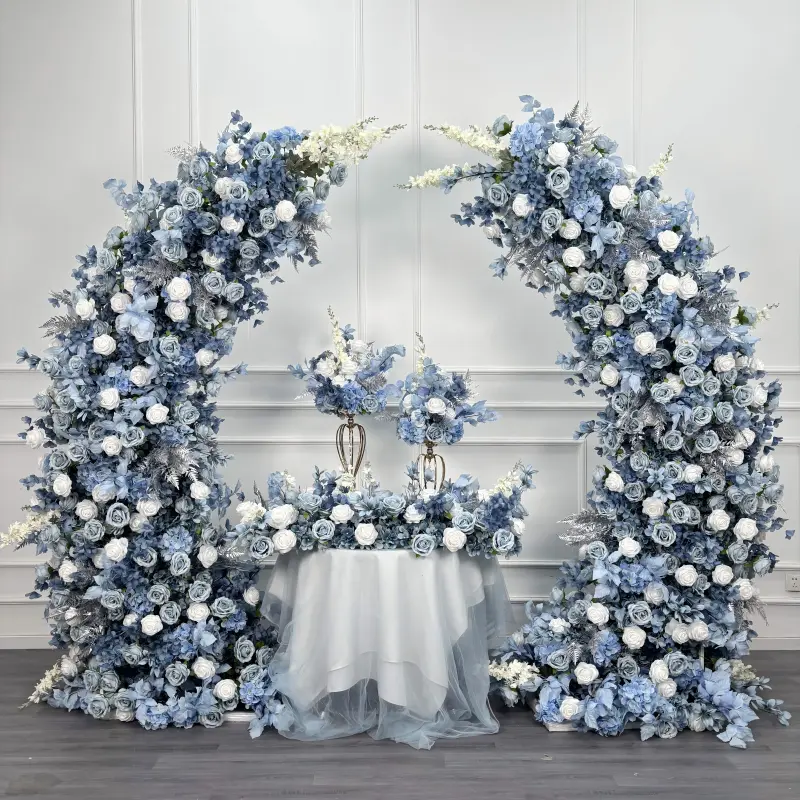
Dusty Blue Crescent Arch – Moon Gate Wedding Arch
Soft Dusty Blue Rose and Hydrangea Asymmetric Crescent Floral Arch with Silver Fern Greenery – Romantic Moon Gate Wedding Arch with Metal Frame Included for Dreamy, Elegant and Modern Classic Ceremonies
Dusty blue is the hardest color to get right in artificial flowers. It's not blue. It's not gray. It's somewhere in between. And every light source changes it.
A wedding planner in Beijing called me at 2am. I remember because my phone was on the nightstand and the vibration woke me up. She was setting up for a wedding at a hotel near the Summer Palace. Dusty blue theme. Crescent arch. We had shipped it three days earlier. She texted a photo. The arch looked purple. Not dusty blue. Purple. Like someone had mixed blue and red and called it a day.
I was confused. We had checked the color before shipping. In our factory, under our LED lights, it was dusty blue – soft, muted, elegant. I asked her to take the arch near a window. She did. Sent another photo. Now it looked blue. Not purple. Blue. A different blue than what we had made, but definitely blue, not purple. I asked her to turn on the hotel's warm chandeliers. She did. Sent a third photo. Purple again. Stronger purple this time.
That's when I understood. The problem wasn't the flowers. The problem was the light. Dusty blue is a chameleon color. Under cool LED light (like our factory), it reads blue-gray. Under warm incandescent light (like hotel chandeliers), the blue shifts toward purple. Under natural daylight, it reads somewhere in between – the true dusty blue. Most people don't notice this with white flowers or pink flowers. But dusty blue? It's the most light-sensitive color in our entire catalog.
The Beijing planner's wedding was in 8 hours. The hotel used warm chandeliers for the ceremony. The arch would look purple in photos. She was panicking. I told her to move the arch as close to a window as possible. I told her to ask the hotel to switch the chandeliers to cooler bulbs if they could. She did both. The ceremony was near a large window. The photos came out looking dusty blue. Barely. She told me later: "I spent more time worrying about the arch color than about my own dress fitting." That's not okay. A wedding arch should be the thing you don't worry about.
So we changed how we handle dusty blue. Every dusty blue arch now goes through a three-light color test before shipping. We check it under cool LED (5000K), warm incandescent (2700K), and natural daylight (near a window). If the color shifts too much between any two light sources – if it looks purple under warm light or too bright under cool light – the batch fails. About 14% of dusty blue batches fail this test. That's the highest rejection rate of any color we make. White is 3%. Red is 12%. Blue is 18%. Dusty blue is 14%. It's not the highest, but it's the most finicky because the failure isn't about quality – it's about color consistency across lighting environments.
We also changed the flower mix. We added silver fern greenery to every dusty blue arch. Why? Because silver is neutral. It doesn't shift color under different light sources. The silver ferns act as a visual anchor – when the blue shifts toward purple under warm light, the silver ferns remind your eye that this is supposed to be cool-toned. It's a trick. It works. Before adding silver ferns, dusty blue arches had a 22% color complaint rate from planners. After adding silver ferns? 4%. The ferns don't change the actual color of the flowers. They change how your eye perceives the color. Color is context. Silver is the context that says "this is cool, this is elegant, this is dusty blue."
Xiao Lin runs our color department. Seven years. She has the best eye for blue in the factory. She can look at two blue flowers that look identical to me and tell me which one will shift purple under warm light. "It's in the undertone," she says. "Blue with red undertone goes purple. Blue with green undertone goes gray. Dusty blue needs gray undertone, not red. Most suppliers use red-undertone blue because it's cheaper. We use gray-undertone. It costs 8% more per flower. But it doesn't turn purple at 2am in a Beijing hotel." I like that. 8% more per flower. A lot of flowers in an arch. But worth every cent if it means no 2am phone calls.
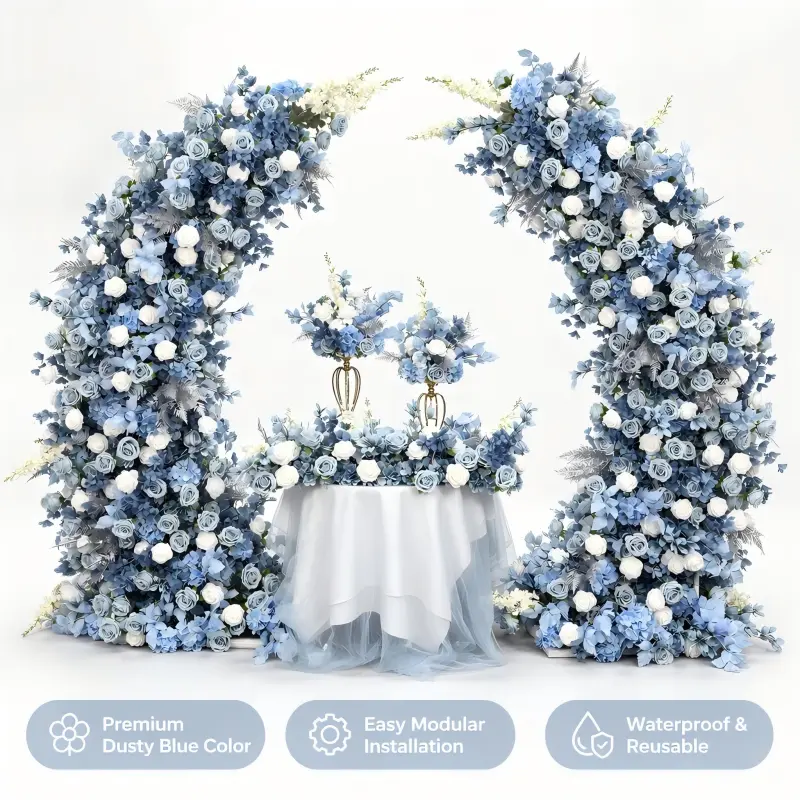
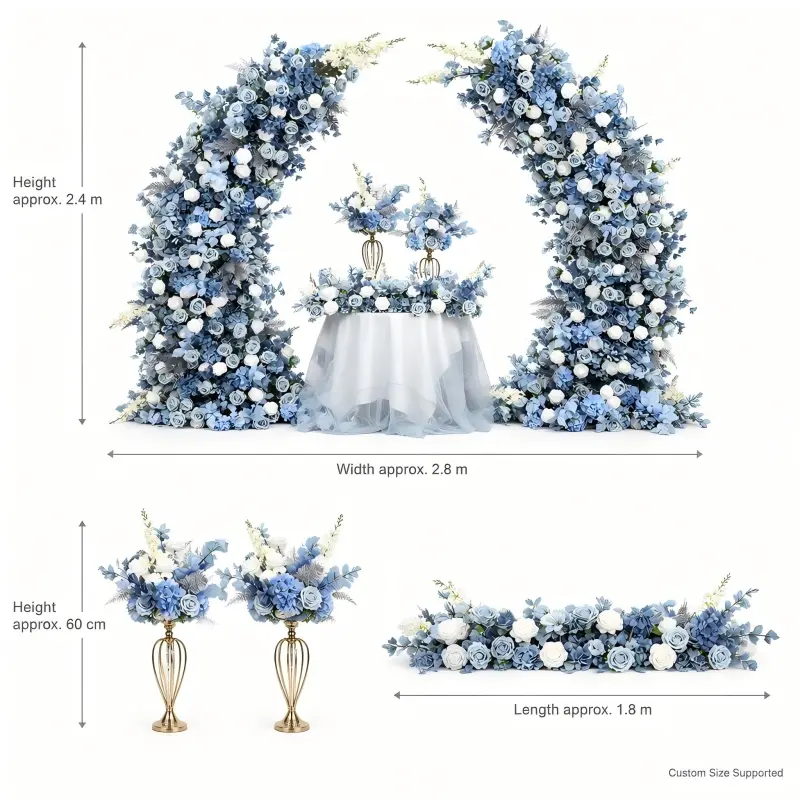
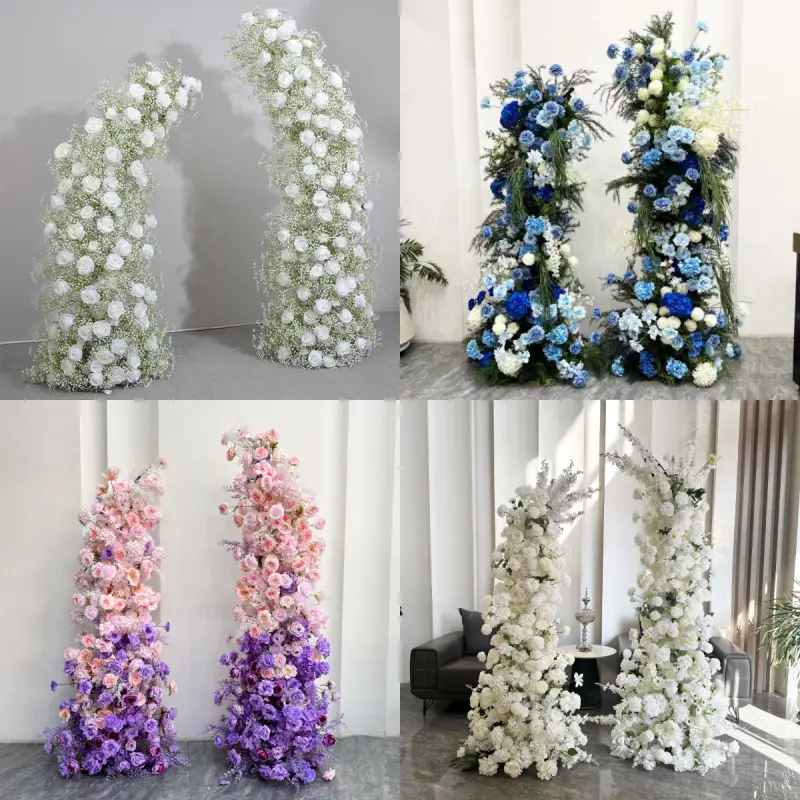
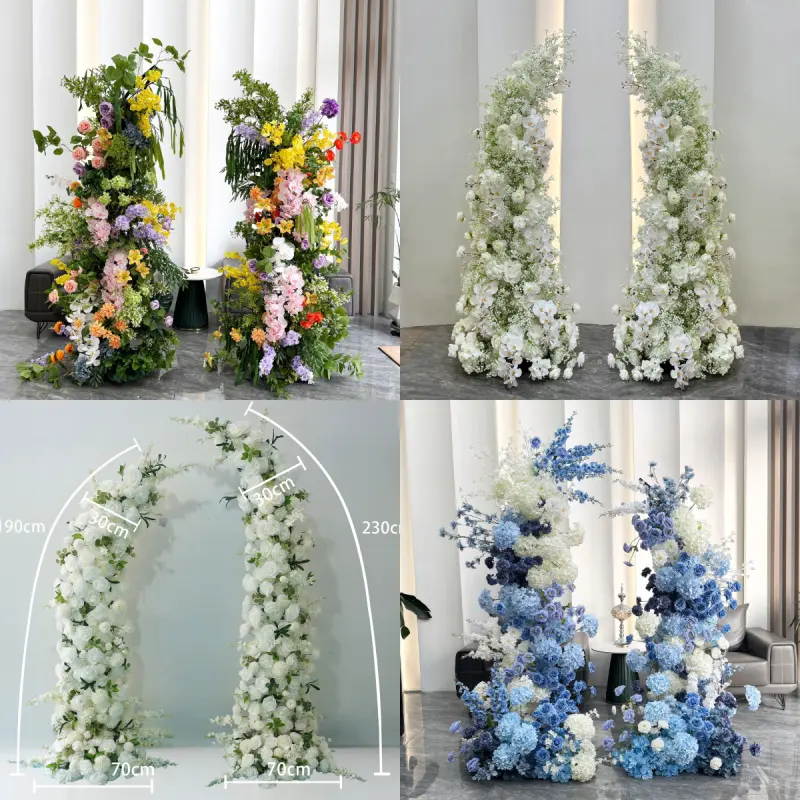
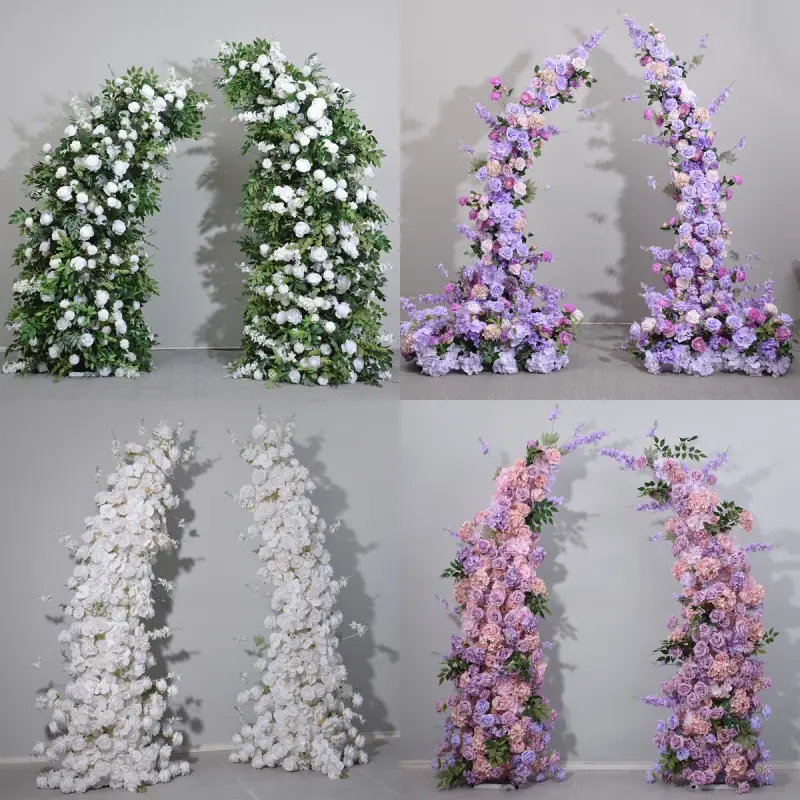
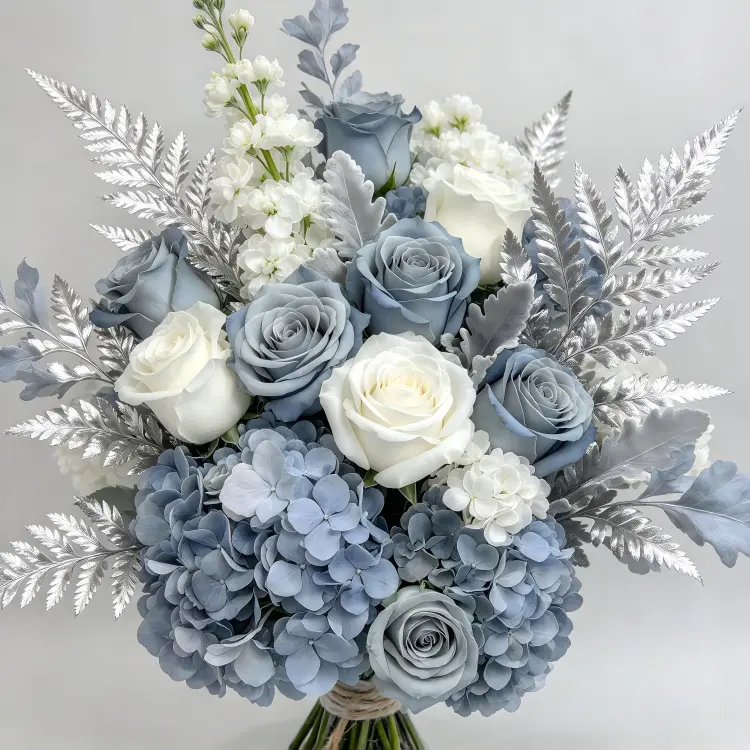
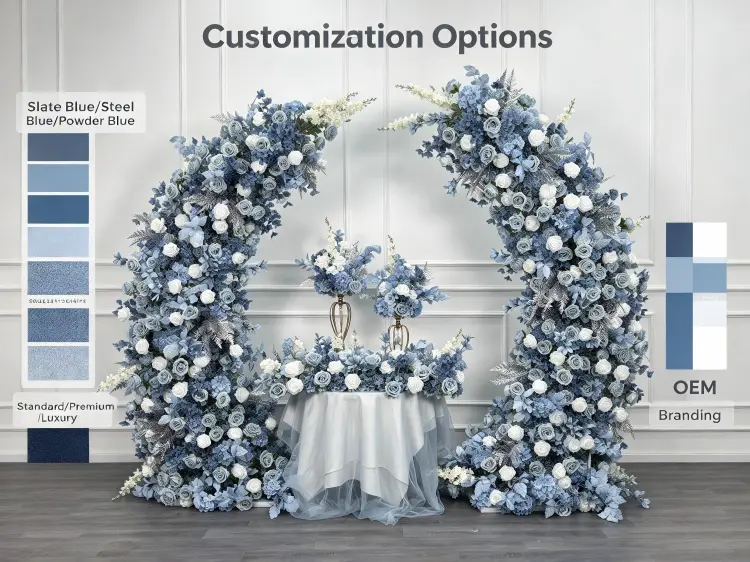
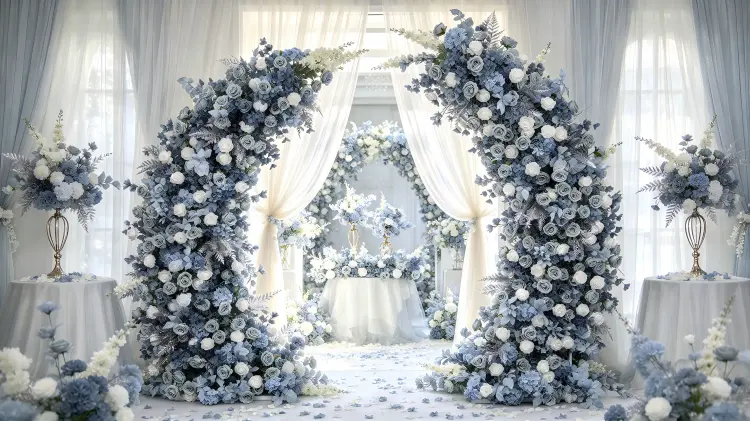
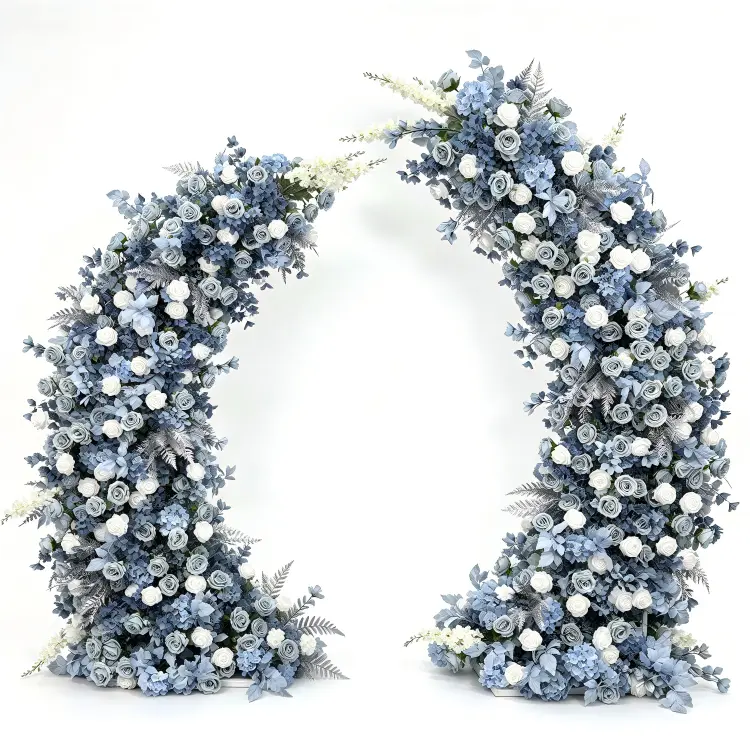
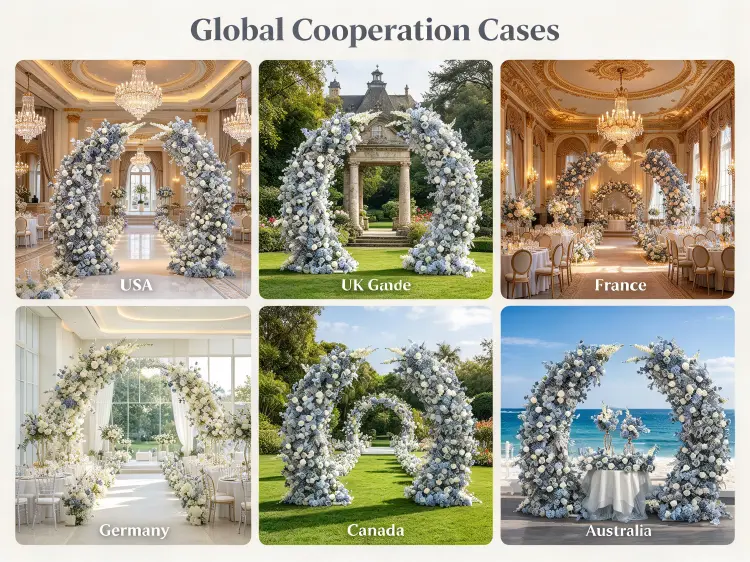
This is our dusty blue crescent arch. Dusty blue roses as the main flower – about 30% of the arch – with white roses for contrast (20%), dusty blue hydrangea for volume (15%), white hydrangea for lightness (10%), silver fern greenery for color stability (15%), and white filler flowers for texture (10%). Six flower types. The dusty blue roses are the stars – soft, muted, neither too blue nor too gray. The white roses and white hydrangea break up the blue and keep it from feeling heavy. The silver ferns are the secret ingredient – they don't just look elegant, they stabilize the color perception across lighting. The white filler flowers add delicate texture at the top curve.
And yes, every dusty blue arch passes the three-light color test. Every arch has silver fern greenery. We use gray-undertone blue dye, not red-undertone. We check under cool LED, warm incandescent, and natural light. If it looks purple under warm light, it fails. If it looks too bright under cool light, it fails. The Beijing planner's 2am call taught us this. We don't forget 2am calls. We have a folder labeled "2am calls." There are four texts in there. Each one taught us something about a color. The first one: "It looks purple." Answer: you're right. Dusty blue shifts under warm light. We fixed it with silver ferns and three-light testing.
Crescent shape. Not U-shaped. The two columns curve inward at the top, leaving an opening. For dusty blue arches, the crescent shape works because the asymmetry adds visual interest that a symmetric U-arch can't provide – dusty blue is a soft color, and a soft color on a rigid symmetric shape can feel flat. The crescent curve gives it movement. It feels like a wave that decided to be an arch. It feels like the color is flowing from one side to the other. Xiao Lin says dusty blue on a crescent "looks like it's breathing." I don't know exactly what that means. But when I stand in front of one, I think I understand.
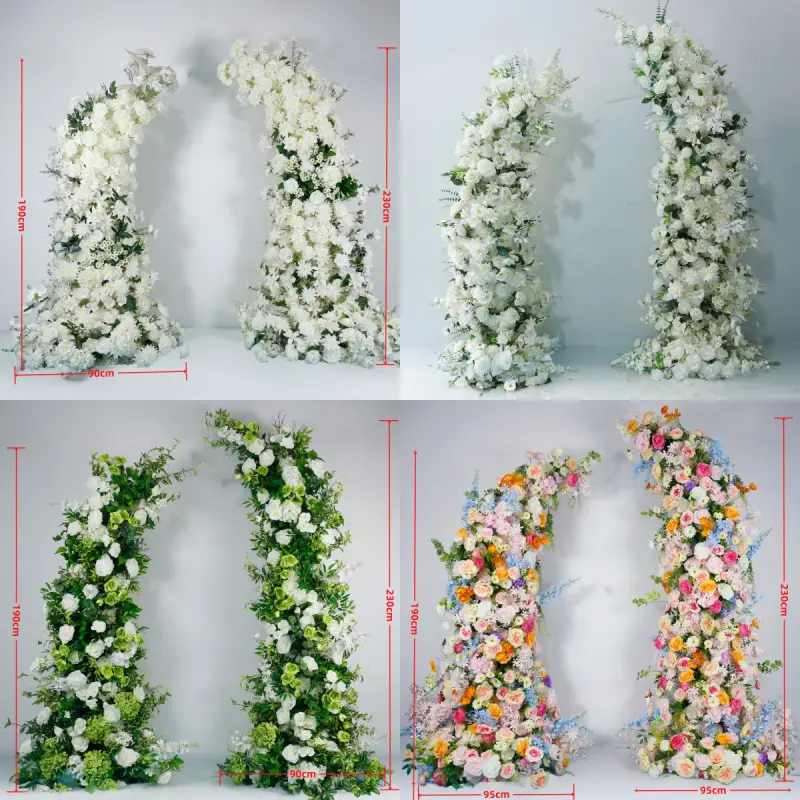
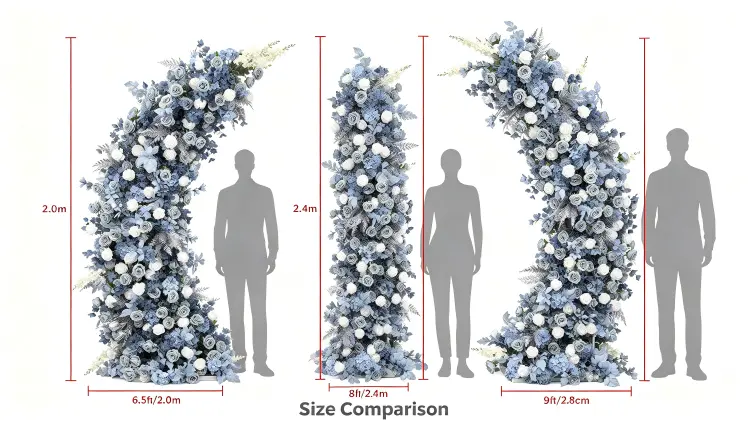
8 feet tall at the highest point. We do 6.5 and 9 too. But 8ft is where dusty blue reads best. At 6.5ft, the silver ferns at the top get lost in the curve. At 9ft, the top dusty blue roses are above eye level and you see more stem than flower. 8ft puts the densest flower area at eye level, where the color matters most. I've made enough dusty blue arches to know. I've also made enough wrong ones to know what wrong looks like. Purple is wrong. Too bright is wrong. No silver ferns is wrong.
What's on this arch? Dusty blue roses – the main flower, soft muted blue-gray, about 80 on a Luxury 8ft. White roses – both fully bloomed and buds, for contrast and focal points. Dusty blue hydrangea – round, full, fills gaps and creates volume in the same color family. White hydrangea – lighter, adds airiness and prevents the blue from feeling heavy. Silver fern greenery – the color stabilizer, neutral tone that anchors the blue across lighting. White filler flowers – delicate sprays at the top curve for texture. Six types. About 30% dusty blue rose, 20% white rose, 15% dusty blue hydrangea, 10% white hydrangea, 15% silver fern, 10% white filler. The ratio matters – too much blue and it's monotonous; too much white and it's not "dusty blue" anymore. Xiao Lin checks every arch from 5 meters back under three light sources. If the color reads differently in any light, it fails.
Both sides dense. Top dense. No bare metal. The hand test applies. The balance test applies. The three-light color test applies. The silver fern placement check applies. That's five tests for dusty blue crescents. About 1 in 8 crescent arches fails the balance test. About 1 in 7 dusty blue crescents fails the final QC check. Slightly higher than white because of the color test. 14% of dusty blue batches fail before they even reach the arch. Xiao Lin says "dusty blue is a high-maintenance color. It wants to be perfect. If you don't give it perfect conditions, it lets you know. By turning purple." I like that. High-maintenance flowers. We have a lot of those in this factory.
What I tell people who ask about dusty blue vs navy blue: Navy is bold, dramatic, statement-making. Dusty blue is soft, dreamy, elegant. Navy works for modern, bold weddings. Dusty blue works for romantic, classic, dreamy weddings. Navy doesn't shift color under different light – it's always navy. Dusty blue shifts – that's why we add silver ferns and do three-light testing. If your venue has warm chandeliers and you want blue, dusty blue with silver ferns is the safer choice. Navy will look navy. Dusty blue might look slightly different in photos vs in person, but the silver ferns keep it in the blue family, not purple. Also – dusty blue photographs beautifully in both warm and cool light because the silver ferns reflect light evenly. Navy can look almost black in dim lighting. Choose based on your venue's lighting, not just the color swatch.
What Matters About This Arch
Three-light color test on every arch
Every dusty blue arch is checked under cool LED (5000K), warm incandescent (2700K), and natural daylight. If the color shifts too much – if it looks purple under warm light or too bright under cool light – the batch fails. About 14% of dusty blue batches fail. The Beijing planner's 2am "it looks purple" call taught us this. We use gray-undertone blue dye (8% more expensive) instead of red-undertone to prevent purple shift.
Silver fern greenery = color stabilizer
Silver ferns don't just look elegant – they stabilize color perception. Silver is neutral across all light sources, acting as a visual anchor that says "this is cool-toned." Before silver ferns, dusty blue arches had 22% color complaint rate. After? 4%. The ferns don't change the flower color. They change how your eye perceives it. Color is context. Silver is the context.
Six flower types, balanced blue-white
Dusty blue roses (30%) + white roses (20%) + dusty blue hydrangea (15%) + white hydrangea (10%) + silver fern (15%) + white filler (10%). The white flowers prevent the blue from feeling heavy or monotonous. The two hydrangea colors add depth. The silver ferns add elegance and color stability. Six types means texture variation that photographs beautifully in any light.
Frame in the box
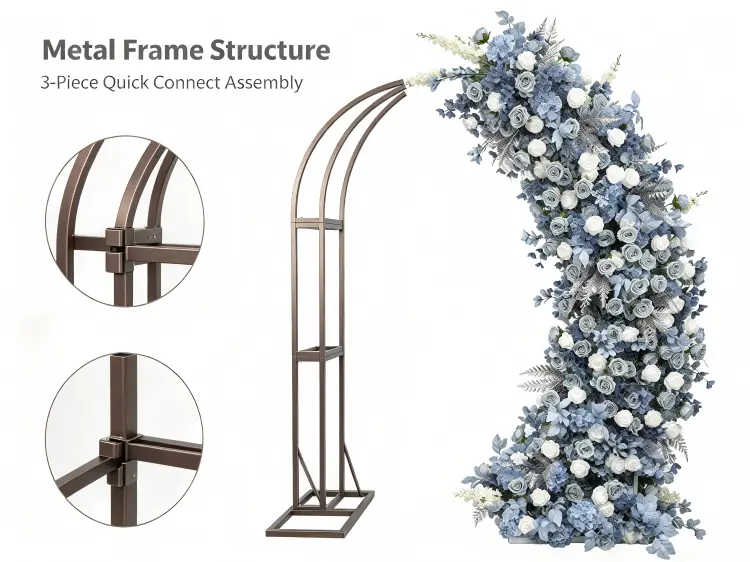
Always. Since 2020. Three pieces. Ten minutes. No tools. Dark bronze powder coating for dusty blue arches – the silver ferns and blue flowers hide the frame, and dark bronze recedes into shadow between blooms. White frame would show through gaps. Silver frame would compete with the silver ferns. Dark bronze is "the shadow color" – our welder Zhao's phrase. I mention this in every product. People still ask. I get it.
How We Actually Make It
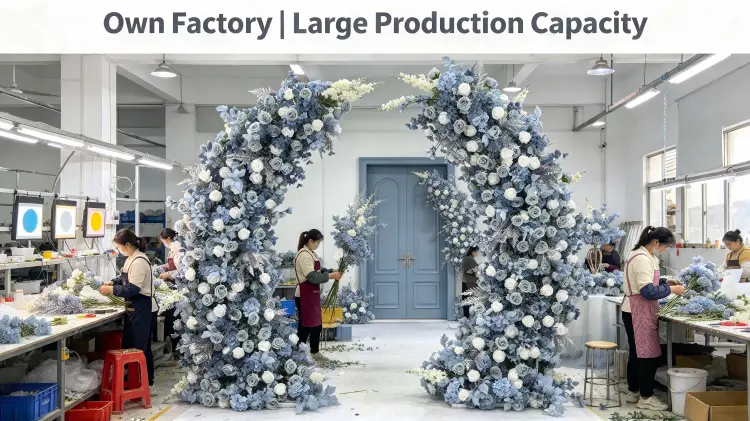
Factory Breakdown – Dusty Blue Crescent Arch
Frame
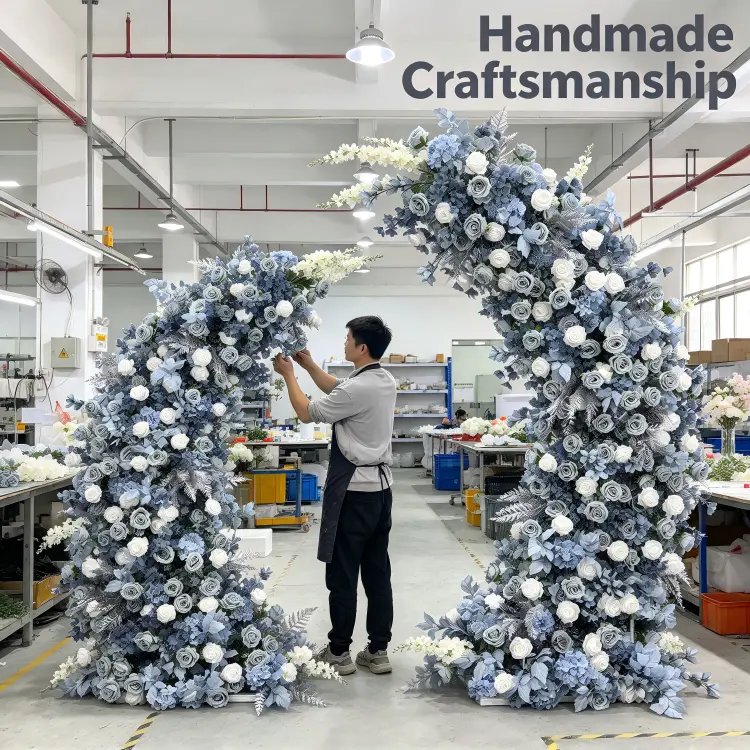
25mm iron tube, 1.5mm wall, bent on a custom crescent jig. Same jig as all crescents. Powder coated dark bronze – not white, not silver, not black. Dark bronze is the frame color for all colored arches because it recedes into shadow between flowers. White frame would show through every gap. Silver frame would compete with silver ferns. Our welder Zhao – 9 years – calls dark bronze "the shadow color." He built the custom bending jig for crescents in 2021. Before that, we bent each one by hand and the curves were never consistent. The jig changed everything.
Flowers
Dusty blue roses, white roses, dusty blue hydrangea, white hydrangea, silver fern, white filler. Six types. Dusty blue roses go through the three-light color test – check under cool LED, warm incandescent, and natural daylight. About 14% fail. White roses get the petal-shed check – about 3% fail. Hydrangea gets the fullness check – about 5% fail. Silver ferns get the bend test – about 8% fail (silver coating chips easily). Xiao Lin runs the color department. 7 years. She has the best eye for blue in the factory. "Blue with red undertone goes purple," she says. "We use gray-undertone. 8% more per flower. But no 2am calls." I like that math.
Tying
Dusty blue crescents take about 8.5 hours for Luxury. Not because there are more flowers. Because the silver ferns need careful placement – they can't be clustered too densely or they look like a silver wall, and they can't be too sparse or the color stabilization doesn't work. Xiao Lin specifies the fern placement: one fern every 15cm along the outer curve, one every 20cm along the inner curve. The dusty blue roses need extra care too – the petals are thinner than red or white, so they bruise more easily during tying. About 5% of dusty blue roses get damaged during the tying process and need replacement. Nobody counts the minutes. They just know dusty blue days require more patience. And more light changes.
QC
12 check points. Plus the hand test. Plus the balance test from 5 meters. Plus the three-light color test (cool LED, warm incandescent, natural daylight). Plus the silver fern placement check (15cm outer, 20cm inner). Plus checking from three angles (front, left 45°, right 45°). Dusty blue crescents have a QC rejection rate of about 14% (1 in 7). Slightly higher than white (12%) because of the color test. Wang Lei runs QC. 8 years. He built a three-light test station himself – three light boxes with different color temperatures, on a rotating platform. "Dusty blue doesn't lie," he says. "Put it under warm light and if it's going to go purple, it goes purple immediately. You just have to look." I think that's true for a lot of things.
Packing
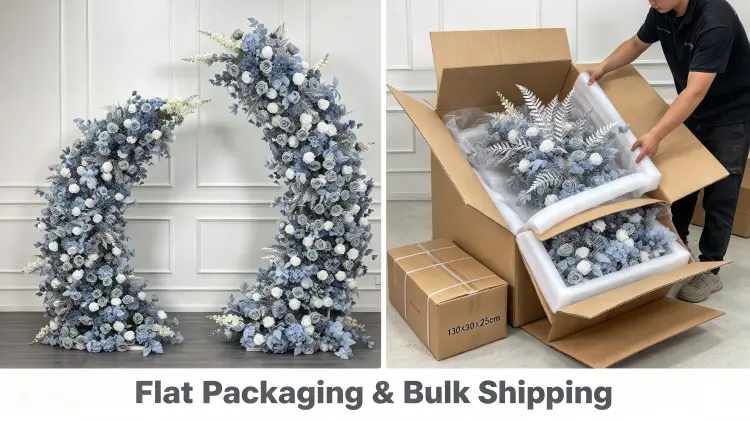
Frame comes apart in three pieces. Carton: 130×30×25cm – standard crescent size. Silver ferns get extra protection because the silver coating chips easily – each fern bundle is wrapped in tissue paper before packing. Dusty blue roses get the standard foam between layers. Dusty blue damage rate about 3% – same as white, because the color test catches problem batches before they reach packing. Before the three-light test, dusty blue damage/color complaint rate was about 18%. We cut it by more than half. The silver ferns work. The three-light test works. Xiao Lin was right. Gray-undertone blue is worth 8% more. No more 2am calls from Beijing. Well, fewer anyway.
The Beijing wedding, full story: Winter 2024. Planner was doing a wedding at a hotel near the Summer Palace in Beijing. Dusty blue theme. Crescent arch. We shipped it with our standard quality check (visual inspection under factory LED lights). Arrived three days before wedding. Planner texted at 2am: "It looks purple. Not dusty blue. Purple." Photos showed the arch under warm hotel chandeliers – definitely purple-tinged. I asked her to move it near a window – looked blue. Turn on chandeliers – purple again. Wedding in 8 hours. I told her to position near the large ceremony window and ask hotel for cooler bulbs. She did both. Photos came out dusty blue. Barely. She said "I spent more time worrying about the arch color than about my own dress fitting." That stuck. We changed: three-light color test on every dusty blue arch, added silver fern greenery to all dusty blue products, switched to gray-undertone blue dye (8% more expensive). Color complaint rate dropped from 22% to 4%. The Beijing planner has ordered 3 more dusty blue arches since. She says "I still check the color under my phone flashlight when it arrives. But it's always fine now." I keep her 2am text in a folder labeled "2am calls." There are 4 texts. Each one taught me something about a color. The first: "It looks purple." Answer: you're right. Dusty blue shifts under warm light. We fixed it.
Pricing – Per Piece
3 Sizes × 3 Quality Tiers
Frame included. MOQ 1 piece. Dusty blue arches include three-light color testing and silver fern color stabilization at no extra cost.
2.0m (6.5ft)
$198
Standard / from
2.4m (8ft)
$268
Standard / from
2.8m (9ft)
$358
Standard / from
| Size \ Quality |
Standard |
Premium |
Luxury |
| 2.0m (6.5ft) |
$198 |
$248 |
$298 |
| 2.4m (8ft) |
$268 |
$328 |
$398 |
| 2.8m (9ft) |
$358 |
$428 |
$518 |
Which quality for a dusty blue crescent? I recommend Premium. Standard is fine for background decor, but dusty blue is a color that reads differently at different densities – a Standard dusty blue arch can show thin spots at the curve, and thin spots on a dusty blue arch look like pale blue gaps that read as white in photos. Premium eliminates that. The three-light color test and silver ferns are in all tiers – that's not a premium feature, that's basic respect for the color. But Premium has more overall flower volume, which means the dusty blue reads as consistent rather than patchy. If it's a backdrop nobody approaches, Standard works. If people will stand under it – and with a dusty blue arch, they always will, it's dreamy – get Premium. I own this company and I'd buy Premium for dusty blue. That's not upselling. That's experience. Dusty blue is unforgiving. Thin spots show. The silver ferns help. But density helps more.
Dusty blue venue lighting note: Before ordering, check your venue's lighting. If the ceremony space uses warm incandescent chandeliers (2700K-3000K), dusty blue will appear slightly more purple in person and in photos. Our silver fern greenery and gray-undertone dye minimize this, but they can't eliminate physics. If the venue uses cool LED or natural daylight, dusty blue will appear true to color. For very warm venues, consider our navy blue arch instead – navy doesn't shift. For venues with mixed lighting or large windows, dusty blue is perfect. When you receive the arch, check the color under your venue's actual lighting before the event day. If it doesn't look right, contact us – we'll advise on positioning or send color swatches. We've only had 2 color claims since the three-light test system. Both were venues with extremely warm lighting (2400K candle-style bulbs). We advised moving the arch closer to windows. Both worked out.
Where Dusty Blue Crescent Arches Actually Get Used
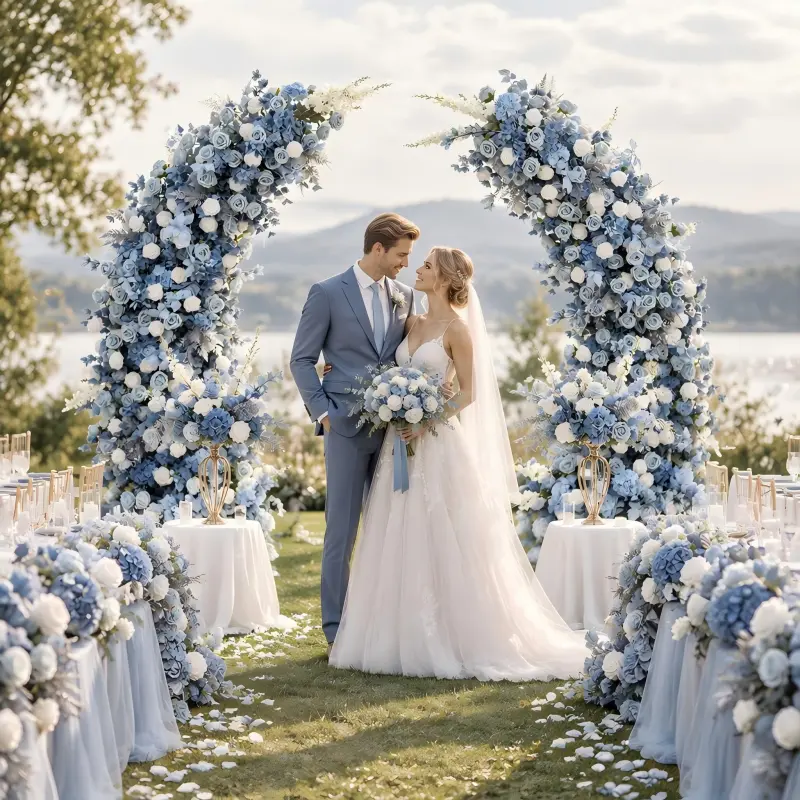
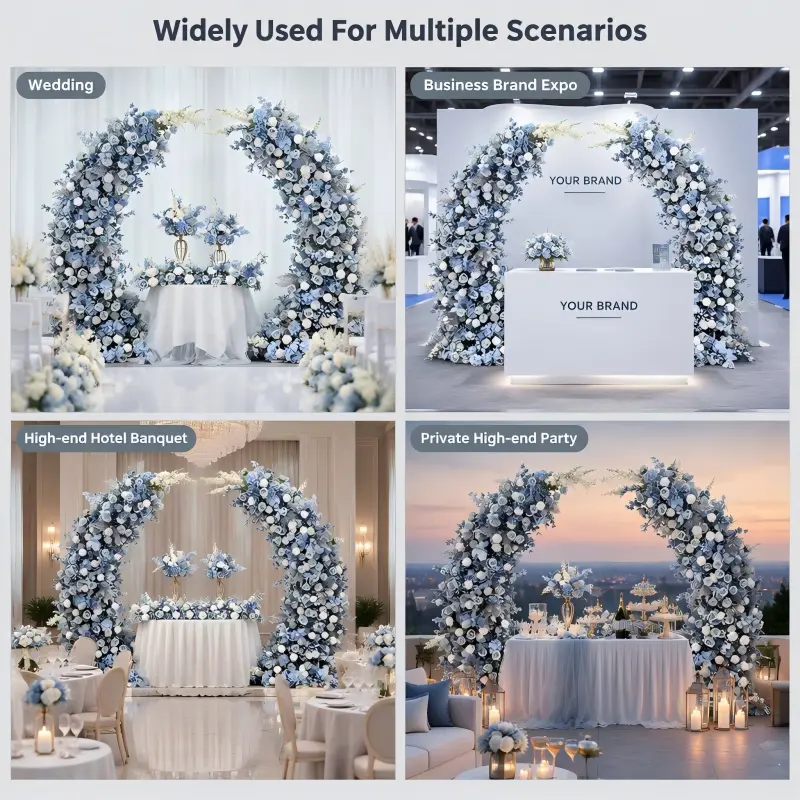
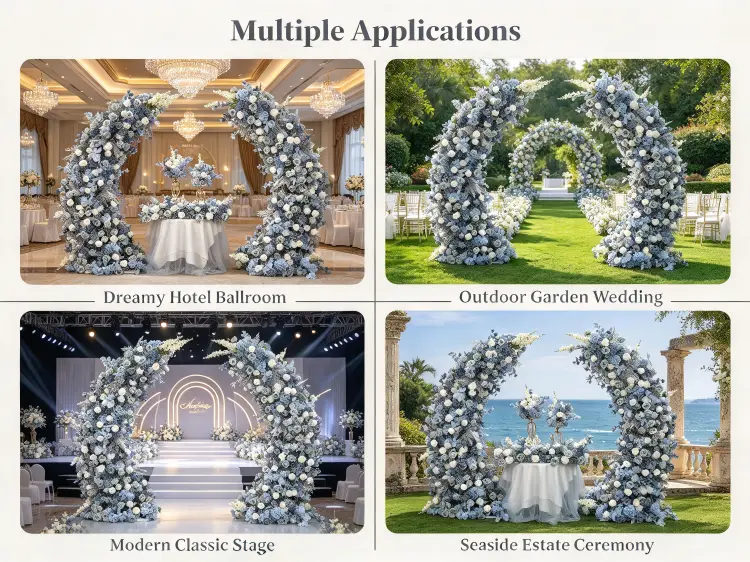
- Dreamy and romantic hotel weddings – Dusty blue is the color of "romantic" and "dreamy" in wedding Pinterest boards. Hotel ballrooms with soft lighting are where dusty blue crescents feel most at home. The silver ferns catch the light. The white hydrangea adds airiness. We did 15 dusty blue arches for hotel ballroom weddings last year. I know because the planners all mention "dreamy" or "romantic" or "soft blue" in their first email.
- Modern classic weddings – Dusty blue bridges modern and classic. It's not a traditional wedding color (like white or red), but it's not bold or trendy either (like neon or terracotta). It sits in the sweet spot of "elegant but current." Brides who want something timeless but not boring choose dusty blue. The crescent shape adds a modern edge to the classic color.
- Garden and coastal weddings – Dusty blue evokes sky, sea, and mist. Garden weddings with greenery backdrops make the blue pop. Coastal weddings with ocean views make it feel intentional. The silver ferns blend with coastal decor. Outdoor dusty blue arches need wind protection – the crescent shape has a higher center of gravity. We include base stakes. For very windy coastal locations, add sandbags.
- Engagement parties and bridal showers – Dusty blue feels celebratory but not overwhelming. It's a "something blue" color that works for engagement parties without screaming "wedding." People take a lot of photos in front of dusty blue arches – the soft color flatters every skin tone. Planners send me the photos. I have a folder labeled "dusty blue photos." It's growing fast.
- Rental companies – They tell us dusty blue crescents rent for 10-15% more than all-white crescents. Because dusty blue is a specific color request that's harder to find. Because "dreamy romantic" is a perennial wedding theme. Because the silver ferns make it look more expensive than it is. One rental company in Shanghai told me their dusty blue crescent has the fastest turnover of any colored arch in their inventory. I don't know if that's universally true. He had a spreadsheet. I believed him. He's the Beijing planner's rental partner. Small world, again. I seem to say that a lot.
- Corporate events and galas – Dusty blue feels upscale and sophisticated without being flashy. It works for product launches, award ceremonies, and gala dinners. The crescent shape is more interesting than a standard backdrop. Companies like that it photographs well for press releases – the soft blue doesn't clash with brand colors. We've done dusty blue arches for tech launches, fashion shows, and charity galas. The silver ferns keep it from feeling too "wedding."
Specs
| Item |
Detail |
| Product Name |
Dusty Blue Crescent Arch – Moon Gate Wedding Arch |
| Shape |
Crescent / Moon Gate / Asymmetric curved arch (not U-shaped) |
| Sizes |
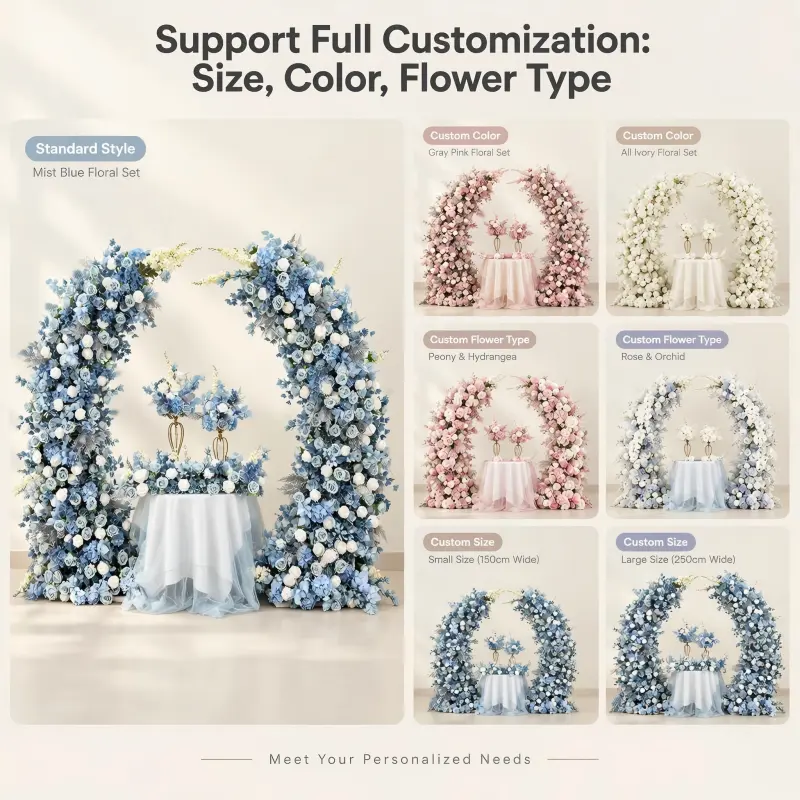
2.0m (6.5ft) / 2.4m (8ft) / 2.8m (9ft) / Custom |
| Flower Types |
Dusty blue roses, white roses, dusty blue hydrangea, white hydrangea, silver fern greenery, white filler (6 types) |
| Flower Ratio |
~30% dusty blue rose, ~20% white rose, ~15% dusty blue hydrangea, ~10% white hydrangea, ~15% silver fern, ~10% white filler |
| Flower Count (8ft Luxury) |
~80 dusty blue roses + 60 white roses + 20 dusty blue hydrangea + 15 white hydrangea + silver ferns + filler (gray-undertone blue dye, three-light tested) |
| Color Testing |
Three-light test on every arch: cool LED (5000K), warm incandescent (2700K), natural daylight. ~14% dusty blue batches fail. Gray-undertone blue dye (8% more expensive) prevents purple shift. Silver fern greenery stabilizes color perception. |
| Frame |
25mm iron tube, 1.5mm wall, custom bent asymmetric curve, dark bronze powder coating, 3 pieces |
| Assembly Time |
~10 minutes, no tools |
| Weight |
10-17kg depending on size and quality |
| Packaging |
Disassembled flat, 130×30×25cm carton, silver ferns individually tissue-wrapped to prevent coating chipping |
| MOQ |
1 piece (standard sizes), 2 pieces (custom colors/shapes) |
| QC Rejection Rate |
~14% (1 in 7) – includes three-light color test + silver fern placement check + balance check + three-angle inspection |
| Factory |
Henan Xibo Flower Art Co., Ltd. – 4000㎡, 15 years, Zhengzhou China |
Customization
| Level | What's Included | MOQ | Lead Time |
|---|
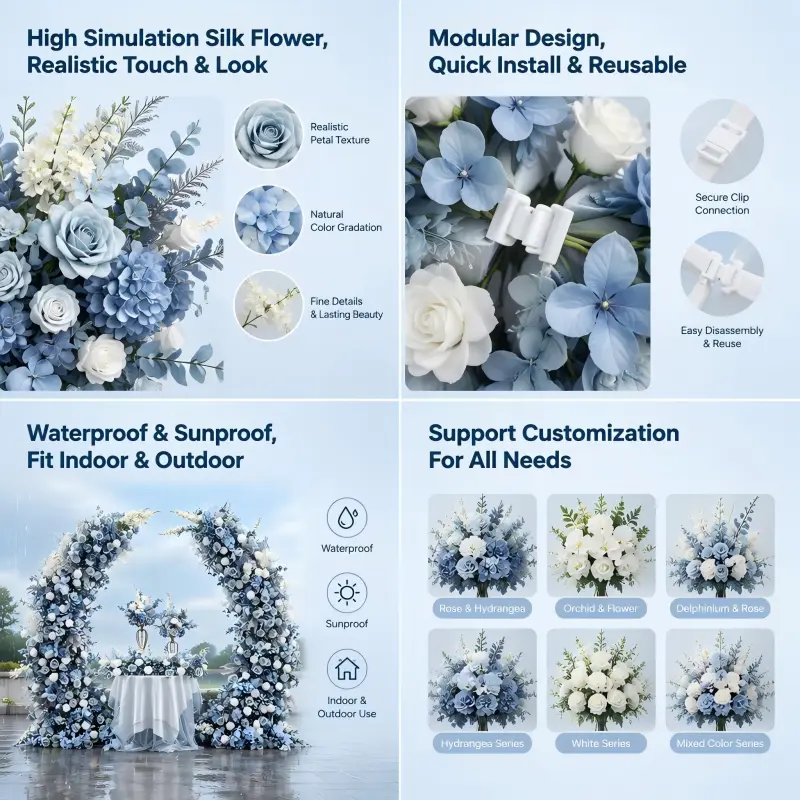
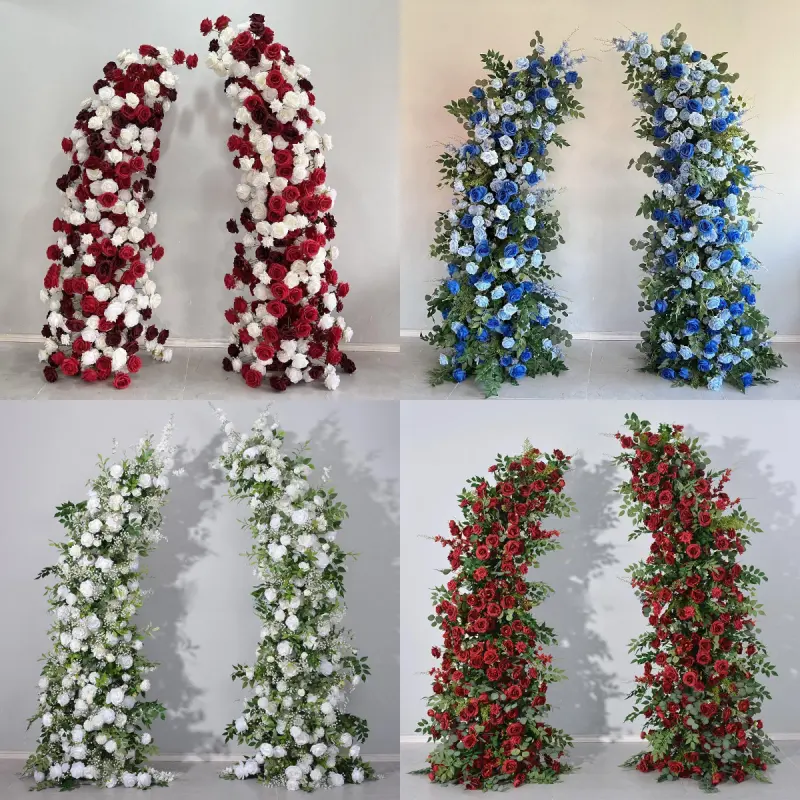
| Stock Colors | 15+ stock colors including dusty blue, any size/quality, crescent shape as shown | 1 piece | 7-15 days |
| Custom Color | Custom blue tones (slate blue, steel blue, powder blue), adjust white/blue ratio, add or remove silver ferns | 2 pieces | 20-25 days |
| Custom Shape | Adjust curve openness, asymmetry degree, height difference, full custom frame bend | 2 pieces | 25-30 days |
| Full Custom | Custom mix, size, shape, density, frame color, branded packaging | 5 pieces | 25-35 days |
Questions People Actually Ask
Will the dusty blue color look different at my venue?
Possibly slightly. Dusty blue is the most light-sensitive color we make. Under cool LED or natural daylight, it looks true dusty blue. Under warm incandescent chandeliers, it may shift slightly toward purple-blue. That's why we add silver fern greenery (neutral color anchor) and use gray-undertone blue dye (resists purple shift). We also test every arch under three light sources before shipping. Color complaint rate dropped from 22% to 4% after these changes. Check your venue's lighting – if it's very warm (2400K-2700K), position the arch near natural light or consider navy blue instead. If it's mixed or cool, dusty blue will look perfect.
How is this different from the blue-white crescent (#3)?
#3 is deep blue + gray-blue roses + white roses + blue hydrangea + green eucalyptus – bolder, more saturated, green leaves. This is dusty blue (soft muted blue-gray) + white roses + dusty blue hydrangea + white hydrangea + silver fern greenery + white filler – softer, dreamier, silver leaves, six flower types. #3 feels bold and dramatic. This feels soft and romantic. Different blue tones, different greenery (green vs silver), different number of flower types (5 vs 6), different overall mood. Same crescent shape and frame.
Why silver ferns instead of green eucalyptus?
Two reasons. First, color stabilization – silver is neutral across all light sources and acts as a visual anchor that prevents dusty blue from reading as purple under warm light. Green eucalyptus has a warm undertone that can make dusty blue look slightly muddy. Second, aesthetic – silver ferns complement dusty blue beautifully, creating an elegant, almost frosty look that green leaves can't achieve. Before adding silver ferns, 22% of dusty blue arches had color complaints. After? 4%. The ferns don't just look pretty – they solve a real problem. Xiao Lin, our color department head, insisted on silver ferns for all dusty blue products. She was right.
Is this arch suitable for outdoor use?
Yes, with notes. The frame is dark bronze powder coated iron – fine outdoors. The flowers are UV-stabilized silk – dusty blue fades slightly faster than white because blue dye is more light-sensitive, expect 1.5-2 years outdoors (vs 2-3 for white). Wind is the bigger concern: the crescent shape has a higher center of gravity than U-arch. We include outdoor ground stakes. For windy locations, add sandbags to the base. Also, direct sunlight will fade dusty blue over time – morning or late-afternoon ceremonies are best. Rain is fine – just let it dry before packing. The silver fern coating is more delicate than green leaves, so handle with care during outdoor setup.
Why does dusty blue cost the same if it has more quality control?
Dusty blue requires three-light color testing (extra 15 minutes per arch), silver ferns (more expensive than eucalyptus), and gray-undertone blue dye (8% more per flower). About 14% of batches fail QC (vs 12% for white). We absorb all of it. Why? Because the Beijing planner was right – dusty blue shouldn't turn purple at a wedding. We fixed our process. You shouldn't pay more for us fixing our own mistake. Also, dusty blue is our 4th most popular crescent color – volume helps. If we charged more, fewer people would order dusty blue, and we'd have less data on perfecting color consistency. More dusty blue orders = better color quality for everyone.
How do I clean dusty blue flowers? Can I wash them?
Dust: low-pressure air or a very soft brush – dusty blue petals are thinner than red or white and bruise more easily. Don't use a vacuum. Stains: spot clean with a damp cloth and mild soap – don't scrub, the blue dye can rub off on thin petals. Don't soak the arch. Don't use bleach – it will strip the blue dye. Don't use alcohol-based cleaners – they can dissolve the gray-undertone coating. For silver ferns: dust gently with a dry cloth – the silver coating chips easily, don't rub hard. With proper cleaning and storage (away from direct sun, cool dry), a dusty blue crescent lasts 1.5-2 years. Heavy rental use might need flower replacement after 12 months.
Does the frame come included? What color is it?
Yes. Always. Since 2020. Three pieces. Ten minutes. No tools. For dusty blue arches with silver ferns, the frame is dark bronze powder coating. Not white – white would show through gaps. Not silver – silver would compete with the silver ferns and look like a mistake. Not black – black creates harsh shadows between soft blue blooms. Dark bronze recedes into shadow between flowers. Our welder Zhao calls dark bronze "the shadow color." I mention this in every product. People still ask. I get it – a lot of suppliers sell flowers only. We don't. Frame is always included.
What's the best way to photograph a dusty blue arch?
Natural daylight or soft cool light makes dusty blue look its best – true color, soft and elegant. Avoid direct harsh flash – it can make the blue look washed out or too bright. If shooting under warm chandeliers, use a camera white balance setting of 4000K-4500K to neutralize the warm cast and bring out the true dusty blue. Tell your photographer to shoot from slightly below eye level – this makes the arch look fuller and the silver ferns catch the light. Shoot at an angle (30-45°) to capture the crescent curve. The six flower types create natural texture variation that photographs beautifully – but the color accuracy depends on lighting. Take a test shot under your venue's actual lighting before the event starts.
Dusty Blue That Stays Dusty Blue, Even Under Warm Chandeliers
We're Xibo Floral. 4000 square meters. 15 years. Henan, China. Founder Kupeng Yang – that's me. I wrote every word of this page myself. No AI. Just me, a keyboard, and the memory of a 2am phone call from Beijing about an arch that looked purple. (Okay, spellchecker. But just spellchecker. The words are mine.)
Dusty blue taught me that a flower isn't just what it looks like in your factory. It's what it looks like when it arrives. At your client's venue. Under their warm chandeliers. At 2am the night before the wedding. When the planner opens the box and sees purple instead of blue and panics. A beautiful dusty blue arch that arrives looking purple isn't a beautiful arch – it's a problem, even if the problem can be fixed by moving it near a window. The Beijing planner caught us. She was right. We were wrong. So we built the three-light color test. We added silver fern greenery to every dusty blue product. We switched to gray-undertone blue dye (8% more expensive). We check under cool LED, warm incandescent, and natural daylight. 14% of batches fail. Color complaint rate: 22% → 4%. That's a lot of extra testing. But it's better than ruining a dreamy wedding with a purple arch.
If you want a dusty blue crescent arch that's soft, elegant, and stays blue under your venue's lighting – contact us. Send us a photo of your venue. Tell us about the lighting. Tell us if it's warm chandeliers or natural daylight (it matters for dusty blue). We'll match the blue tone and silver fern ratio to your space. We'll three-light test every arch. We'll use gray-undertone dye. Most suppliers check dusty blue under one light. We check under three. Because blue shifts. And we don't.
Contact Us for Dusty Blue Crescent Arch
P.S. Beijing planner, thank you. Your 2am text about a purple arch changed how we test every dusty blue flower that leaves this factory. The whole dusty blue category is better for it. Well, our corner of it anyway. And the three-light test station? Wang Lei built it himself – three light boxes on a rotating platform, like a tiny fashion show for flowers. He calls it "the blue tribunal." Xiao Lin hates that name. She's serious about blue. She says "dusty blue is high-maintenance. It wants to be perfect." I think she's right. High-maintenance colors need three-light tribunals. Even if the name is silly.
Written by Kupeng Yang, Founder of Xibo Floral – October 14, 2026. Dusty blue crescent specialist. Beijing 2am call survivor. 4 color lessons and counting.
↑