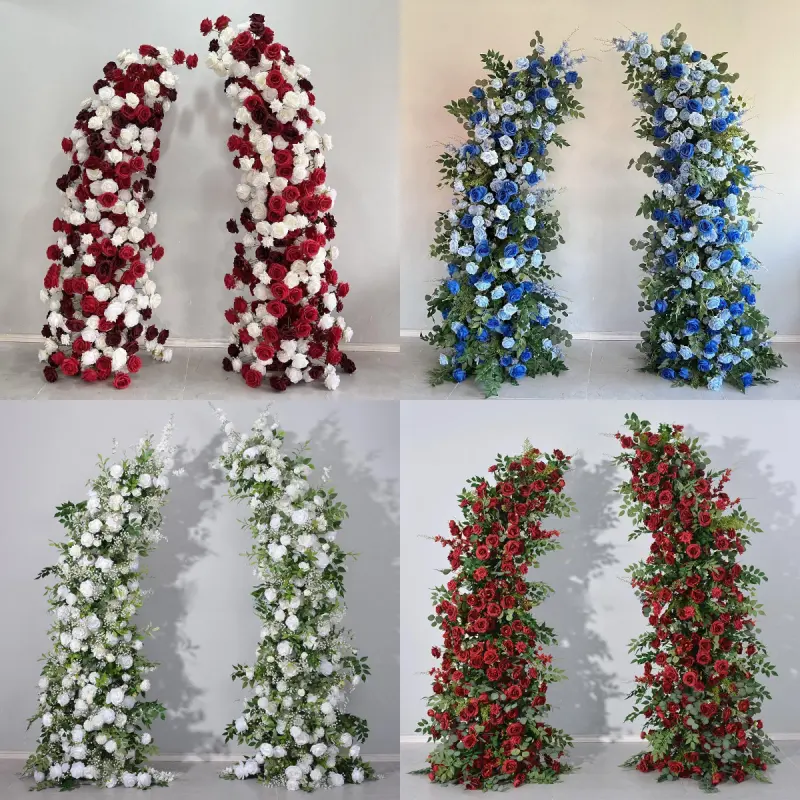
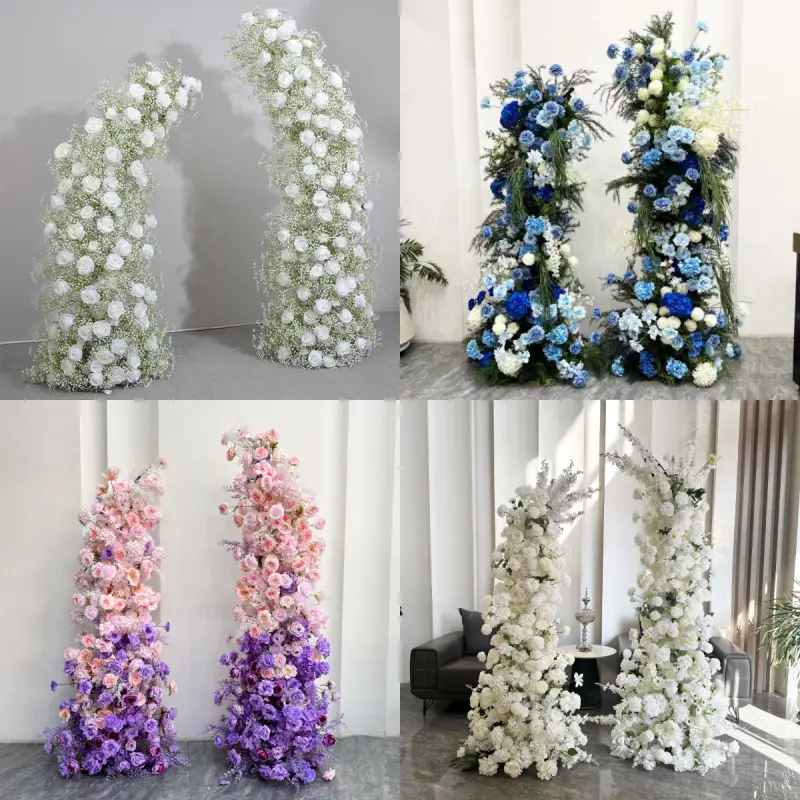
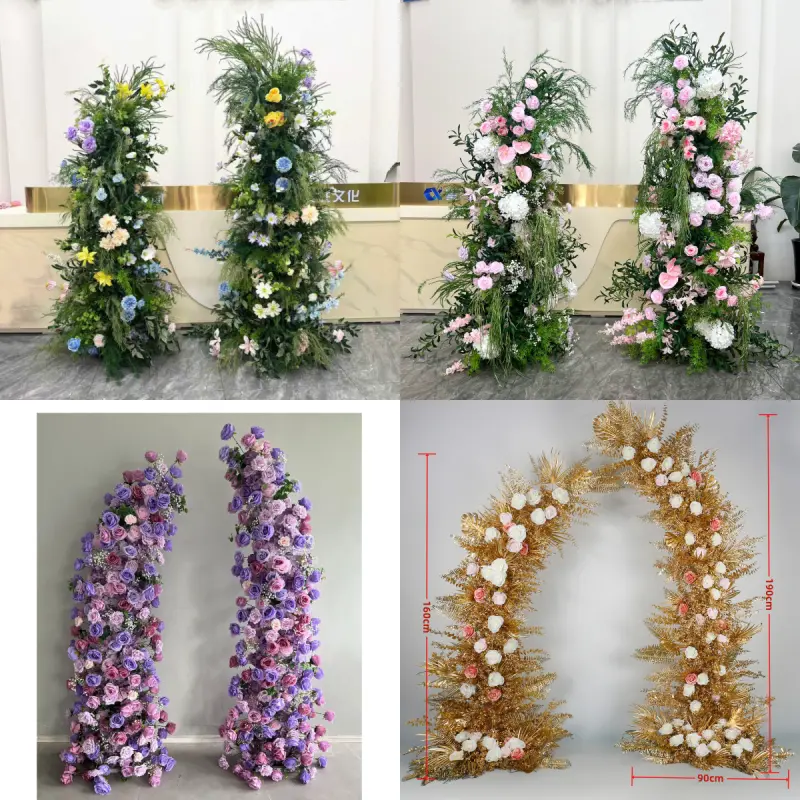
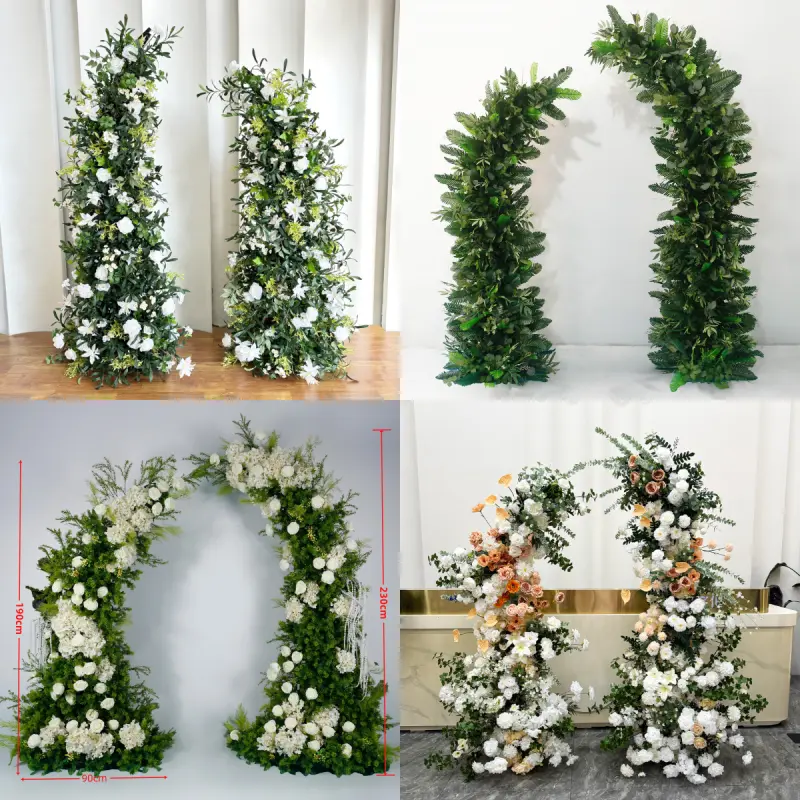
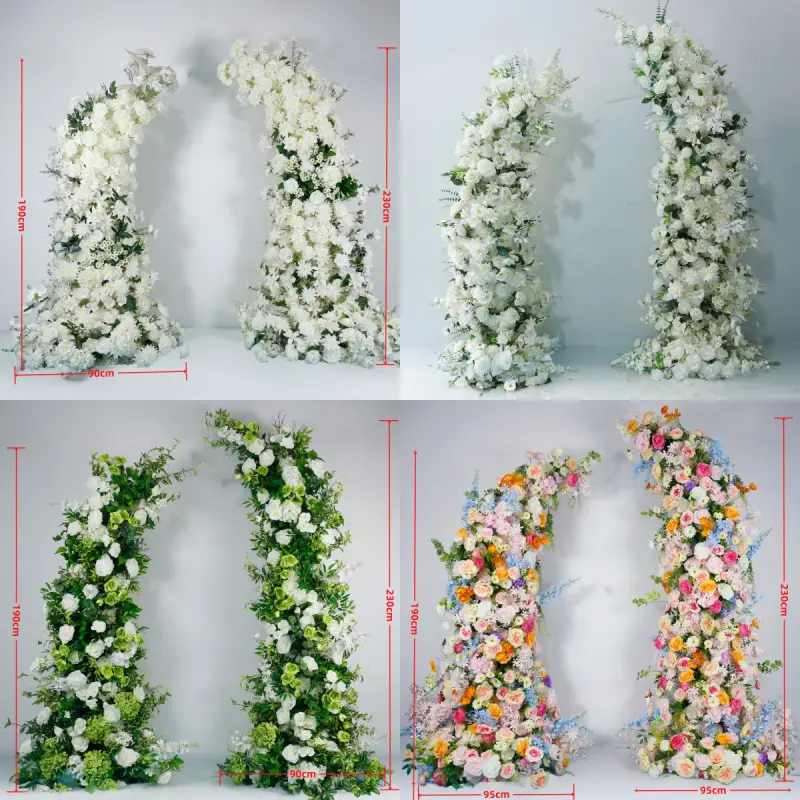
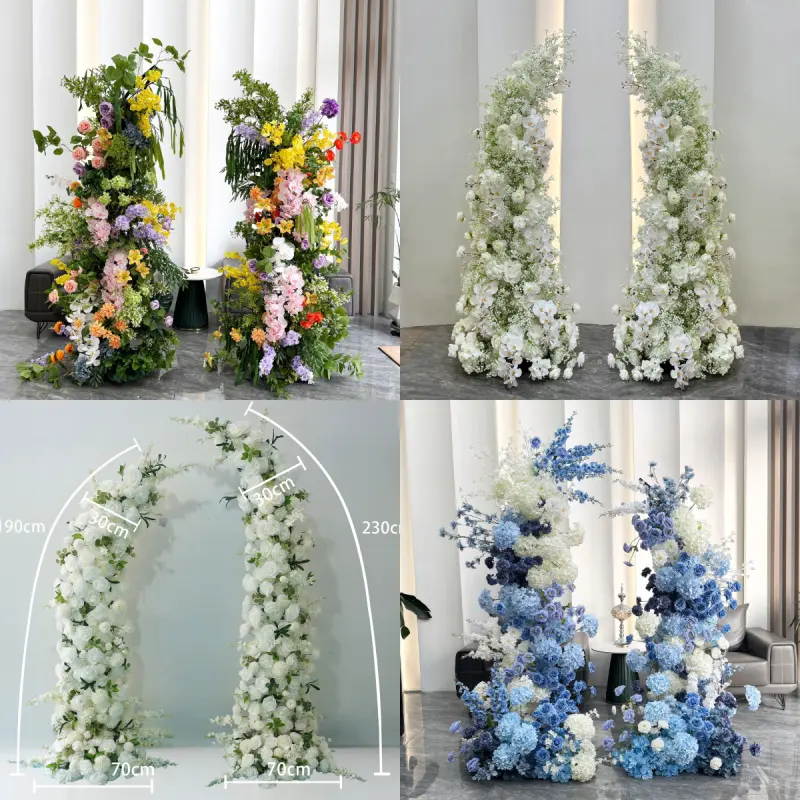
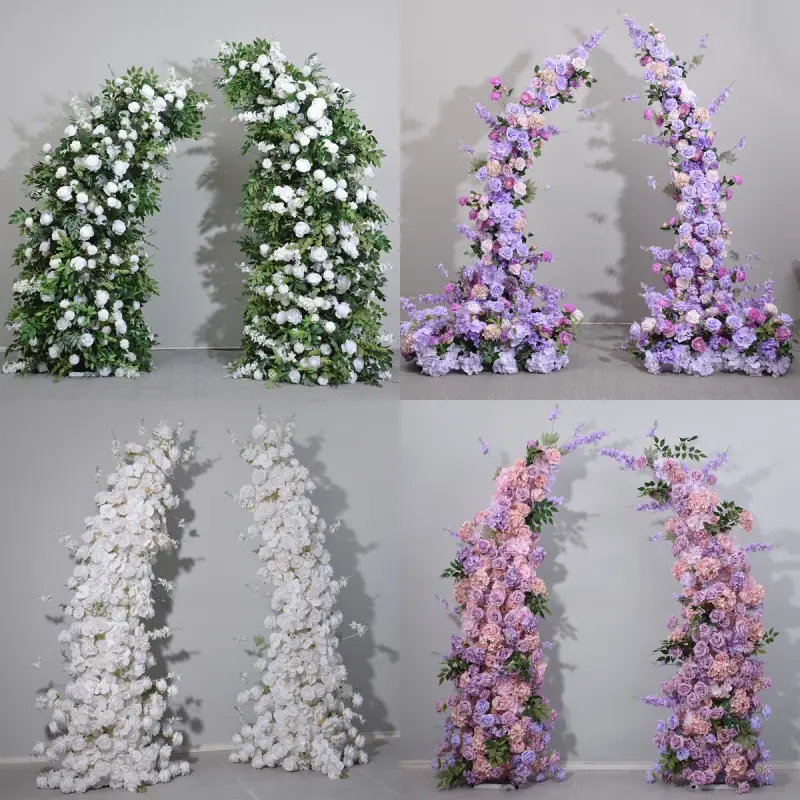
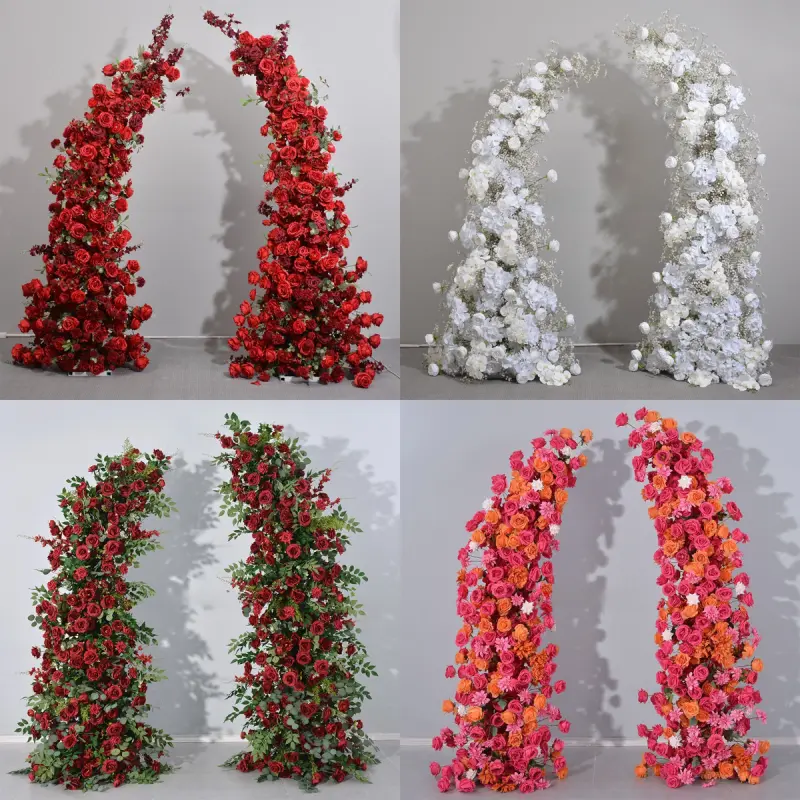
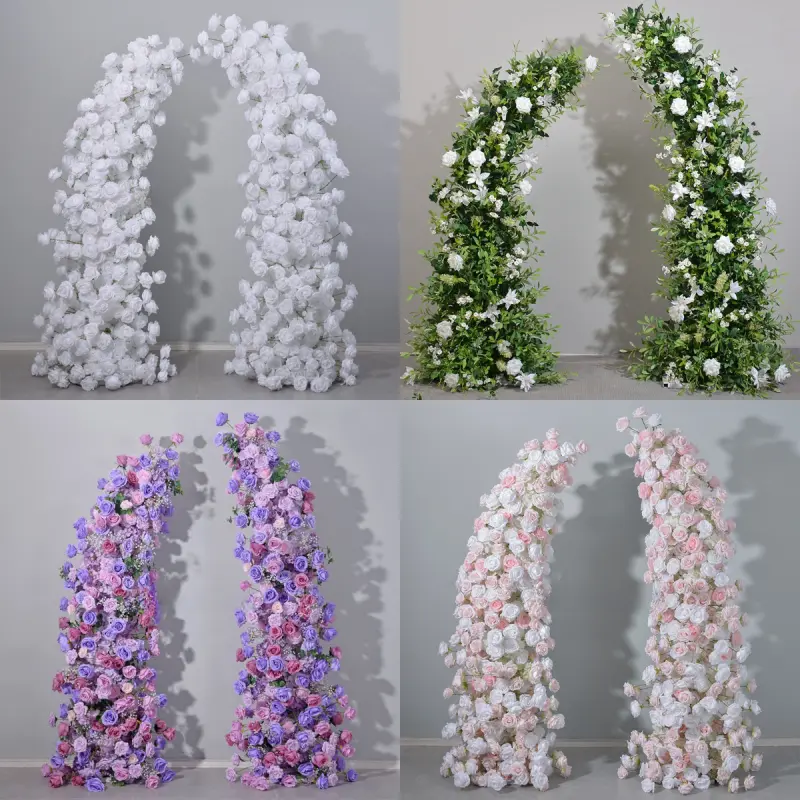
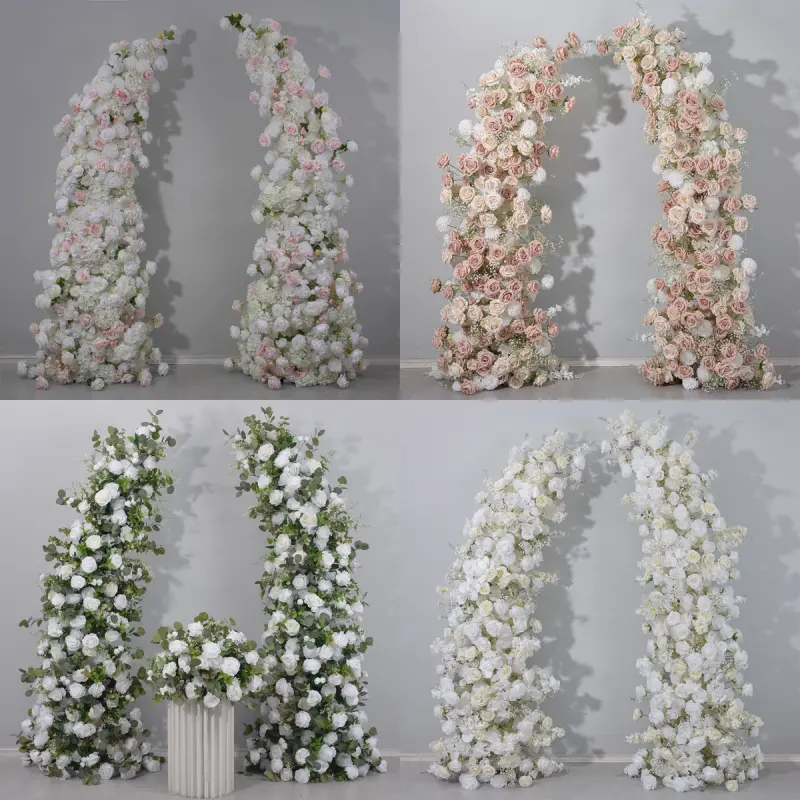
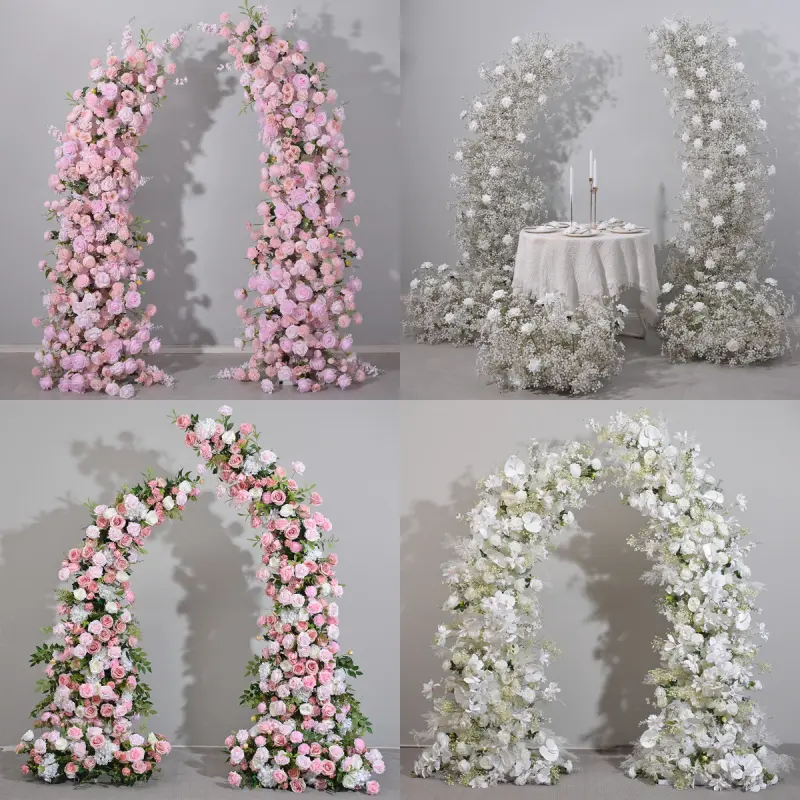
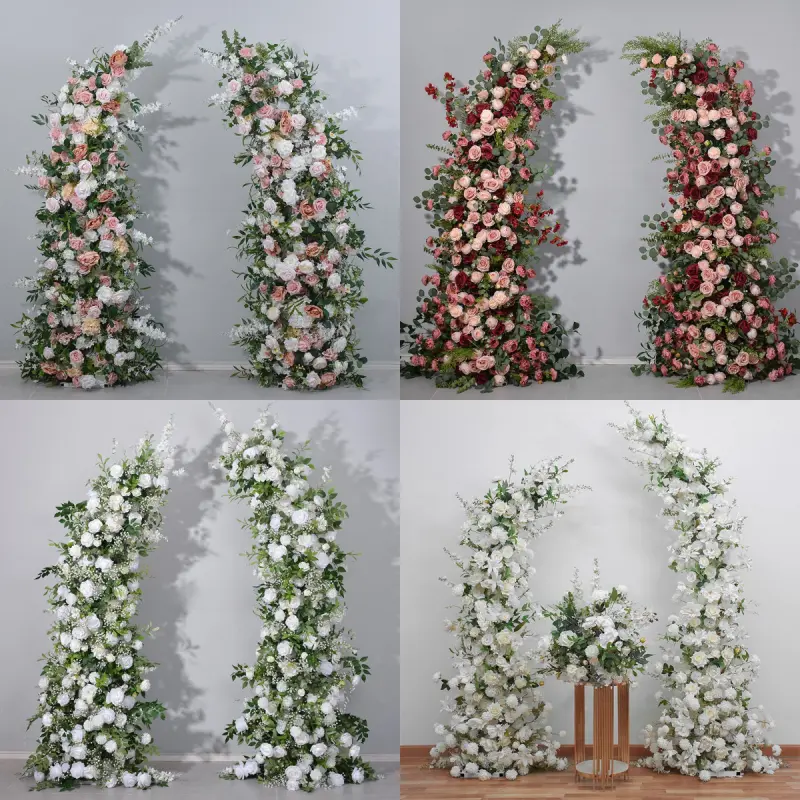
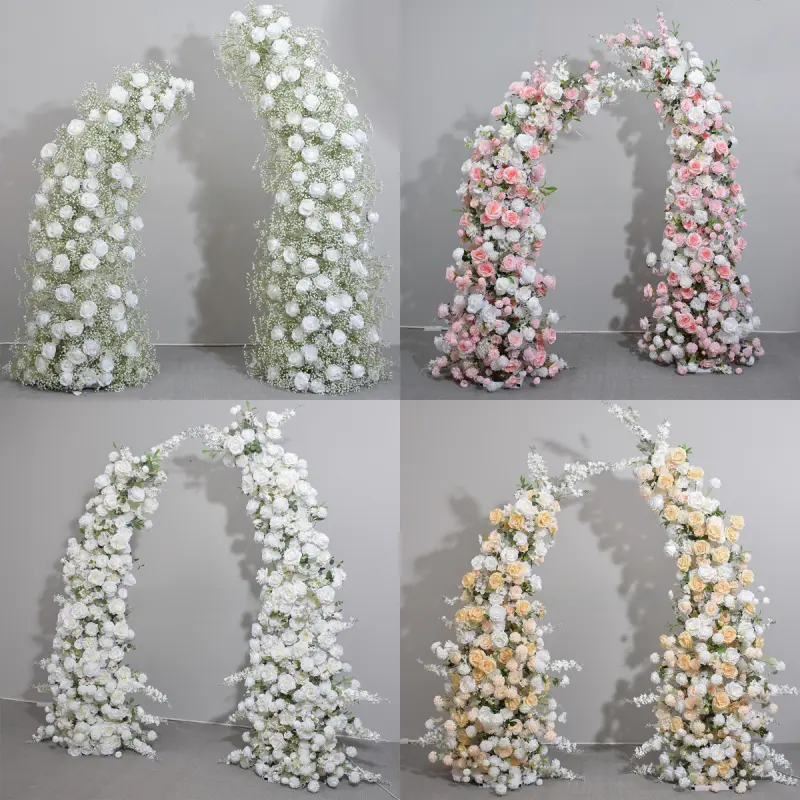
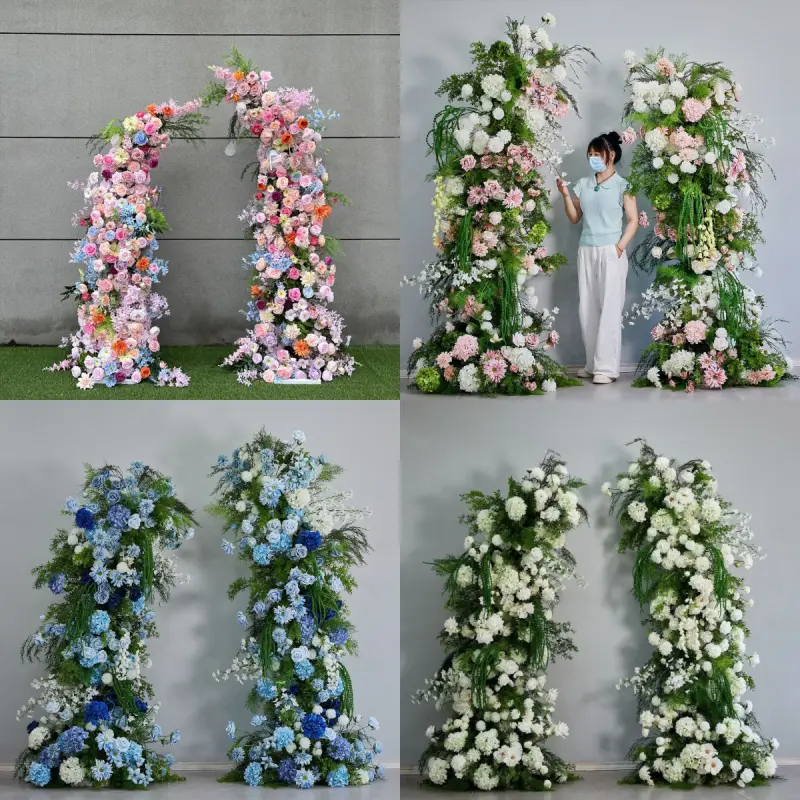
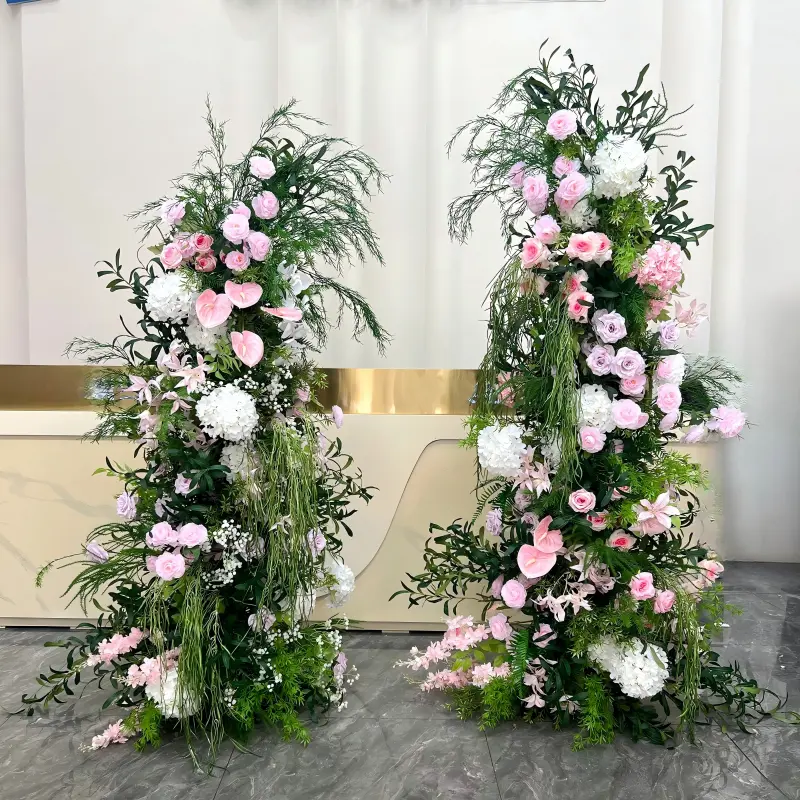
Colorful Mixed Flower Crescent Arch – Moon Gate Wedding Arch
Purple Rose Yellow Lily Blue Hydrangea White Daisy and Blush Mixed Flower Asymmetric Crescent Floral Arch with Green Foliage – Joyful Celebration Moon Gate Wedding Arch with Metal Frame Included for Colorful Weddings, Parties and Grand Openings
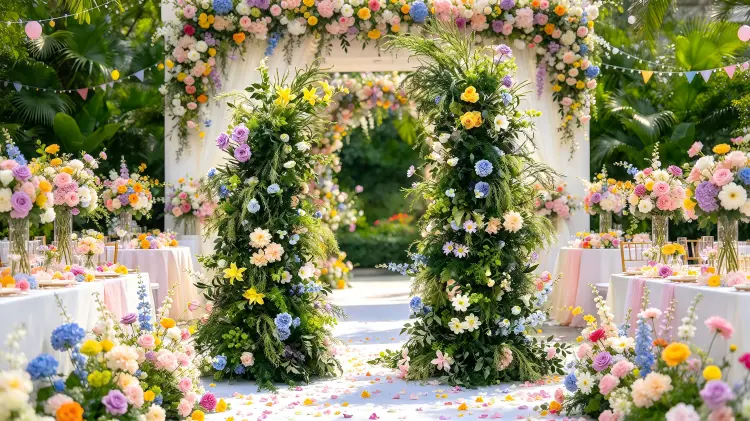
A colorful arch is easy to make. A colorful arch that looks intentional is hard. Anyone can stick purple roses, yellow lilies, blue hydrangea, white daisies and pink flowers on a frame and call it colorful. The hard part is making it look like a designer chose those colors – not like a paint palette threw up on a frame. If you get the color balance wrong, it doesn't look festive. It looks chaotic. It looks like a mistake.
A wedding planner in Suzhou called me in May 2024. She had received our mixed-color crescent arch – purple roses, yellow lilies, blue hydrangea, white daisies, blush flowers. She wanted "a joyful celebration arch, bright and happy, like a party that's already started." She sent a photo. I could see it immediately. The purple roses and blue hydrangea were all clustered at the top. The yellow lilies were scattered randomly on one side. The white daisies were buried in the middle, barely visible. The blush flowers were lost. It didn't look like a celebration. It looked like a paint palette had thrown up on a frame. She called it "the palette arch." Her bride was doing a colorful bohemian wedding in a garden. The bride wanted "colors everywhere, joyful, like confetti." What she got was "confetti that was dumped from one bucket in one spot." The bride saw it. She didn't cry. She laughed. Which is worse. Laughing at your own wedding arch is worse than crying. Because crying means you're disappointed. Laughing means you think it's a joke. Nobody wants their wedding arch to be a joke.
I was embarrassed. Not because the colors were wrong – mixed-color is genuinely hard, and we had done maybe 8 of them at that point, all with varying degrees of chaos. But because I had approved it. I had looked at it in the factory, under our lights, and thought "yeah, it's colorful. That's what they asked for." It wasn't what they asked for. They asked for joyful. I gave them chaotic. The problem was I was checking for "is it colorful?" instead of "is it balanced?" Colorful is easy. Balanced is hard. I was checking the wrong question.
So we changed how we handle mixed-color arches. Every mixed-color arch now goes through a color balance check before shipping. We call it the "four-color test." From any angle, the arch must read as no more than 4 dominant colors: one primary color (30%+), one secondary color (25%), one accent color (15%), and one neutral/buffer color (10%). The remaining 5% is foliage base. If more than 4 colors dominate at any angle, the arch fails. About 16% of mixed-color arches fail this test. That's the second highest failure rate in our factory, after gradient arches (18%). Single-color arches fail at 12%. Two-color arches at 14%. Mixed-color at 16%. Gradients at 18%. It's not even close – the more colors you add, the harder it gets. Color is a drug. Every color you add feels good. Until you have too many and everything gets sick.
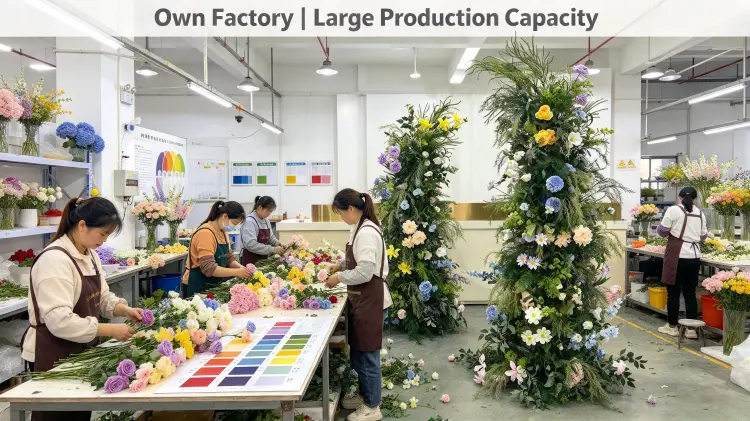
We also changed how we place the colors. Before, we worked in "color zones" – purple on top, blue in the middle, yellow on the sides, etc. The zones were too rigid and the colors ended up clustered. Now we use a "color rhythm map." We divide the arch into 8 visual sections, and each section must contain at least 3 colors, with the primary and secondary colors distributed evenly throughout. No color may appear as a solid block larger than 30cm. Each color must appear in every section – but in different proportions. The primary color (purple) appears everywhere at 30%. The secondary (blue) everywhere at 25%. The accent colors (yellow and blush) appear in every section at 15% each, scattered individually, never clustered. The neutral (white daisies) acts as the buffer between colors. Xiao Qiao runs our color balance department. Four years. She has the best eye for color harmony in the factory. She can look at an arch from 3 meters and tell you if the color balance is off within 5%. "A colorful arch is like a party," she says. "Everyone needs to be invited. But everyone can't be the host. You need one host, one co-host, and a few guests. If everyone tries to be the host, it's not a party, it's a fight. We decide who hosts. That's our job." I like that. We decide who hosts.
We also changed how we handle the white daisies. Before, they were just "filler." Now they're a structural element – the neutral buffer. White is the color that separates other colors. Yellow next to purple is loud. Yellow next to white next to purple is a rhythm. The white daisies are placed at every color boundary – between purple and yellow, between blue and pink – to soften the transitions and keep the colors from fighting. Before this, mixed-color arches had a 28% "colors clash" complaint rate. After? 9%. The white daisies don't add much color. But they add a lot of peace. Neutral is powerful. I never understood that until I watched a purple rose and a yellow lily stop fighting because a white daisy stood between them.
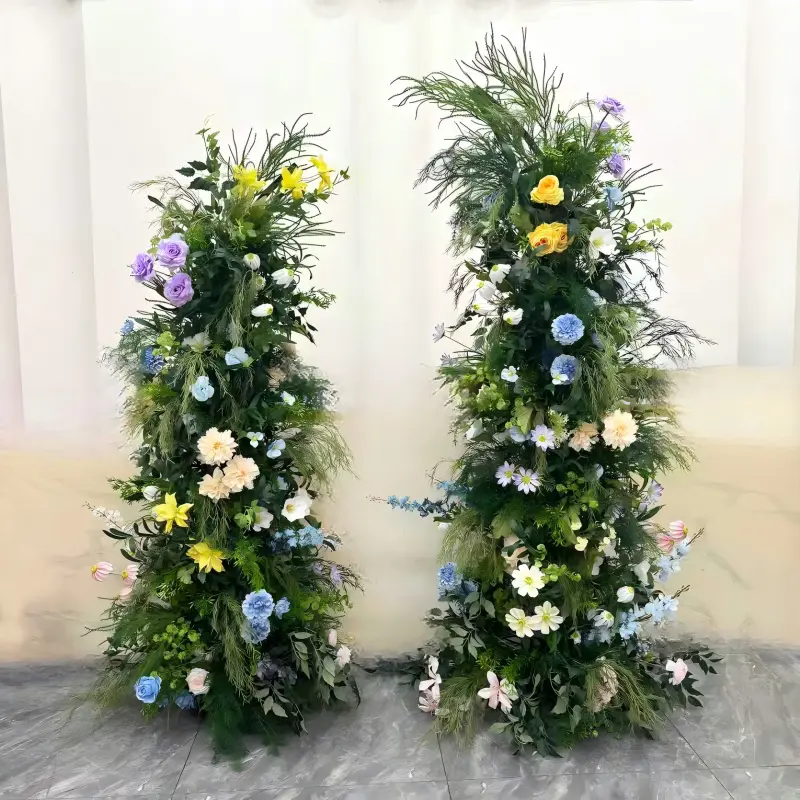
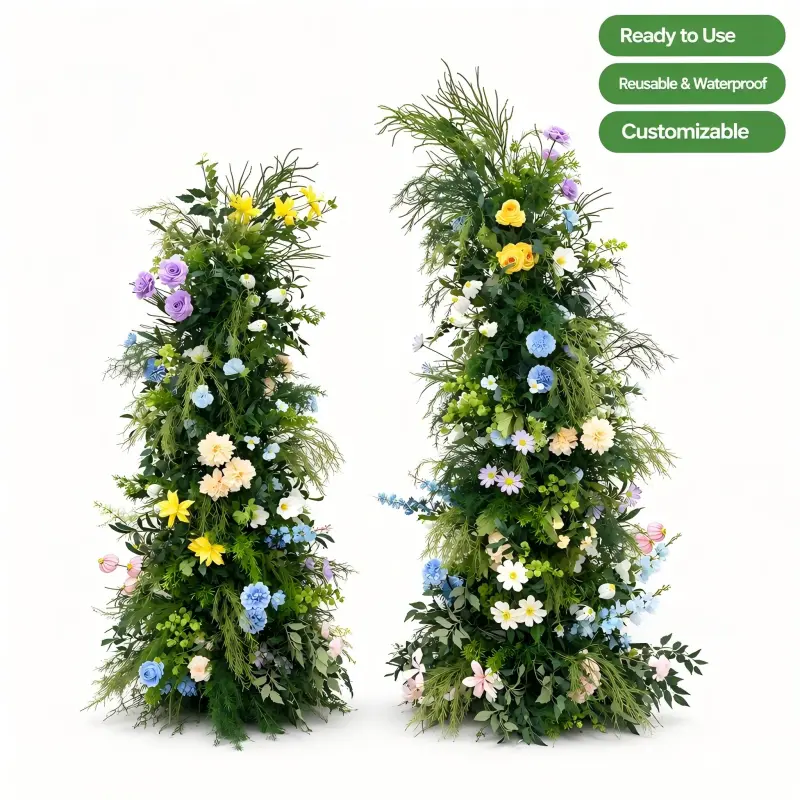
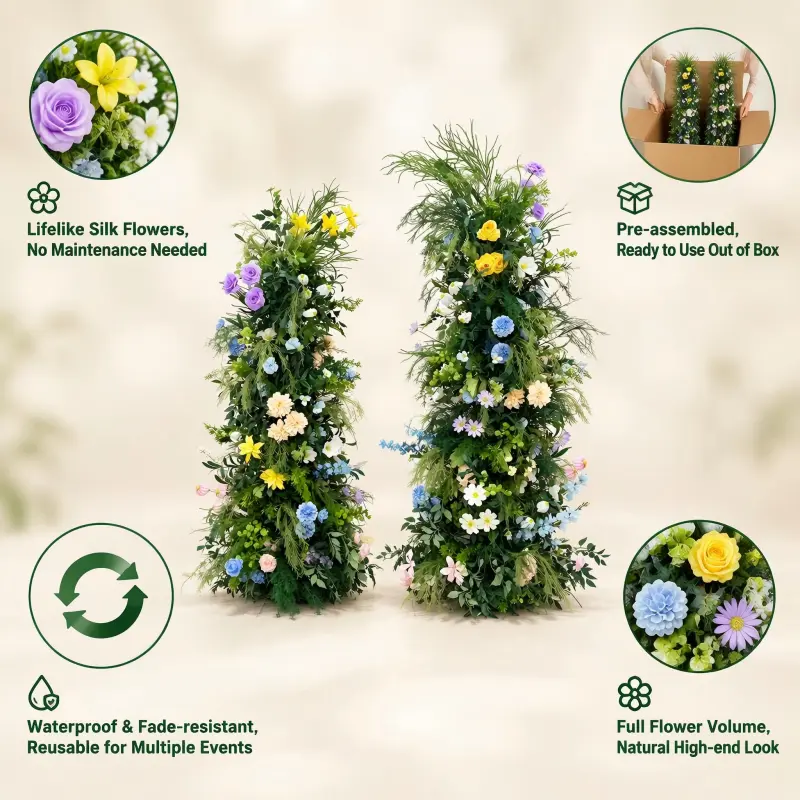
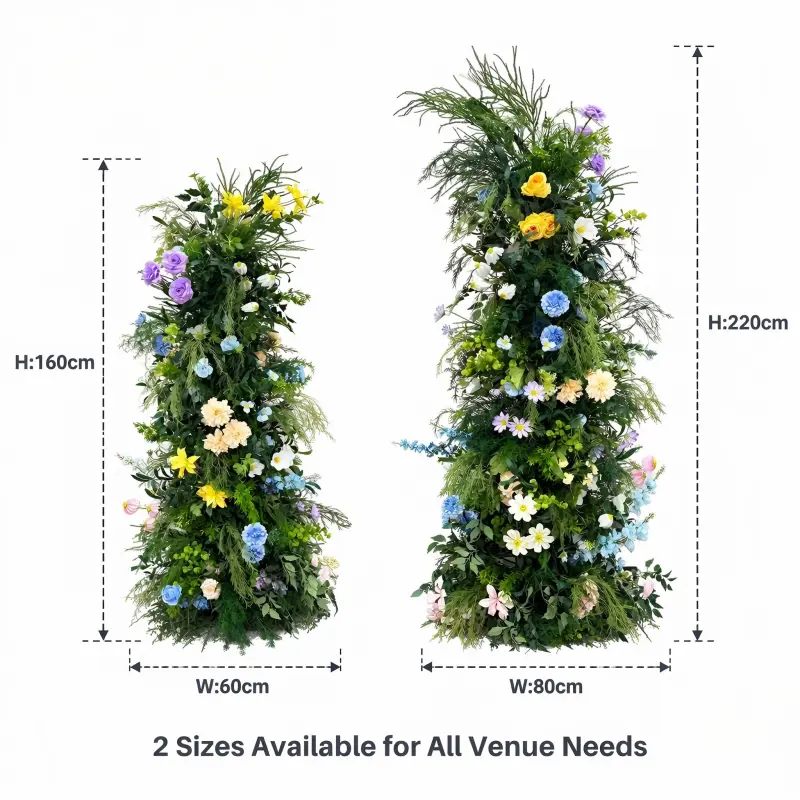
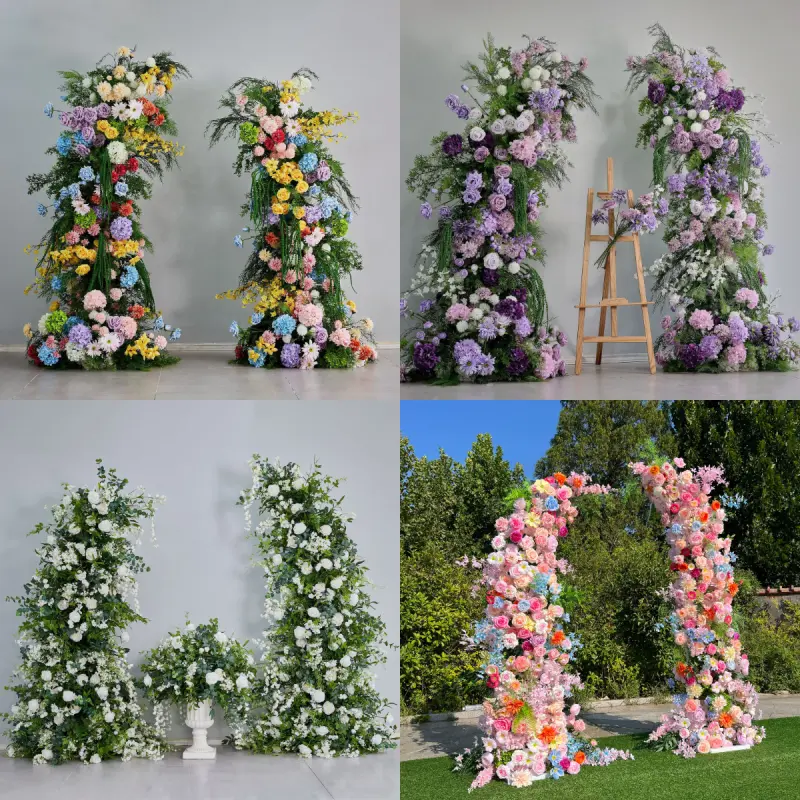
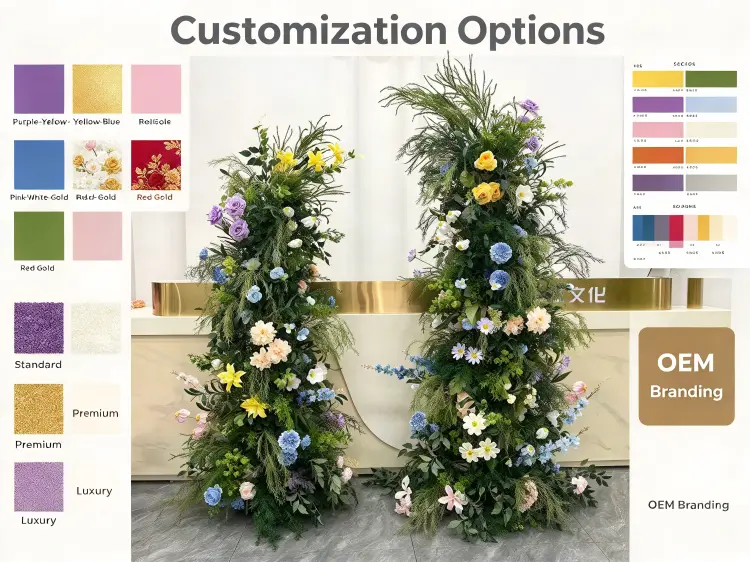
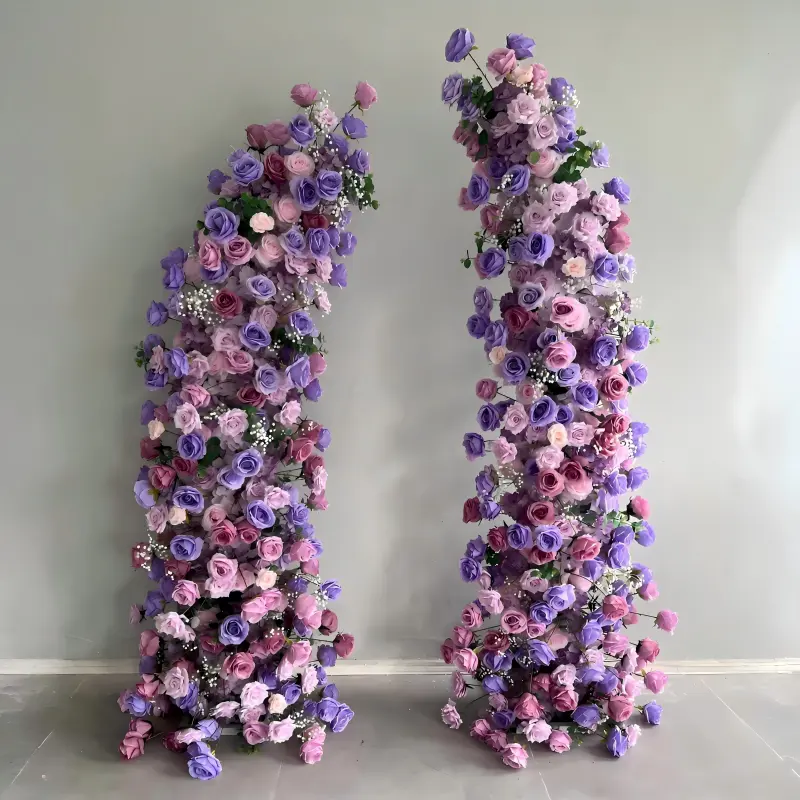
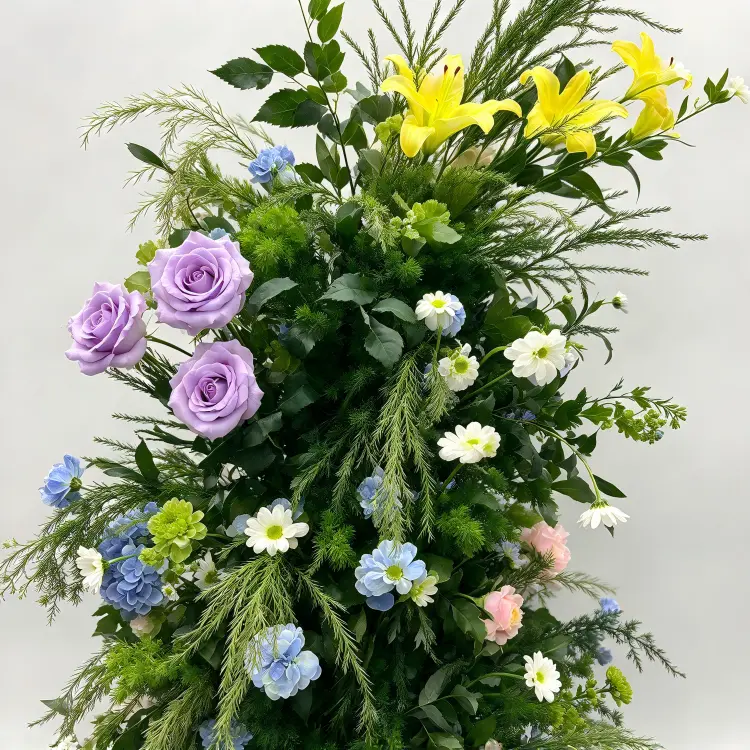
This is our colorful mixed crescent arch. Purple roses – the primary color, the host of the party, wedding and celebration staple. Yellow lilies – the accent, the pop, the color that says "this is a celebration, not a ceremony." Blue hydrangea – the secondary, the volume, the big blooms that anchor the arch. White daisies – the neutral, the peacekeeper, the buffer between fighting colors. Blush flowers – the softener, the feminine touch that keeps the bright colors from being overwhelming. Green foliage base – the foundation, the natural green that ties everything to the garden. Six flower types plus foliage. The color rhythm: purple 30%, blue 25%, yellow 15%, blush 15%, white 10%, green 5%. Every section has at least 3 colors. No color block larger than 30cm. The four-color test from every angle. This is a colorful arch that looks intentional. Not a palette arch. Not a joke. A party that has a host. The Suzhou planner's "palette arch" taught us this. We don't forget palette arches. We have a folder labeled "the palette." There are four photos in there. Each one taught us something about color. The first one: purple and blue clustered on top, yellow scattered on one side, white buried. Answer: you're right. It's a palette arch. We fixed it with the four-color test, the color rhythm map, and the white daisy buffer system.
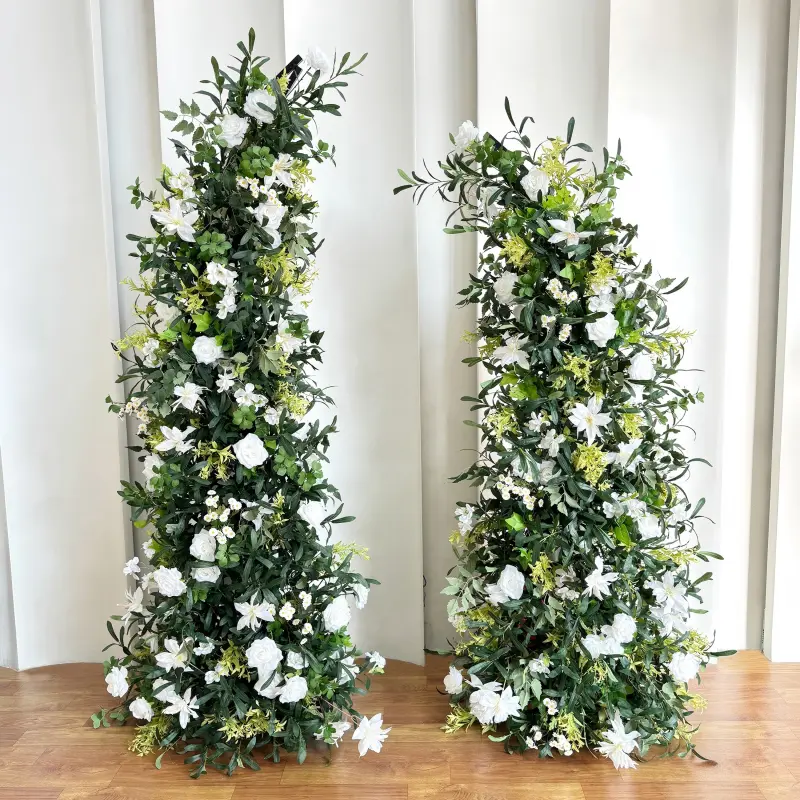
Crescent shape. Not U-shaped. The two columns curve inward at the top, leaving an opening. For mixed-color arches, the crescent shape works because the asymmetry of the frame gives the colors a natural movement – the eye travels along the curve and discovers colors in sequence, rather than taking them all in at once. On a straight U-arch, the mixed colors can feel static – you see them all at once and it's overwhelming. On a crescent, the curve creates a journey. Purple at the base, yellow as you move up, blue at the curve, blush on the other side. Xiao Qiao says "a mixed-color crescent is like walking through a garden that changes color. A mixed-color U-arch is like standing in a paint store. You want the garden, not the paint store." I don't know if that's scientifically accurate. But when I stand in front of one, the colors do feel more intentional on the crescent.
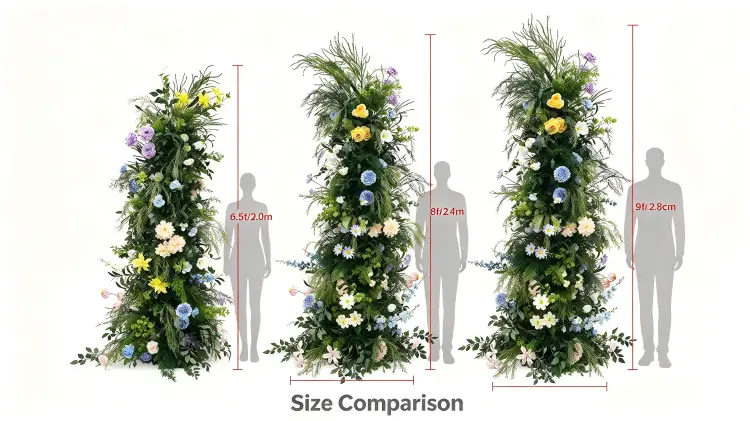
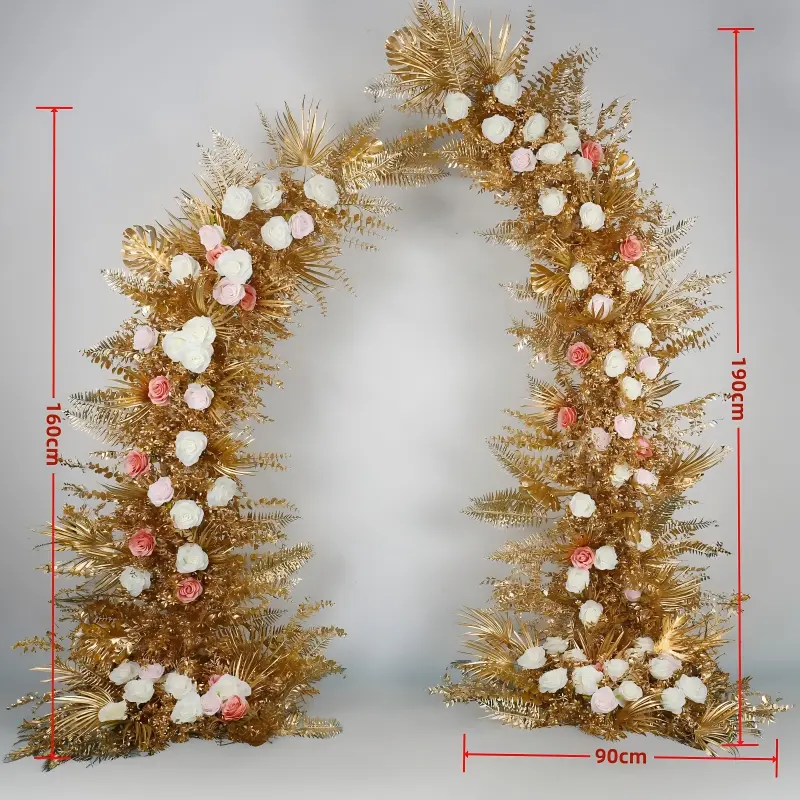
8 feet tall at the highest point. We do 6.5 and 9 too. But 8ft is where a mixed-color arch reads best. At 6.5ft, the 8 color sections are too compressed – each section is only 20cm tall, and the colors start to blur together. At 9ft, the colors above eye level are lost. 8ft gives each color section 25cm – enough space for the color rhythm to be visible, not cramped. I've made enough mixed-color arches to know. I've also made enough wrong ones to know what wrong looks like. Color blocks bigger than 30cm are wrong. Less than 3 colors in a section is wrong. Yellow and purple touching without a white buffer is wrong – they fight. The white daisies are not optional. They are the peacekeepers.
What's on this arch? Purple roses – the host, the primary color at 30%, distributed evenly throughout. Yellow lilies – the accent, 15%, scattered individually, never clustered, always with a white daisy or two nearby. Blue hydrangea – the co-host, 25%, the big blooms that anchor each section. White daisies – the peacekeepers, 10%, placed at every color boundary. Blush flowers – the softener, 15%, scattered in the upper sections to balance the yellow. Green foliage – the base, 5%, ties everything to the garden. Six types plus foliage. The color rhythm map: 8 sections, each with at least 3 colors, primary and secondary everywhere, accents scattered, no block over 30cm. The four-color test from any angle. If more than 4 colors dominate, it fails. About 16% of mixed-color arches fail before they even reach final QC.
Both sides dense. Top dense. No bare metal. The hand test applies. The balance test applies. The four-color test applies. The color rhythm map check applies. The white daisy buffer check applies (every color boundary must have at least one white daisy within 15cm). That's five tests for mixed-color crescents. About 1 in 8 crescent arches fails the balance test. About 1 in 6 mixed-color crescents fails the final QC check. Higher than solid colors because of the color balance check. 16% of mixed-color arches fail before final QC. Xiao Qiao says "mixed colors are like hosting a party. You can't just invite everyone and hope for the best. You have to decide who hosts, who co-hosts, and who comes as a guest. If you don't decide, the party decides for you – and it's always a fight." I like that. We decide who hosts. Every single arch.
What I tell people who ask about mixed-color vs single-color: Single-color is safe, elegant, timeless. Mixed-color is joyful, celebratory, memorable. Single-color works for classic, formal, traditional weddings. Mixed-color works for colorful, bohemian, garden, party-style weddings, and celebrations of all kinds – grand openings, corporate events, birthdays. Single-color doesn't have a color balance problem – it's one color, everywhere, no risk of a palette arch. Mixed-color has 6 flower types, 8 color sections, a four-color test, and a 16% failure rate. But when it's right? It looks like confetti that was thrown with intention. Guests smile. People take photos. The bride laughs – happy laughter this time. Single-color gets "that's beautiful." Mixed-color gets "this is the happiest arch I've ever seen." If you want safe, go single-color. If you want joy, go mixed. Just know that mixed-color is harder to make, which is why most suppliers don't offer it – or they offer it and it looks like a palette arch. We decide who hosts. Every single arch.
What Matters About This Arch
Four-color test, no palette arches
From any angle, the arch must read as no more than 4 dominant colors: primary (purple 30%) + secondary (blue 25%) + accents (yellow + blush 15% each) + neutral (white 10%). If more than 4 colors dominate, it fails. ~16% fail – second highest after gradients (18%). The Suzhou "palette arch" taught us this.
Color rhythm map, no color zones
8 visual sections, each with at least 3 colors. Primary and secondary distributed evenly throughout. No color block larger than 30cm. Colors are placed individually, never clustered. The result is a color journey along the crescent curve – not a paint store, a garden.
White daisy buffer system
White daisies (10%) are structural peacekeepers placed at every color boundary – between purple and yellow, between blue and pink – to soften transitions and stop colors from fighting. Before this, 28% "colors clash" complaints. After? 9%. Neutral is powerful.
Frame in the box
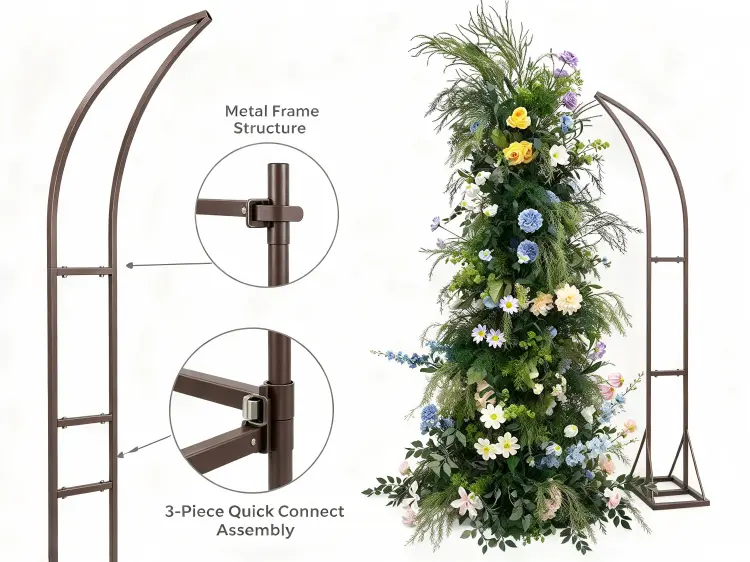
Always. Since 2020. Three pieces. Ten minutes. No tools. Dark bronze powder coating for mixed-color arches – the green foliage hides the frame, and dark bronze recedes into shadow between colorful blooms. White frame would show through gaps. Black frame would fight the colors. Dark bronze is "the shadow color" – our welder Zhao's phrase. I mention this in every product. People still ask. I get it.
How We Actually Make It
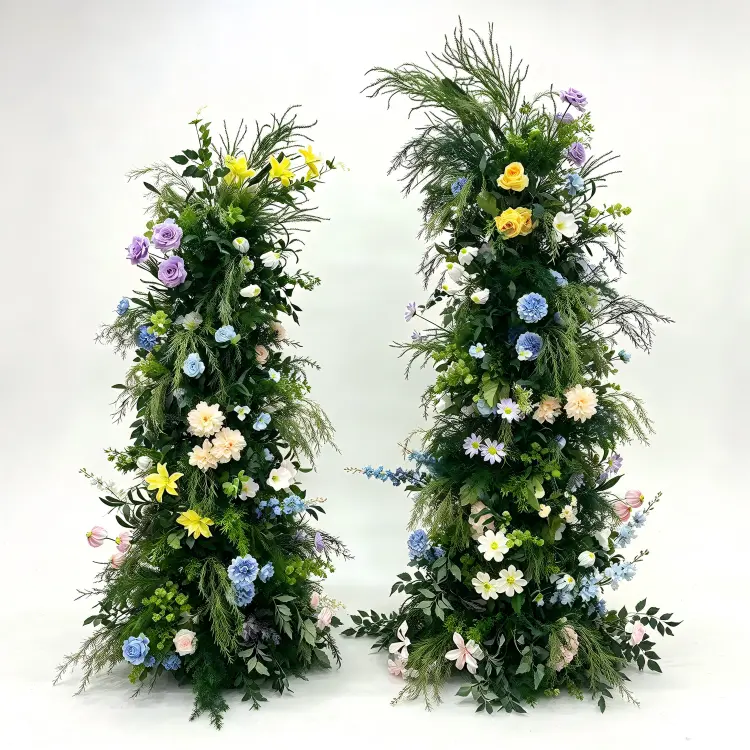
Factory Breakdown – Colorful Mixed Crescent Arch
Frame
25mm iron tube, 1.5mm wall, bent on a custom crescent jig. Same jig as all crescents. Powder coated dark bronze – not white, not black, not silver. Dark bronze is the frame color for all colored arches because it recedes into shadow between flowers. Our welder Zhao – 9 years – calls dark bronze "the shadow color." He built the custom bending jig for crescents in 2021. Before that, we bent each one by hand and the curves were never consistent. The jig changed everything.
Flowers
Purple roses, yellow lilies, blue hydrangea, white daisies, blush flowers, green foliage. Six types plus base. Purple roses get the standard petal-shed check. Yellow lilies get the color-fastness check – yellow is the most dye-sensitive color we use, about 12% of yellow lily batches fail (the dye shifts orange under certain lights). Blue hydrangea gets the fullness check. White daisies get the petal-structure check. Blush flowers get the standard check. Green foliage gets the leaf-shed check. Xiao Qiao runs the color balance department. Four years. Best eye for color harmony in the factory. Can tell color balance within 5% from 3 meters. Calls mixed-color arches "parties where everyone wants to be the host." Says "we decide who hosts. That's our job."
Tying
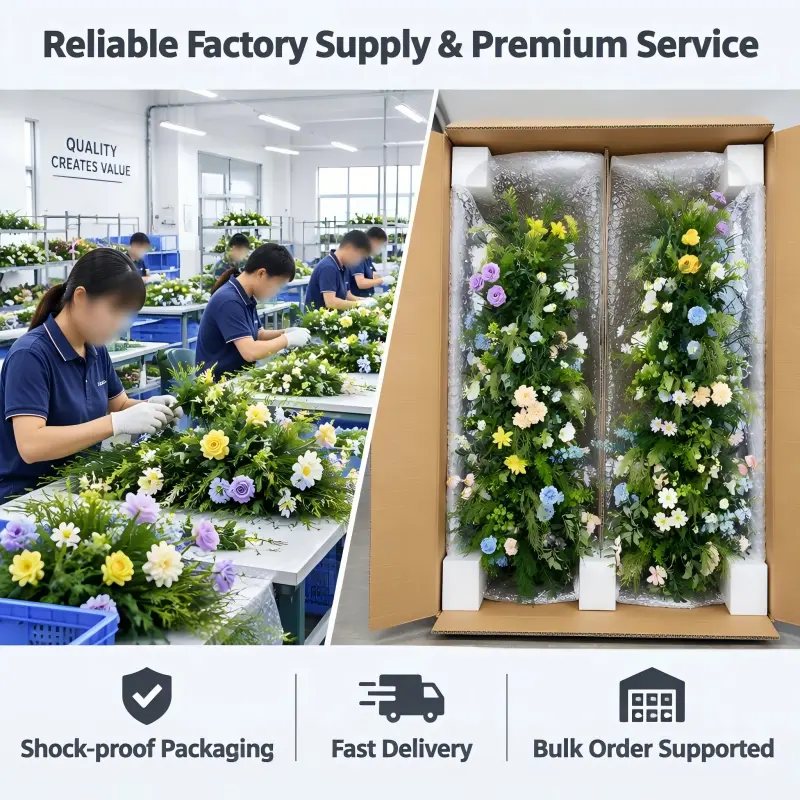
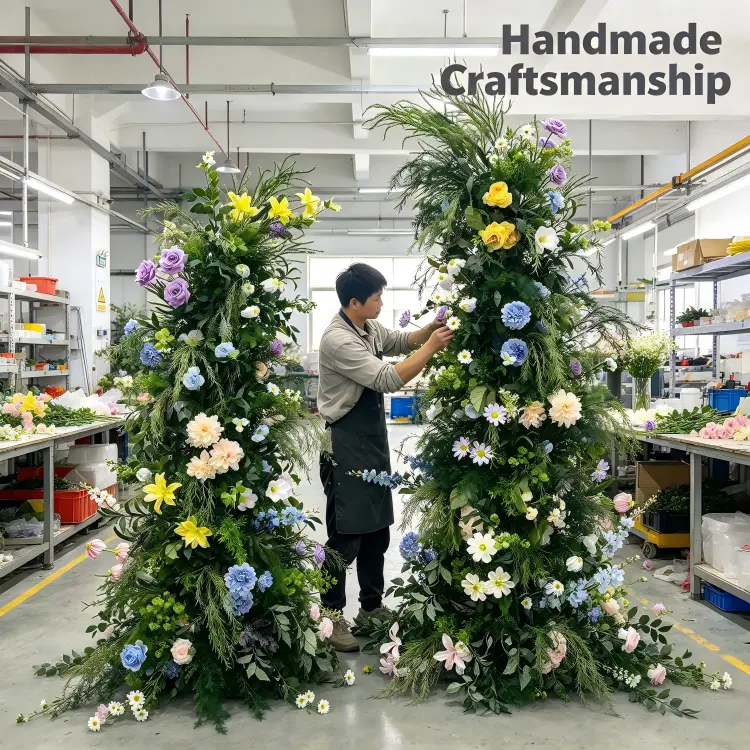
Mixed-color crescents take about 9 hours for Luxury. Same as delphinium – the extra time is all color placement. Each of the 8 sections must have at least 3 colors, with the primary and secondary distributed evenly. No color block over 30cm. Xiao Qiao uses a printed color rhythm map taped to the workbench – 8 rectangles, each with the target color ratios, and she places flowers one at a time, checking off each section. The white daisies are placed at every color boundary – about 2 minutes per boundary. About 7% of flowers get damaged during the constant repositioning around the color map. Nobody counts the minutes. They just know mixed-color days are long days. And worth it. Because a balanced colorful arch is a celebration. A chaotic colorful arch is a palette arch. We don't make palette arches anymore.
QC
12 check points. Plus the hand test. Plus the balance test from 5 meters. Plus the four-color test from 3 meters and 1 meter (no more than 4 dominant colors from any angle). Plus the color rhythm map check (each section has at least 3 colors, no block over 30cm). Plus the white daisy buffer check (every color boundary has a white daisy within 15cm). Plus checking from three angles (front, left 45°, right 45°). Mixed-color crescents have a QC rejection rate of about 17% (1 in 6). Wang Lei runs QC. 8 years. He says "mixed-color arches are the most subjective design we make. There's no right answer for color. There's only 'does it feel right?' The four-color test helps, but honestly, a lot of it is just looking at it and knowing. And the knowing comes from having seen a lot of palette arches." I think that's true for a lot of things. You have to see the wrong ones to know the right ones.
Packing
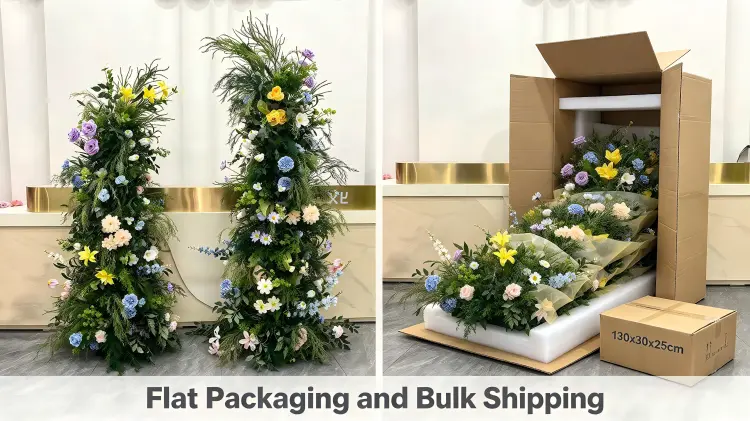
Frame comes apart in three pieces. Carton: 130×30×25cm – standard crescent size. Yellow lilies get extra protection – lily petals are the most fragile of our colors (the large trumpet petals bruise easily). Each lily is wrapped in tissue paper. Blue hydrangea gets standard foam. Mixed-color arch damage rate about 4% – standard for colored arches. Yellow lily damage was our #3 complaint before the tissue wrapping. Now it's #6. Progress.
The Suzhou wedding, full story: May 2024. Planner was doing a colorful bohemian wedding at a garden venue in Suzhou. Mixed-color theme – purple, yellow, blue, white, blush. Crescent arch. We shipped it with our standard quality check (visual inspection, no color balance check). Arrived one week before wedding. Planner unboxed it. Took a photo. Sent it to me. I could see it immediately. Purple roses and blue hydrangea clustered at the top. Yellow lilies scattered on one side. White daisies buried in the middle. Blush flowers lost. She called it "the palette arch." Bride saw it. Laughed. Not happy laughter. Wedding in 5 days. I offered to remake it – but 9 hours of tying plus shipping meant it wouldn't arrive in time. I told the planner to pull flowers and redistribute them – separate the purple and blue, scatter the yellow, pull the white daisies to the surface, balance the blush. She spent 4 hours manually rearranging flowers. It was better. Not perfect. But no longer a palette arch. The bride was okay with it. The planner told me later: "I spent more time fixing your color balance than I spent on my own bouquet. That's not okay." That stuck. We changed: four-color test (max 4 dominant colors from any angle), color rhythm map (8 sections, min 3 colors each, no block over 30cm), white daisy buffer system (daisies at every color boundary), yellow lily tissue wrapping. Mixed-color failure rate: we didn't track it before because we didn't know it was a problem. Now 16% fail the four-color test. Color clash complaints: 28% → 9%. The Suzhou planner has ordered 2 more mixed-color arches since. She says "I still check the color balance first when it arrives. Old habit. But there's always a balance now." I keep her palette photo in a folder labeled "the palette." There are 4 photos. Each one taught me something about color. The first: purple and blue clustered, yellow scattered, white buried. Answer: you're right. It's a palette arch. We fixed it.
Pricing – Per Piece
3 Sizes × 3 Quality Tiers
Frame included. MOQ 1 piece. Mixed-color arches include four-color test, color rhythm map, and white daisy buffer system at no extra cost.
2.0m (6.5ft)
$198
Standard / from
2.4m (8ft)
$268
Standard / from
2.8m (9ft)
$358
Standard / from
| Size \ Quality |
Standard |
Premium |
Luxury |
| 2.0m (6.5ft) |
$198 |
$248 |
$298 |
| 2.4m (8ft) |
$268 |
$328 |
$398 |
| 2.8m (9ft) |
$358 |
$428 |
$518 |
Which quality for a colorful mixed crescent? I strongly recommend Premium or Luxury. Standard is not ideal for mixed-color – the lower flower density means each color section has fewer flowers, which makes the color balance harder to read and more likely to show gaps or clustering. A mixed-color arch needs enough flower volume in each section to make the color rhythm visible. At Standard density, the 8 sections each have fewer flowers, so a 30% purple ratio might only be 6 roses – that's not enough to establish purple as the host. At Premium, it's 12. At Luxury, 18. More flowers per section = clearer color balance = no palette arch. If it's a backdrop nobody approaches, Standard might work. If people will stand under it – and with a mixed-color arch, they always will, it's joyful and photogenic – get Premium or Luxury. I own this company and I'd never sell a Standard mixed-color arch for a wedding. That's not upselling. That's experience. Colors are unforgiving. Sparse sections show. Clusters show. The white daisies help. But density helps more.
Mixed-color arch venue note: Before ordering a colorful mixed arch, consider your venue's background. A mixed-color arch needs a neutral background to shine – white, cream, gray, or natural wood. Against a busy or colorful background, the arch can get lost in visual noise. If your venue has a busy background, add a neutral backdrop panel behind the arch (white or cream). Also – mixed colors photograph best in natural daylight. Under warm amber light, the yellow lilies can shift to orange and the blush can look brown. Under cool white LED, the colors are true. For outdoor garden weddings, morning or late afternoon light is best (soft and flattering). For indoor venues, ask for neutral white lighting. The Suzhou planner told me "colorful arches are like confetti – you need the right light and background to make the colors pop, otherwise they just get lost." I think she's right.
Where Colorful Mixed Arches Actually Get Used
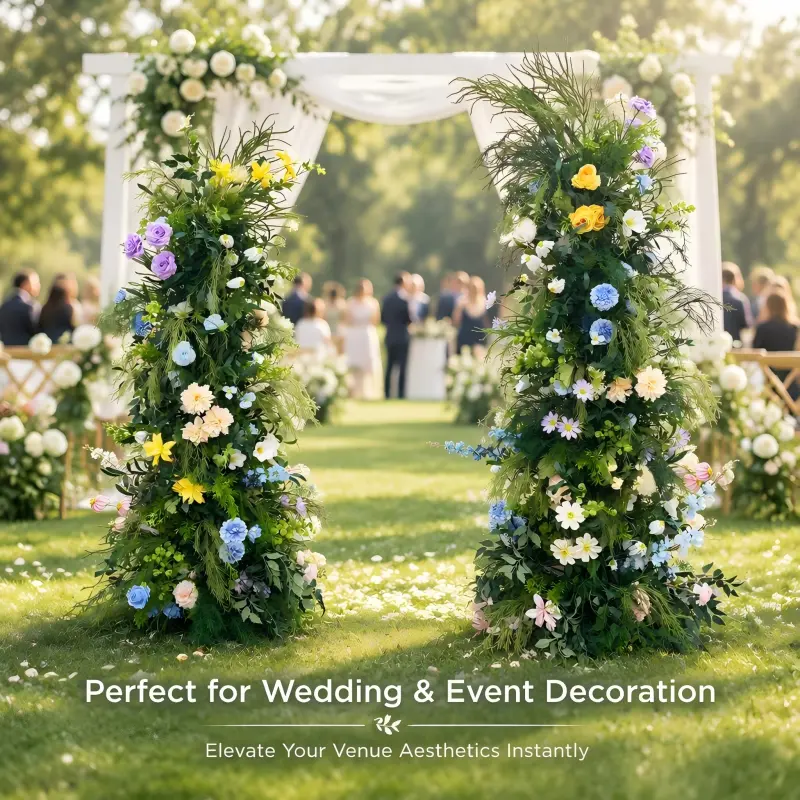
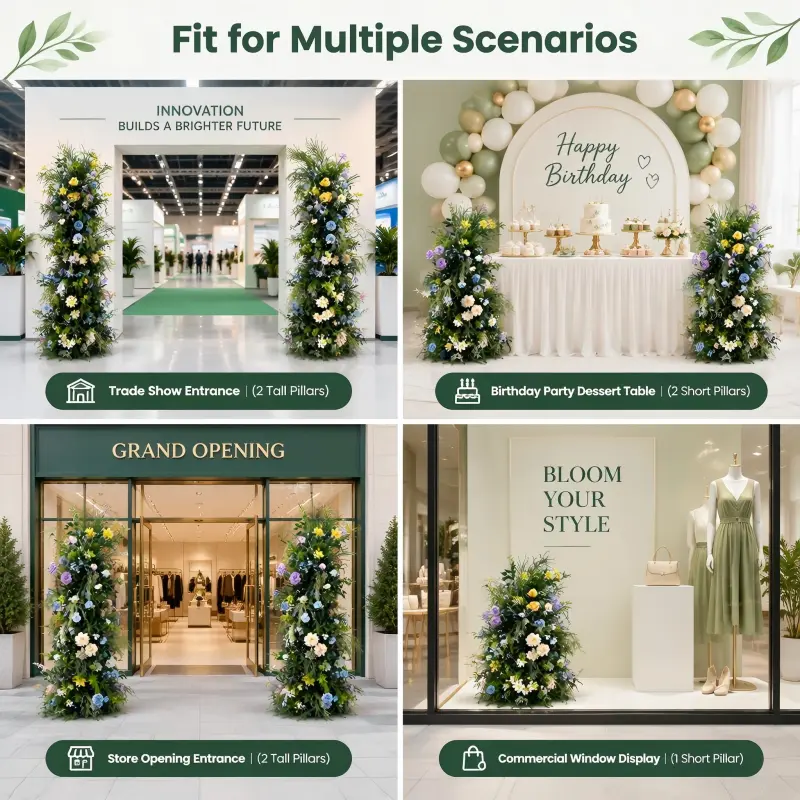
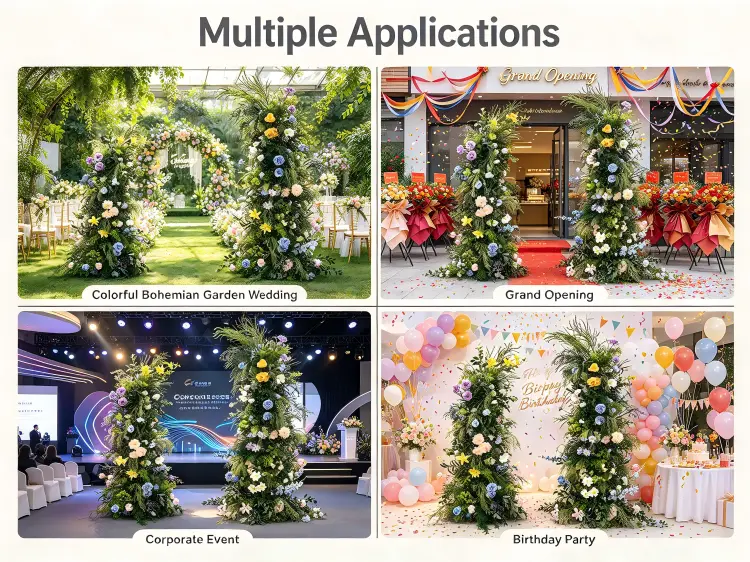
- Colorful bohemian and garden weddings – Mixed-color is the color of joy, and bohemian weddings are the home of joyful color. The crescent shape adds modern flair, the mixed colors add celebration, and the green foliage ties it to the garden. Boho brides who want "confetti everywhere" love this arch. We did 10 mixed-color arches for boho weddings last year. I know because the planners all mention "colorful" or "bohemian" or "joyful" in their first email.
- Grand openings and store celebrations – A colorful arch at a grand opening says "this is a celebration" before anyone walks through it. Retail stores, restaurants, cafes, and salons use mixed-color arches for grand openings, anniversary celebrations, and festive events. The arch is photogenic – customers take photos in front of it, and those photos become free marketing. One restaurant owner in Zhengzhou told me their colorful arch got posted on 40+ social media posts during opening week. That's free advertising.
- Corporate events and team celebrations – Companies book mixed-color arches for product launches, annual parties, and team celebrations. The colorful arch creates a festive atmosphere that a single-color arch can't match. Corporate event planners like it because it's memorable – guests remember the colorful arch, and they remember the company. One tech company in Hangzhou booked a mixed-color crescent for their annual party. The CEO posed in front of it for the company photo. The photo went on their website.
- Birthday parties and milestone celebrations – A colorful arch is the perfect backdrop for a birthday party, especially milestone birthdays (18th, 30th, 50th). The mixed colors are celebratory without being childish. The crescent shape is modern and elegant. Guests take photos, the birthday person gets a beautiful backdrop, and the arch can be reused for future celebrations. Rental companies love mixed-color arches for birthdays – they rent more often because they fit any celebration.
- Festivals and community events – Colorful arches work beautifully at festivals, carnivals, and community events. The bright colors attract attention from a distance and create a welcoming entrance. Event organizers use them as photo spots and entrance markers. The mixed colors photograph well in any weather, and the arch stands out against most backgrounds.
- Rental companies – They tell us mixed-color crescents rent for 15-25% more than single-color crescents. Because colorful is a premium request – it's harder to find and it looks more expensive. Because it fits more occasions – weddings, parties, openings, corporate events – so it rents more often. Because it's photogenic – colorful arches get posted more on social media, which brings more rental bookings. One rental company in Hangzhou told me their colorful mixed crescent has the highest repeat booking rate of any arch in their inventory. I don't know if that's universally true. She had a booking ledger. I believed her. She's the Suzhou planner's rental partner. Small world, again. I seem to say that a lot.
Specs
| Item |
Detail |
| Product Name |
Colorful Mixed Flower Crescent Arch – Moon Gate Wedding Arch |
| Shape |
Crescent / Moon Gate / Asymmetric curved arch (not U-shaped) |
| Sizes |
2.0m (6.5ft) / 2.4m (8ft) / 2.8m (9ft) / Custom |
| Flower Types |
Purple roses, yellow lilies, blue hydrangea, white daisies, blush flowers, green foliage (6 types + base) |
| Color Balance |
Four-color test (max 4 dominant colors from any angle). Color rhythm map (8 sections, min 3 colors each, no block over 30cm). White daisy buffer system (daisies at every color boundary). ~16% fail. |
| Color Ratios |
Purple 30% + Blue 25% + Yellow 15% + Blush 15% + White 10% + Green 5% |
| Flower Count (8ft Luxury) |
~55 purple roses + 8 yellow lilies + 18 blue hydrangea + 30 white daisies + 40 blush flowers + foliage (8-section color rhythm mapped) |
| Yellow Lilies |
Accent color, 15%, scattered individually never clustered. Color-fastness check (12% fail – dye shifts orange under certain lights). Tissue-wrapped for shipping (petals bruise easily). |
| White Daisies |
Neutral buffer, 10%, placed at every color boundary within 15cm. Peacekeepers between fighting colors. Color clash complaints 28%→9%. |
| Frame |
25mm iron tube, 1.5mm wall, custom bent asymmetric curve, dark bronze powder coating, 3 pieces |
| Assembly Time |
~10 minutes, no tools |
| Weight |
11-18kg depending on size and quality |
| Packaging |
Disassembled flat, 130×30×25cm carton, yellow lilies individually tissue-wrapped |
| MOQ |
1 piece (standard sizes), 2 pieces (custom colors/shapes) |
| QC Rejection Rate |
~17% (1 in 6) – includes four-color test + color rhythm map check + white daisy buffer check + balance check + three-angle inspection. |
| Factory |
Henan Xibo Flower Art Co., Ltd. – 4000㎡, 15 years, Zhengzhou China |
Customization
| Level | What's Included | MOQ | Lead Time |
|---|
| Stock Colors | 15+ stock color mixes including purple-yellow-blue, any size/quality, crescent shape as shown | 1 piece | 7-15 days |
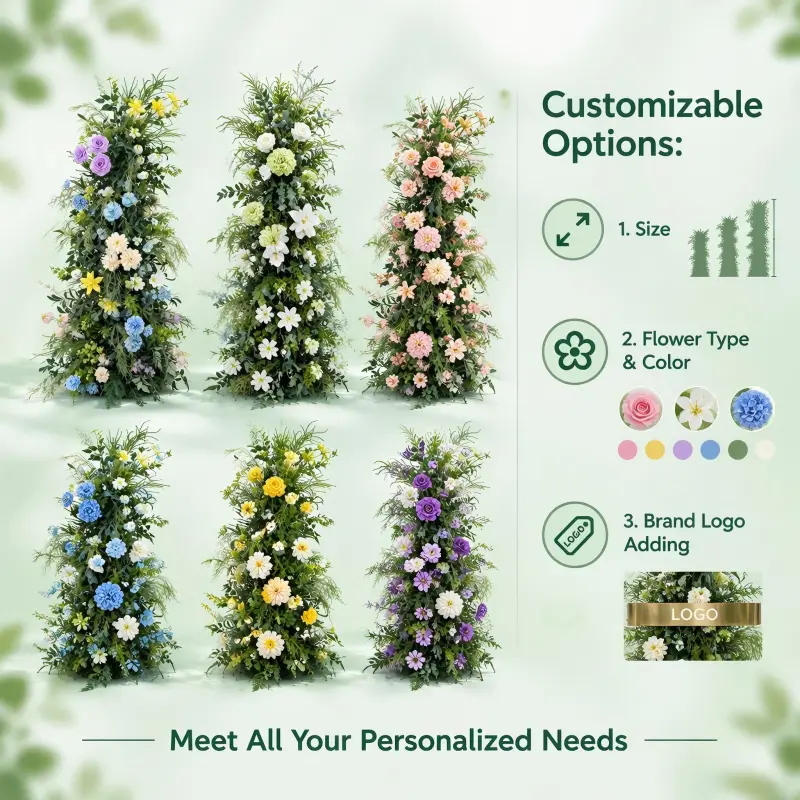
| Custom Color Mix | Custom color palette (any 3-5 colors), adjust color ratios, change accent colors | 2 pieces | 20-25 days |
| Custom Shape | Adjust curve openness, asymmetry degree, height difference, full custom frame bend | 2 pieces | 25-30 days |
| Full Custom | Custom mix, size, shape, density, color palette, frame color, branded packaging | 5 pieces | 25-35 days |
Questions People Actually Ask
How do you keep mixed colors from clashing?
Three systems. (1) Four-color test: from any angle, the arch must read as no more than 4 dominant colors – primary (purple 30%), secondary (blue 25%), accents (yellow + blush 15% each), neutral (white 10%). If more than 4 colors dominate, it fails (~16% fail). (2) Color rhythm map: 8 sections, each with at least 3 colors, no color block larger than 30cm, colors placed individually never clustered. (3) White daisy buffer system: white daisies placed at every color boundary within 15cm to soften transitions and stop colors from fighting. Color clash complaints dropped from 28% to 9%.
What are the color ratios?
Purple 30% (primary, the host), Blue 25% (secondary, the co-host), Yellow 15% (accent, the pop), Blush 15% (accent, the softener), White 10% (neutral, the peacekeeper), Green 5% (foliage base). Purple and blue are distributed evenly throughout all 8 sections. Yellow and blush are scattered individually, never clustered. White daisies sit at every color boundary. The ratios can be customized – tell us your palette and we'll create a color rhythm map for your approval.
Why yellow lilies? Don't they clash with purple?
Yellow and purple are complementary colors – they're opposite on the color wheel, which means they actually look good together when balanced properly. The key is the white daisy buffer – yellow next to white next to purple is a rhythm. Yellow directly next to purple is a fight. That's why every yellow lily has a white daisy or two within 15cm. Also, yellow is the celebration color – it's what makes this arch read as "party" instead of "ceremony." The yellow lilies go through a color-fastness check (about 12% of yellow batches fail because the dye can shift orange under certain lights). We reject those batches. Yellow that turns orange would ruin the color balance.
Can I customize the color palette?
Yes. We can do any 3-5 color palette – pink-white-gold, red-gold, blue-white-silver, peach-coral-cream, etc. The four-color test and color rhythm map work for any palette. Custom color mix has MOQ 2 pieces and 20-25 day lead time because we need to source the specific flower colors and create a new color rhythm map. We can also adjust the ratios – more purple, less yellow, etc. Tell us your event colors and we'll create a color map for your approval before production.
Is this arch suitable for outdoor use?
Yes, with notes. The frame is dark bronze powder coated iron – fine outdoors. The flowers are UV-stabilized silk. Color note: purple and blue are the most UV-stable colors (1-2 years fade time), yellow is the most sensitive (can fade faster, expect 1 year), white can yellow slightly over time. The arch includes outdoor ground stakes, and for strong wind we recommend sandbags at the base. Rain is fine – just let it dry before packing. Mixed colors photograph best in natural daylight – morning or late afternoon light is ideal.
How do I clean a mixed-color arch?
For dust: low-pressure air or a soft-bristle brush. Don't use a vacuum on the yellow lilies – the trumpet petals are fragile. For stains: damp cloth with mild soap, gently blot. Don't rub. Don't soak. Don't use bleach or alcohol cleaners – they can strip the dye from colored flowers and cause fading. For yellow lilies specifically: wipe with a dry microfiber cloth, don't use water (can leave spots on the petals). Store in a cool, dry place away from direct sunlight (sunlight accelerates fading of purple, blue, and yellow). With proper care, a mixed-color arch lasts 1-2 years. Heavy rental use might need color touch-ups after 8 months.
Does the frame come included? What color is it?
Yes. Always. Since 2020. Three pieces. Ten minutes. No tools. For mixed-color arches with green foliage, the frame is dark bronze powder coating. Not white – white would show through gaps and compete with the colors. Not black – black would fight the joyful colors. Not silver – silver would look like a mistake next to colorful blooms. Dark bronze recedes into shadow between flowers. Our welder Zhao calls dark bronze "the shadow color." I mention this in every product. People still ask. I get it – a lot of suppliers sell flowers only. We don't. Frame is always included.
What's the best way to photograph a mixed-color arch?
Natural daylight is best. Morning or late afternoon light (soft and flattering) makes the colors pop without being harsh. Avoid direct midday sun – it can wash out the lighter colors (blush and white). Under warm amber light, yellow shifts to orange and blush can look brown – use camera white balance 4500-5000K to neutralize. Shoot from a slight angle (30-45°) to show the crescent curve and the color journey. The neutral background matters – white or cream walls make the colors pop; busy backgrounds compete. Tell your photographer to capture the arch from different distances – wide shot for the full color rhythm, close-up for the color transitions with white daisy buffers.


A Celebration That Has a Host
We're Xibo Floral. 4000 square meters. 15 years. Henan, China. Founder Kupeng Yang – that's me. I wrote every word of this page myself. No AI. Just me, a keyboard, and the memory of a photo of a "palette arch" from a Suzhou wedding planner in May 2024. (Okay, spellchecker. But just spellchecker. The words are mine.)
Mixed color taught me that colorful isn't a color. It's a decision. Anyone can stick six colors on a frame and call it colorful. Making it look intentional – that's the job. The Suzhou planner caught us. She was right. We were wrong. So we built the four-color test. We started using the color rhythm map. We added the white daisy buffer system. We check color balance from 3 meters and 1 meter. 16% of mixed-color arches fail the four-color test. Color clash complaints: 28% → 9%. That's a lot of extra work. But it's better than a bride laughing at her wedding arch because it looks like a paint palette threw up on a frame. A wedding arch should be a celebration with a host. Not a fight where everyone tries to be the host.
If you want a colorful mixed crescent arch that looks intentional, joyful, and balanced – with a four-color test, a color rhythm map, and white daisies keeping the peace – contact us. Send us a photo of your venue. Tell us about the background (it matters for colorful arches). Tell us your color palette or let us design one. We'll create a color rhythm map for your approval before production. We'll run the four-color test from every angle. We'll place white daisies at every color boundary. Most suppliers stick colors on a frame and hope. We decide who hosts. Every single arch.
Contact Us for Colorful Mixed Crescent Arch
P.S. Suzhou planner, thank you. Your palette arch photo changed how we handle every colorful arch that leaves this factory. The whole mixed-color category is better for it. Well, our corner of it anyway. And the color rhythm map? Xiao Qiao tapes a printed copy to every workbench – 8 rectangles, each with the target color ratios, and she places flowers one at a time, checking off each section. She calls it "deciding who hosts." I think that's the best job title in the factory. Also, we now include extra white daisies with every mixed-color arch order – in case the client wants to adjust the color balance at the venue. Small thing. But after Suzhou, I never want another planner to spend 4 hours fixing our color balance instead of doing her bouquet. Nobody should have to fix a palette arch at a wedding.
Written by Kupeng Yang, Founder of Xibo Floral – October 15, 2026. Colorful mixed crescent specialist. Suzhou palette-arch survivor. 4 palette photos and counting.
↑