- Why Proper Transport Matters for Your Investment
- Pre-Transport: How to Disassemble and Pack Panels
- Loading Your Vehicle: Best Practices
- Carrying and Moving Panels Without Damage
- Unloading and On-Site Handling Tips
- Post-Event Teardown and Return Transport
- Common Transport Damages (And How to Prevent Them)
- Essential Transport Supplies Every Rental Business Needs
- Frequently Asked Questions
If you own flower walls, you already know they are an investment. A single panel can cost hundreds of dollars, and a full backdrop set can run into the thousands. But here is what many new rental business owners learn the hard way: the biggest threat to your flower wall inventory is not normal event use — it is transport. Every time you load panels into a van, carry them through doorways, or stack them in storage, you risk bending petals, cracking frames, and crushing flowers. One bad transport job can turn a $600 wall into a repair project. The good news is that almost all transport damage is preventable. With the right packing, loading, and carrying techniques, you can keep your flower walls looking brand new for years of rentals. This guide covers everything from disassembly to unloading, so your inventory stays in perfect shape event after event.
Why Proper Transport Matters for Your Flower Wall Investment
Before we get into the how-to, let us talk about why this matters so much for your bottom line. Flower walls are not cheap decor — they are revenue-generating assets. Every scratch, bent petal, or cracked frame reduces the value of that asset and how much you can charge for it. Clients notice damage, even if they cannot quite put their finger on what looks "off." A wall with crushed or bent flowers reads as low quality, and you will have a harder time charging premium prices. Worse, severe damage can take a panel out of rotation entirely, costing you lost bookings and replacement expenses.
Transport damage adds up fast. If each event causes $20 worth of minor damage and you do 40 events a year, that is $800 in lost value per wall — every single year. Multiply that across a full inventory, and you are looking at thousands of dollars in avoidable depreciation. Proper transport techniques cost almost nothing to implement, but they can double or triple the usable lifespan of your flower walls. For a rental business, that is pure profit.
Pre-Transport: How to Disassemble and Pack Flower Wall Panels
Good transport starts before anything goes in the van. How you take down and pack your walls sets the tone for the entire trip. Rushed teardown is the number one cause of preventable damage. Take the extra five minutes to do it right.
Start with a clean, flat workspace. Lay down a soft blanket or drop cloth on the ground before you place panels down. This prevents dirt from getting on the flowers and protects the front side from scratches against the floor. Never set a flower panel face-down on bare ground or concrete — the petals will get crushed and dirty.
When stacking panels, always stack them face-to-face and back-to-back. This means the flower side of one panel faces the flower side of the next panel, and the frame side faces the frame side. Why? Because if you stack flower-side against frame-back, the hard frame edges will crush and bend the petals of the panel below it. Face-to-face stacking means petal touches petal — soft on soft, no damage.
Use the original cardboard packaging if you still have it. The custom-fit slots and protective corners are designed specifically for transport. If you no longer have the boxes, wrap each stack of 2-3 panels in a moving blanket or thick furniture pad. Secure with soft straps — never use duct tape directly on the flowers. The tape adhesive will pull petals off and leave sticky residue.
Pro tip: Label every panel stack with the wall name and panel count. This saves you so much time on site. Instead of opening every bundle to find what you need, you just read the label and grab the right stack. It also helps you do a quick inventory check at the end of an event to make sure nothing got left behind.
Loading Your Vehicle: Best Practices for Safe Transport
How you load your van or truck matters more than the drive itself. Most in-transit damage happens during the first 10 minutes — when panels shift, fall, or get crushed by other items sliding into them. The goal of loading is simple: nothing moves, ever.
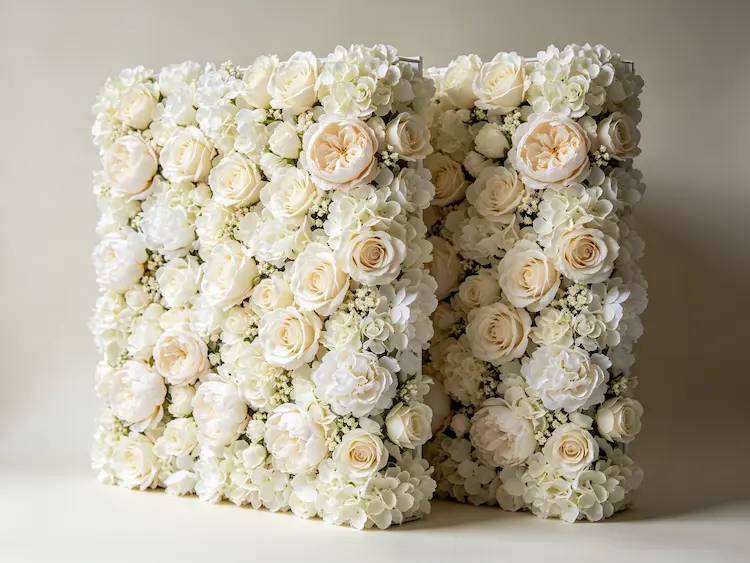
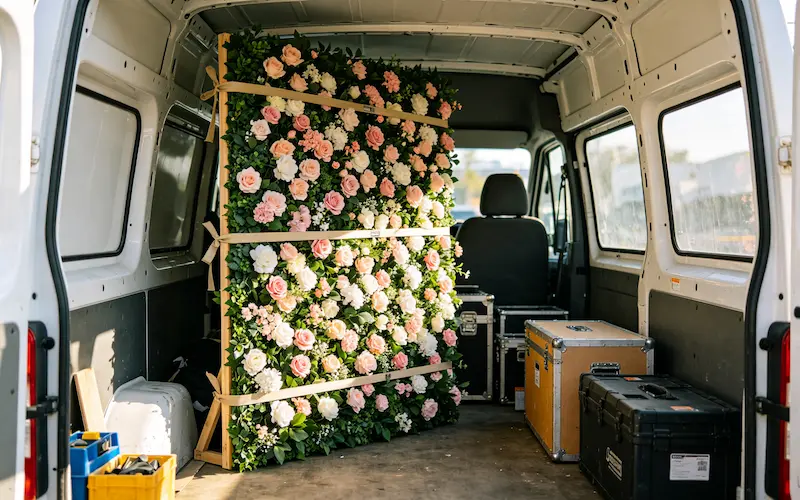
Always transport flower wall panels vertically, like books on a shelf. Standing them on edge means there is no weight pressing down on the flowers. If you lay panels flat and stack things on top — even light items — you will get crushed petals and permanent creases. Vertical storage eliminates that entirely.
Secure panels against the side wall of your vehicle. Use ratchet straps or bungee cords to hold them in place. You want them snug but not so tight that the frames bend. The key is that they cannot slide or tip over during sudden stops or turns. If you have multiple stacks, place them next to each other and strap them as a group.
Never place heavy items on top of or leaning against flower wall stacks. A 50-pound speaker box leaning against your flower panels during a sharp turn can crush an entire stack. Keep heavy cargo separate, ideally on the opposite side of the vehicle or secured in a different area.
Drive carefully, obviously. But know this: even the most careful driver cannot compensate for bad loading. If panels are loose in the back, every stop sign becomes a damage risk. Invest the time in loading properly, and the drive itself becomes low-risk.
Carrying and Moving Panels Without Damage
Carrying flower wall panels seems straightforward, but this is where a surprising amount of damage happens. Doorways, staircases, tight corners — these are the danger zones. One wrong angle and you can bend a frame or snap off a whole section of flowers.
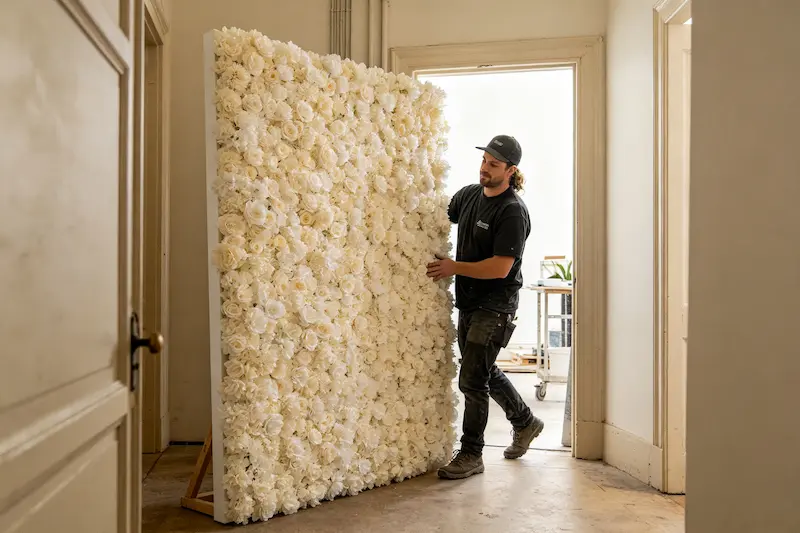
Always carry panels vertically, on edge. This is the same principle as loading — vertical means no weight on the flowers. It also makes panels much easier to maneuver through doorways. Carrying a panel flat is awkward, you cannot see where you are going, and you are far more likely to bang the edges into door frames.
Two people for large panels. A standard 40×60 inch panel is manageable by one person, but anything bigger or heavier is a two-person job. Trying to save 30 seconds by carrying a big panel alone is how you end up with bent corners and scratched frames. It is never worth it.
Watch the leading edge. When going through doorways, the front corner of the panel is what hits first. Tilt the panel slightly so the leading corner goes through first, then straighten it out. This is the same technique movers use for couches and mattresses, and it works exactly the same for flower walls.
Never drag panels on the ground. Even on carpet, dragging will grind dirt into the bottom edge and can fray the fabric on the frame sides. Pick it up, carry it, set it down. Three steps, no shortcuts.
Unloading and On-Site Handling Tips
Getting to the venue is only half the battle. How you handle panels on site matters just as much. Venues have tight hallways, elevators, banquet chairs everywhere, and staff rushing around. It is easy to damage walls in the chaos of setup.
Do a walkthrough first. Before you bring anything inside, scout the path from the loading dock to your setup area. Check for low ceilings, narrow doorways, tight turns, and anything else that could cause problems. Knowing the route ahead of time prevents awkward surprises when you are mid-carry with an expensive panel.
Use a rolling cart or dolly for multiple panels. If you have more than 3-4 panels to move across a venue, do not carry them one by one. Stack them carefully on a furniture dolly with a blanket underneath, and wheel them in one trip. This is faster and reduces the number of times you are lifting and maneuvering panels — which means fewer opportunities for damage.
Keep panels in their protective blankets until setup time. Do not unwrap everything as soon as you get to the venue. Leave panels wrapped until you are actually ready to put them on the stands. This protects them from getting bumped by other vendors, stepped on, or splashed by drinks during the setup chaos.
Post-Event Teardown and Return Transport
People rush teardown. Everyone is tired, the event is over, and the last thing anyone wants to do is carefully pack flower walls. But this is actually when a lot of damage happens. Tired, rushed packing leads to bent frames and crushed petals that you will not discover until your next booking.
Inspect every panel before you pack it up. This takes two extra minutes per wall and it is worth every second. Check for bent petals, loose flowers, frame damage, and any stains. If something is damaged, you know exactly when it happened and can address it before the next event. If you just throw everything in the van, you will have no idea which event caused which damage.
Pack the same way you loaded — vertical, secured, face-to-face stacking. Do not get lazy on the way back. Return transport is just as important as the trip there. Walls are just as vulnerable to damage on the drive home, especially if you are tired and in a hurry to get back.
Unload as soon as you get back to the shop. Do not leave flower walls sitting in a hot van overnight. Extreme heat can warp plastic frames and can cause fabric flowers to fade or become brittle. Unload, do a quick check, and get them into climate-controlled storage as soon as possible.
The Most Common Transport Damages (And How to Prevent Them)
Knowing what goes wrong is half the battle. Here are the four most common types of transport damage, exactly what causes them, and how to make sure they never happen to your inventory.
🌸 Crushed Petals
Cause: Wrong stacking, flat transport, heavy items on top
Prevention: Face-to-face stacking + always transport vertically
🔧 Bent Frames
Cause: Dropping, banging doorways, shifting cargo impact
Prevention: Two-person carry + secure everything in vehicle
🌼 Loose Flowers
Cause: Twisting/bending panels during transport
Prevention: Carry flat against body + even stacking
💨 Dirt & Stains
Cause: Unwrapped panels, setting on bare ground
Prevention: Moving blanket wraps + never set on ground
Crushed or flattened petals — This is the most common damage by far. It happens when panels are stacked wrong, heavy items are placed on top, or panels are transported flat. The fix is simple: always stack face-to-face, always transport vertically, and never put anything on top of flower panels. Most crushed petals can be fluffed back into shape with your fingers, but repeated crushing causes permanent creases.
Bent or cracked frames — Frame damage usually happens from impact: dropping a panel, banging it into a doorway, or having heavy cargo slide into it during transport. Prevention: two-person carry for large panels, scout doorways ahead of time, and secure everything in the vehicle so nothing can shift. A bent frame is not just cosmetic — it also means panels will not line up properly when you build the wall.
Flowers falling off panels — Individual flowers or whole clusters can pop loose if a panel gets twisted or bent during transport. The glue holding flowers on is strong, but it is not designed to handle the panel being flexed repeatedly. Prevention: always carry panels flat against your body (not bent at an angle), and never stack panels unevenly where one is hanging off the edge.
Dirt and stains — Transport is dirty. Roads have dust, vans have dirt on the floors, venues have parking lot grime. Panels that are not properly wrapped get dirty quickly. Prevention: always wrap stacks in moving blankets, never set panels directly on the ground, and use the original cardboard packaging whenever possible. A clean wall looks more expensive and commands higher rental rates.
Essential Transport Supplies Every Rental Business Needs
You do not need fancy equipment to transport flower walls safely. A few basic supplies make a huge difference, and most of them are one-time purchases that last for years.
🛒 Must-Have Transport Supplies
Moving Blankets / Furniture Pads
The single most