- What "Moody" Actually Means in Wedding Design
- The Dark Romantic Color System & Flower Species
- 4 Moody Color Schemes for Different Venues
- 6 Design Principles That Make Moody Work
- Moody Florals Across the Wedding: Arch, Table, Bouquet, Backdrop
- Why Artificial Flowers Excel in Moody Palettes
- Lighting & Photography: Making Dark Flowers Read
- 5 Costly Moody Wedding Mistakes
- FAQ
Blush pink is out. Burgundy, black, and plum are in — and they're not a niche. Moody dark-romantic weddings have moved from alternative trend to mainstream luxury aesthetic, and the floral industry is following fast. Deep-toned weddings now command premium budgets because they photograph like editorial spreads, feel cinematic in person, and give couples a chance to skip the "expected" pastel palette entirely (Wedding Sprinkle, 2026; Prairie Hive, 2026).
But here's the thing most people get wrong: moody is not a color. It's a relationship between color, contrast, texture, movement, negative space, and light (Aria Vera Floral, 2026). A deep burgundy arrangement can feel romantic at a wedding, architectural at a corporate gala, or dramatic at an evening reception — the difference isn't the flowers, it's how they're designed. Get the design principles right and the palette does the rest.
This guide covers what moody design actually means, the flower species and color system that make it work, four complete schemes for different venues, the six principles that separate "dark" from "moody," how to apply florals across the wedding, and why artificial flowers are uniquely suited to deep palettes.
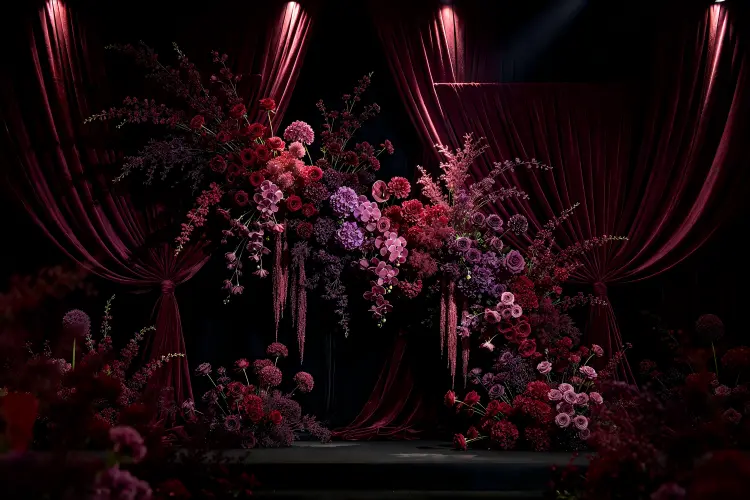
What "Moody" Actually Means in Wedding Design
The word "moody" gets thrown around a lot, and most of the time it's used wrong. Moody floral design is not simply a matter of choosing dark-colored flowers. Rich tones establish the palette — but the atmosphere comes from the relationship between color, contrast, texture, movement, negative space, and light (Aria Vera Floral, 2026).
Dark is a color. Moody is an atmosphere. You can have a fully burgundy room that feels flat and heavy, or a mostly light room with one deep focal point that feels mysterious and luxe. The palette matters less than the design decisions around it.
The signature moody elements:
- Deep saturated tones — burgundy, plum, black, forest green — as the base, not the accent
- Strong contrast — smoke-hued roses or creamy anemones against saturated blooms (My Celeberations, 2026)
- Layered texture — velvet ribbon, dried grasses, trailing amaranthus, inky foliage
- Movement and asymmetry — loose, sculptural arrangements instead of tightly rounded designs
- Negative space — the room breathes; darkness needs emptiness to feel luxurious, not heavy
- Light as a design tool — candles, warm pin lights, and the soft glow that turns dark florals from flat to radiant (Whole Blossoms, 2026)
Why it's trending now. Couples increasingly want weddings that feel personal and cinematic rather than formulaic. The moody aesthetic photographs like an editorial spread, works year-round (especially autumn and winter), and gives couples permission to reject the pastel default. Gothic destination weddings are having a serious moment — and the color schemes couples are choosing are breathtaking (Prairie Hive, 2026).
The Dark Romantic Color System & Flower Species
Moody doesn't mean "all black." The best moody palettes build depth with a specific color system and signature flower species. Here's the framework designers use (Plan A Wedding, 2026; Fiory AI, 2026; Wedding Sprinkle, 2026):
| Palette Tone | Signature Flowers | Texture & Fill | Best Used For |
|---|---|---|---|
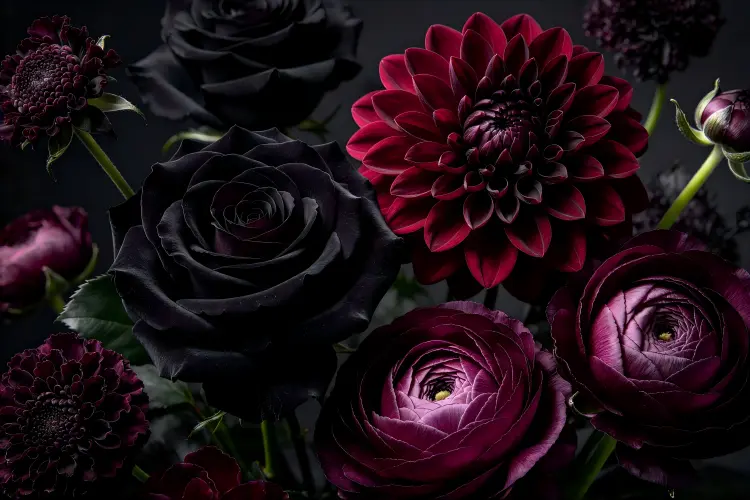
| Deep red / burgundy | Burgundy dahlias, black baccara roses, chocolate cosmos | Trailing amaranthus in deep red, dark eucalyptus | The base color — arches, centerpieces, bouquets |
| Plum / purple | Deep plum ranunculus, dark purple calla lilies, plum-toned hellebores | Blackberry branches, dusty miller | Gradient transitions, depth in arrangements |
| Black / midnight | Black baccara roses, black dahlias, dark anemones | Inky foliage, dark berries | Statement moments — focal flowers, dramatic arches |
| Ivory / smoke contrast | Smoke-hued roses, creamy anemones, ivory lisianthus | Dried lunaria, soft eucalyptus | The contrast element — keeps dark from going flat |
| Forest green | Dark eucalyptus, dusty miller, inky foliage | Rattan, woven grasses, dried elements | The natural base that grounds the palette |
| Mauve bridge | Mauve roses, delicate lisianthus | Blush accents, soft texture | Bridging deep and light tones seamlessly (Whole Blossoms, 2026) |
Source: Plan A Wedding moody romance theme guide (2026), Fiory AI dark wedding flowers palette (2026), Wedding Sprinkle moody flowers (2026), Whole Blossoms burgundy styling guide (2026).
The gradient technique. Dark flowers can read as a solid mass in photographs — the fix is a subtle gradient within each arrangement. Start with the deepest tones (black and burgundy) at the center, then transition gradually to slightly lighter shades of plum or mauve toward the edges. This creates dimension and prevents dark flowers from appearing as a flat block in photos (Dreamy Party Ideas, 2026).
The contrast rule. Never build a moody arrangement entirely from dark flowers. Every arrangement needs an ivory, smoke, or cream element to create the tension that makes dark colors glow. Balance saturated blooms with smoke-hued roses, dried lunaria, or creamy anemones for contrast that still feels mysterious (My Celeberations, 2026).
4 Moody Color Schemes for Different Venues
Moody works in different ways depending on the venue, season, and time of day. These four complete schemes are proven combinations (Prairie Hive, 2026; Fiory AI, 2026; Ling's Moment, 2026):
| Scheme | Palette | Best Venue & Season | Signature Elements | Feel |
|---|---|---|---|---|
| Vintage Noir | Burgundy + black + ivory | Ballroom, autumn & winter | Black baccara roses, burgundy petals, brass candelabras | Dramatic, cinematic, old-world luxury |
| Gothic Garden | Deep purple + plum + forest green | Garden estate, spring & summer | Purple calla lilies, hellebores, dark foliage, moss | Romantic, moody, natural mystery |
| Black Velvet | Black + navy + silver smoke | Modern loft, winter | Black dahlias, navy accents, smoked glass, candles | Sleek, architectural, high-fashion |
| Ember & Plum | Burgundy + plum + mauve bridge | Barn / rustic, autumn | Chocolate cosmos, ranunculus, dried grasses, velvet ribbon | Warm, rich, intimate |
Source: Prairie Hive moody color schemes (2026), Fiory AI dark wedding palettes (2026), Ling's Moment vintage noir collection (2026), Whole Blossoms burgundy styling (2026).
6 Design Principles That Make Moody Work
These are the principles that separate "dark" from "moody" — and the difference between a room that feels luxurious and one that feels heavy (Aria Vera Floral, 2026; Plan A Wedding, 2026):
- Build with contrast, not just depth. Every arrangement needs an ivory, smoke, or cream element. Contrast is what makes deep colors glow instead of disappear. Saturated blooms + smoke-hued roses + creamy anemones = tension that reads as mystery (My Celeberations, 2026).
- Layer texture relentlessly. Velvet ribbon, dried grasses, trailing amaranthus, inky foliage, rattan, woven materials. Moody design lives in texture — flat dark surfaces look cheap; layered dark textures look expensive.
- Use asymmetry and movement. Loose, sculptural, overflowing arrangements inspired by Dutch Golden Age still life paintings (Plan A Wedding, 2026). Tightly rounded designs kill the moody aesthetic — let arrangements flow and cascade.
- Respect negative space. Darkness needs emptiness to feel luxurious. A room packed wall-to-wall with dark flowers feels heavy, not moody. Edit ruthlessly — let the architecture breathe and let the darkness create depth.
- Make light a design element. Candles, warm pin lights, and the soft glow that turns dark florals from flat to radiant (Whole Blossoms, 2026). Antique brass, candelabras, and amber glass amplify the effect. The relationship between darkness and light is the heart of the aesthetic.
- Design for the photograph. Moody weddings are photographed more than they're experienced. Check how arrangements read in photos — use the gradient technique so dark flowers don't become a solid block, and test colors under the venue's actual lighting (Matched Hearts, 2026).
Moody Florals Across the Wedding: Arch, Table, Bouquet, Backdrop
Moody design needs to be consistent across every floral touchpoint — the palette that works on the arch must carry through to the smallest table accent. Here's how to apply it (Wedding Sprinkle, 2026; My Celeberations, 2026; Fiory AI, 2026):
1. The Ceremony Arch
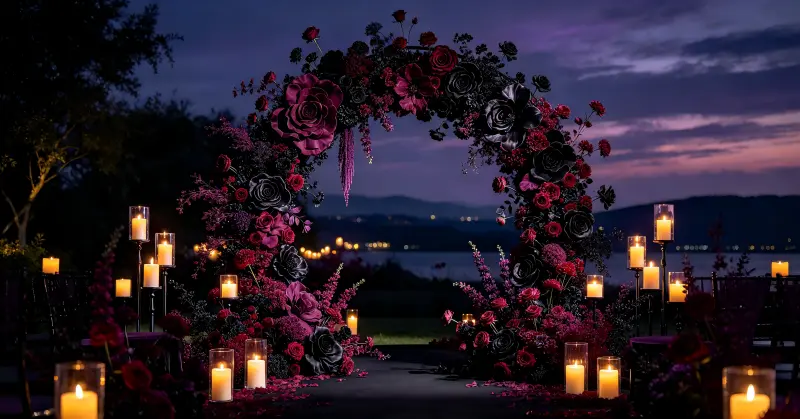
The arch is the moody statement piece. Deep burgundy dahlias and black baccara roses clustered asymmetrically, with trailing amaranthus and dark eucalyptus framing the corners. Ivory accents break the mass. For candlelit evening ceremonies, the arch becomes the most photographed element of the wedding — the contrast between dark florals and warm light is the money shot.
2. Reception Centerpieces
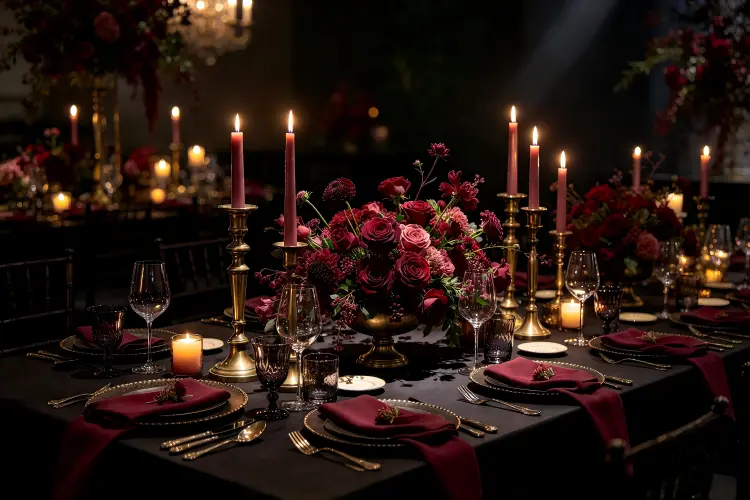
Low, circular arrangements around candles keep tables polished without crowding place settings (Matched Hearts, 2026). Plum blooms and dark greenery form the base; antique brass candle holders and the soft glow of candles make burgundy centerpieces transform into radiant, unforgettable focal points (Whole Blossoms, 2026). Vary heights across the room — low arrangements for conversation, taller statement pieces for focal tables.
3. Bridal Bouquet & Boutonnieres
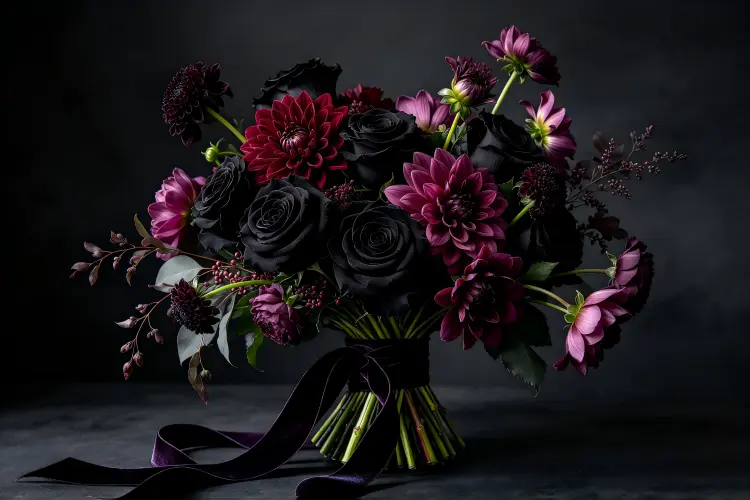
The bouquet is where moody couples make their first floral statement. Deep gradient — black and burgundy at the center, plum and mauve at the edges — wrapped in velvet ribbon. Trailing amaranthus adds movement. Boutonnieres echo the palette with a single dark bloom (black rose, dark dahlia) and a sprig of dusty miller.
4. Backdrop & Ceremony Wall
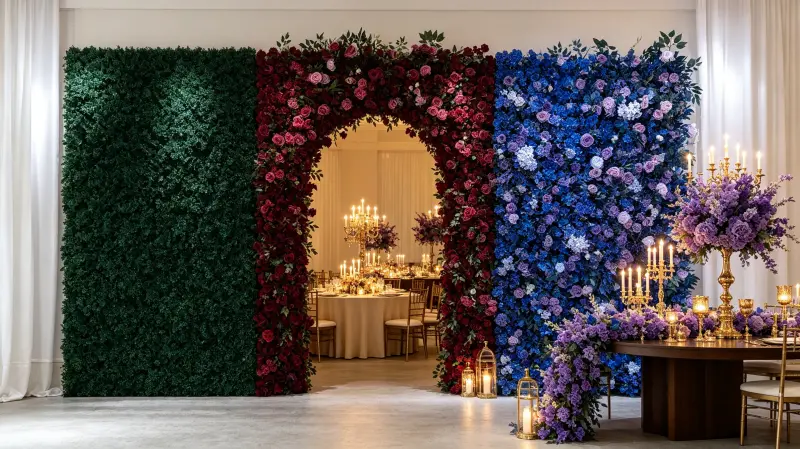
The moody backdrop moves beyond white florals: dark floral walls, inky greenery panels, and draped deep-toned fabric with cascading flower clusters. For luxury budgets, oversized dark blooms (giant burgundy dahlias, statement black roses) create the editorial focal point that photographs like a magazine spread.
5. Aisle & Transition Details
Burgundy and black rose petals along the aisle, dark florals on aisle posts, candle-lined paths. These small touches tie the palette together and create the "first steps as a married couple" moment that guests photograph (Ling's Moment, 2026).
Why Artificial Flowers Excel in Moody Palettes
Here's the industry secret: deep-toned flowers are where artificial florals genuinely outperform fresh — both visually and practically. Moody palettes are the best case for going artificial, and here's why:
| Factor | Fresh Flowers | Artificial (Silk) | Winner |
|---|---|---|---|
| Deep color consistency | Dark blooms fade fast, vary by batch | Deep colors replicated exactly, consistent batch to batch | Artificial |
| Black flower availability | Black baccara roses scarce & expensive | Black roses, dahlias, anemones readily available | Artificial |
| Texture realism | Natural but wilts | Premium silk matches texture at arm's length | Artificial |
| Candlelit venue safety | Wilt near heat, candles | Stable near candles (check flame rating) | Artificial |
| Cost for deep palette | Dark premium blooms expensive | Fixed cost, reusable, rentable | Artificial |
| Color stability in photos | Dark tones shift as blooms age | Perfect color every shot, every event | Artificial |
| Event-to-event reuse | Never reusable | Rentable, reusable for 3-5 years | Artificial |
| Seasonal availability | Dark blooms seasonal | Any dark flower, any season | Artificial |
Source: Ruby's Adorables moody dark flowers guide (2026), Products Review Lab red & black florals (2026), Xibo Floral factory data, industry moody wedding floral cost surveys.
The black flower problem. Fresh black baccara roses are scarce, expensive, and notoriously variable. Artificial versions are exact, consistent, and available year-round. The same applies to black dahlias, dark anemones, and chocolate cosmos — the entire moody palette is easier, cheaper, and more reliable in silk (Ruby's Adorables, 2026).
Why dark suits silk. Premium silk florals are indistinguishable from fresh at arm's length for most colors — but for deep, saturated tones the match is even stronger. Dark colors hide the minor texture differences that betray cheaper artificial flowers in light pastels. Moody palettes are the best-value use of artificial florals in the wedding industry.
The photo consistency advantage. Fresh dark flowers shift color as they age — a burgundy dahlia photographed at 2pm and 8pm reads differently. Artificial dark florals are identical in every shot, which matters enormously for a wedding photographer delivering a consistent editorial gallery.
Lighting & Photography: Making Dark Flowers Read
Dark florals fail when lighting is wrong — and they're unforgiving. These are the rules that make moody florals photograph and feel right (Matched Hearts, 2026; Whole Blossoms, 2026):
- Test under the venue's actual lighting. Strong red or blue lighting can change how burgundy and plum read. Check a sample under the lighting planned for dinner — not daylight, not a phone screen (Matched Hearts, 2026).
- Light from the side, not above. Overhead light flattens dark flowers. Side lighting (candles, uplights, warm pin lights) creates the shadows and depth that make moody arrangements glow.
- Always include the gradient. Deep center, lighter edges — prevents dark arrangements from reading as a solid black mass in photos (Dreamy Party Ideas, 2026).
- Use candles as the primary light source. Antique brass, amber glass, and the soft glow of candles transform burgundy centerpieces into radiant, unforgettable focal points (Whole Blossoms, 2026).
- Balance ambient darkness. Moody doesn't mean dark-room. The room needs enough ambient light for guests to see and photographers to shoot — the mood comes from contrast between pools of candlelight and shadow, not total darkness.
Dark Romantic Floral Collections — Factory Direct
Black baccara roses, burgundy dahlias, plum calla lilies, and chocolate cosmos in premium silk. Moody palette bundles for arches, centerpieces, bouquets, and backdrops. Custom color matching, MOQ 10 panels, 7–10 day production.
Request Moody Collection Catalog & Sample5 Costly Moody Wedding Mistakes
Mistake 1: All dark, no contrast
An arrangement built entirely from dark flowers reads as a flat black mass — in person and in photos. Every moody arrangement needs an ivory, smoke, or cream element. Contrast is what makes deep colors glow instead of disappear (My Celeberations, 2026).
Mistake 2: Ignoring the venue's lighting
Dark florals fail under wrong lighting — flat overhead light, strong red or blue venue lighting, or a room that's too dark for guests to see. Test your palette under the venue's actual reception lighting before committing (Matched Hearts, 2026).
Mistake 3: Over-filling the room
Wall-to-wall dark flowers feel heavy, not luxurious. Moody design needs negative space — let the architecture breathe, use darkness as a tool, and edit arrangements ruthlessly. A room that breathes feels expensive; a packed room feels claustrophobic.
Mistake 4: Buying cheap artificial dark flowers
The moody palette hides texture differences better than pastels — but only up to a point. Cheap artificial dark flowers have flat colors and shiny plastic textures that scream "fake" under candlelight. Premium silk is the difference between a luxury moody wedding and a Halloween party.
Mistake 5: Skipping the flame-safety check
Moody weddings are candle-heavy — and candles near florals need fire-retardant materials. Confirm your artificial florals carry flame-retardant documentation (NFPA 701 or equivalent) and keep arrangements at a safe distance from open flames. Beautiful is not worth a venue rejection or worse.
FAQ
Source Moody Wedding Florals Factory Direct
Dark romantic floral bundles for arches, centerpieces, bouquets, and backdrops. Black baccara roses, burgundy dahlias, plum calla lilies in premium silk. Fire-retardant options, custom color matching, MOQ 10 panels, 7–10 day production.
Browse Moody Collection