Artificial flower balls — also called kissing balls, pomanders, or flower spheres — have become one of the most versatile decor items in the event rental industry. But if you're new to sourcing them for your rental business or event planning, you probably have questions.
What sizes should you buy? How long do they last? Can they go outside? How many do you need for an event?
After working with hundreds of rental businesses and event planners, we've heard every question imaginable about flower balls. Here are the 10 most common ones — answered in full detail by our commercial sourcing team.
- 1. What exactly are artificial flower balls?
- 2. What size flower ball should I choose?
- 3. How long do artificial flower balls last?
- 4. Can flower balls be used outdoors?
- 5. How do you hang flower balls from the ceiling?
- 6. How much does it cost to rent flower balls?
- 7. How many flower balls do I need for an event?
- 8. Can I customize colors and flower types?
- 9. How do you clean and maintain flower balls?
- 10. What's the ROI for rental businesses?
1. What exactly are artificial flower balls?
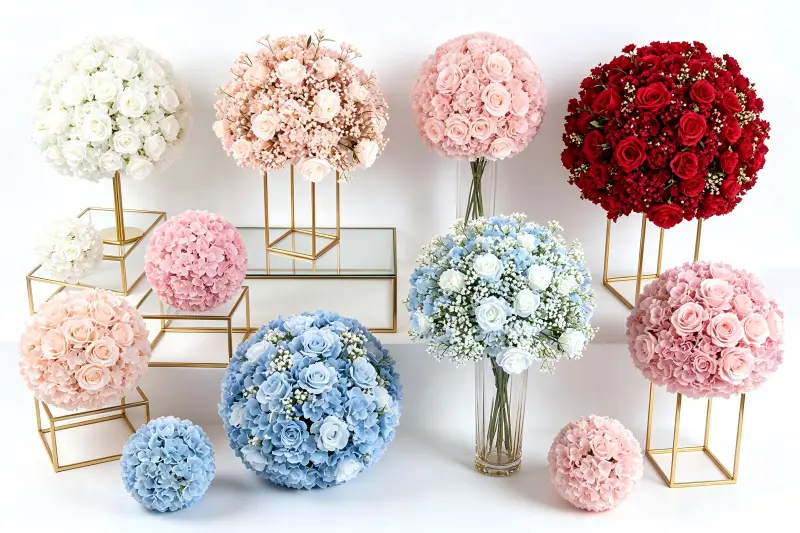
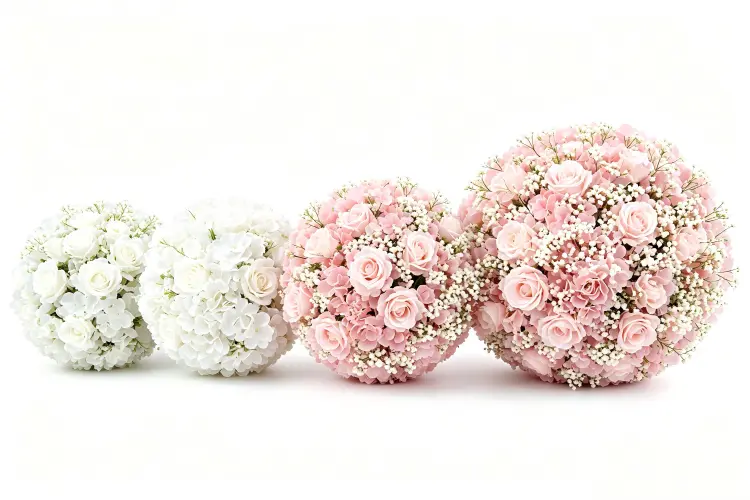
A: Artificial flower balls (also called kissing balls, pomanders, or flower spheres) are round, ball-shaped arrangements of silk or PE flowers built around a core structure. Think of them as perfectly round floral arrangements that you can hang, place, or display anywhere.
They're constructed in two main ways:
- Foam core: Flowers are inserted into a solid foam ball. Budget-friendly but less durable (15-50 uses).
- Plastic cage core: Flowers are attached to a hollow plastic cage frame. More durable (50-150+ uses), lighter, and better air circulation.
Commercial-grade flower balls come in sizes from 4 inches to 20+ inches and are used for table centerpieces, ceiling hanging installations, aisle markers, arch decoration, chair back decor, and much more.
For rental businesses, flower balls are one of the highest-ROI inventory items you can own — they're versatile, durable, and book consistently across all event types.
2. What size flower ball should I choose?
A: It depends on how you'll use them. Here's the quick guide:
- 4" (mini): Chair back decor, place settings, small accent pieces. Wholesale $2-5, rental $5-10.
- 6" (small): Aisle markers, small table accents, tree branch hanging. Wholesale $4-8, rental $10-18.
- 8" (medium): Small table centerpieces, hanging clusters. Wholesale $6-12, rental $15-25.
- 10" ⭐ (standard / most popular): Standard table centerpieces, versatile for everything. Wholesale $8-18, rental $20-35.
- 12" (large): Grand table centerpieces, statement hanging pieces. Wholesale $12-25, rental $30-50.
- 14-20" (giant): Ceiling installations, grand entrances, stage decor. Wholesale $20-50+, rental $50-100+.
For rental businesses starting out: Begin with 10-inch balls as your core inventory — they're the most versatile and book the most often. Add 6-inch balls for aisle markers and chair decor as you grow.
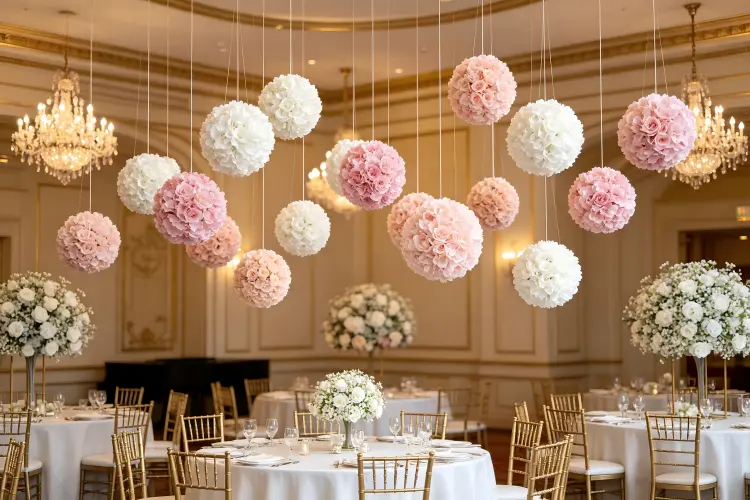
Pro tip: Mixed sizes always look better than all the same size, especially for ceiling installations. Varying heights creates depth and visual interest.
3. How long do artificial flower balls last?
A: Lifespan depends heavily on quality and how well you maintain them. Here's the breakdown:
- Budget / entry-level ($2-8 each): 15-30 uses. Foam core, thin plastic petals, flowers fall out easily. Not recommended for commercial rental.
- Standard commercial-grade ($8-18 each): 50-100 uses. PE + silk mix flowers, foam or basic plastic core. Good for regular rental use with proper care.
- Premium commercial-grade ($18-35 each): 150+ uses. Heavy-duty plastic cage core, high-density silk flowers, UV-stabilized. Built for heavy rental rotation.
The biggest factors affecting lifespan:
- Flower density: Denser balls hold up better because individual flowers share the wear
- Core construction: Plastic cage cores last 2-3x longer than foam cores
- Storage: Hanging or individually boxed storage prevents crushing and flattening
- Transport: Proper packaging prevents petals from getting crushed in transit
- Cleaning frequency: Regular dusting prevents buildup that breaks down petals over time
With proper care, a quality commercial flower ball can easily last 3-5 years of regular rental use — paying for itself dozens of times over.
4. Can flower balls be used outdoors?
A: Yes, but with important caveats. Here's what you need to know:
Weather resistance:
- Sun / UV: UV-stabilized commercial-grade balls handle outdoor sun for 1-2 years before noticeable fading. Non-UV balls may fade in 3-6 months of regular outdoor use.
- Rain: Most artificial flower balls are water-resistant but not waterproof. Light rain is fine, but heavy soaking can damage the core and glue. Always bring them inside after events.
- Wind: The #1 outdoor risk. Hanging flower balls can swing and potentially fall in strong wind. Always use secure hanging points and avoid outdoor use in sustained winds above 15mph.
Best outdoor uses:
- Covered patios and porches
- Tent interiors (protected from direct rain)
- Garden parties with calm weather
- Brief outdoor ceremonies (1-2 hours)
Pro tip for rental businesses: Market flower balls as "indoor and covered outdoor" to set proper expectations. Have a weather policy that requires tenting or backup plans for outdoor events. This protects your inventory and your client relationship.
5. How do you hang flower balls from the ceiling?
A: Most commercial flower balls come with a built-in hanging loop or metal hook at the top. From there, the hanging method depends on your ceiling type:
Essential hanging tools:
- Fishing line (20-30lb test) — invisible, works for most situations
- Clear ribbon or jute twine — visible but decorative
- Command hooks — for smooth ceilings and walls (damage-free)
- S-hooks — for exposed beams and pipes
- T-bar / drop ceiling clips — for office-style drop ceilings
- Zip ties — for tent poles and frames
Ceiling type guide:
- Drywall / smooth ceiling: Use Command hooks (rated for the weight) or screw hooks if holes are allowed
- Exposed beams: S-hooks or wrap with fishing line
- Drop ceiling (T-bar): Special T-bar clips that grip the grid framework
- Tent interior: Zip ties to tent poles or fishing line to tent crossbars
Safety first: Always test the weight capacity of your hanging point before leaving flower balls unattended. For ceiling installations with 6+ balls, use multiple anchor points. Never hang anything above where guests will be standing without double-securing.
Pro tip: Vary the hanging heights for a more dynamic, organic look. Mix 3-5 different heights across the installation space.
6. How much does it cost to rent flower balls?
A: Rental pricing varies by size, quality, and your local market. Here are typical 2026 rental rates:
Per-ball rental prices:
- 4-6" small: $10-20 per ball per event
- 8-10" standard: $20-35 per ball per event
- 12" large: $30-50 per ball per event
- 14-20" giant: $50-100+ per ball per event
Package pricing (more common):
- Table centerpiece package: $250-500 for 10-15 table balls
- Ceiling installation package: $300-800 for 8-20 hanging balls at varying heights
- Aisle marker package: $150-300 for 8-12 aisle balls
- Full venue package: $800-2,000+ for complete floral ball decor
For rental businesses: Flower balls have one of the fastest ROIs in the industry. A standard 10-inch ball costs $8-18 wholesale and rents for $20-35 — that's payback in just 1-2 rentals. After that, it's almost pure profit for the next 48-98 uses.
Pricing strategy tip: Always package flower balls with installation labor rather than renting them individually. Clients value the convenience, and you can charge 2-3x more for a complete installed package.
7. How many flower balls do I need for an event?
A: It depends entirely on how you're using them. Here's a quick reference guide:
By use case:
- Table centerpieces: 1 per table. Typical wedding: 10-15 balls for guest tables + 1-2 for head table.
- Ceiling installation: 6-12 balls for a small room, 15-30+ for a large ballroom. Space them 3-5 feet apart at varying heights.
- Aisle markers: 1 every 6-8 feet on both sides. Standard aisle: 8-12 total.
- Arch decoration: 4-8 balls scattered across the arch for accent.
- Chair back decor: 1 per chair (usually just the ceremony chairs or head table). 6-10 total.
For rental businesses building inventory:
- Starter set (24 balls): 16×10" + 8×6". Investment: $200-350. Handles small weddings and corporate events.
- Growing inventory (50+ balls): 30×10" + 12×6" + 8×12". Investment: $600-1,000. Handles most mid-size events.
- Full service (100+ balls): 50×10" + 25×6" + 15×12" + 10×14-20". Investment: $1,500-2,500. Handles large weddings and full venue installs.
Pro tip: White and blush are your bread-and-butter colors — they book for 70%+ of events. Add sage green and burgundy for seasonal variety, but keep 80% of your inventory in neutral colors that work for everything.
8. Can I customize flower ball colors and flower types?
A: Yes, most Chinese suppliers offer customization options. Here's what's available:
Color customization:
- Standard colors (always in stock): White, ivory, blush pink, red, burgundy, navy blue, sage green
- Custom colors (MOQ required): Pantone-matched colors available. Typical MOQ: 10-20 pieces per color. Lead time: +5-10 days.
- Mixed color balls: Two-tone or gradient color combinations. MOQ: 5-10 pieces per design.
Flower type customization:
- Standard mixes: Rose + hydrangea (most common), peony + eucalyptus, all-rose
- Custom mixes: Choose specific flower types, greenery varieties, and ratios. MOQ: 20-50 pieces.
- Greenery-only balls: All eucalyptus or fern — very on-trend for 2026 minimalist events.
For rental businesses: Start with standard colors and designs — they're faster to source and more versatile. Add custom colors as you grow and identify demand. Many successful rental businesses keep 80% standard inventory and 20% custom/seasonal pieces.
2026 trend alert: Monochromatic all-white and all-green flower balls are surging in popularity for minimalist and modern weddings. They also pair beautifully with neon signs — a huge 2026 wedding trend.
9. How do you clean and maintain artificial flower balls?
A: Proper cleaning and maintenance is what separates flower balls that last 20 uses from ones that last 150+. Here's the professional routine:
After every use:
- Gently shake off dust and debris
- Wipe petals with a soft dry microfiber cloth
- Check for loose flowers — re-glue any that are falling out (hot glue gun works great)
- Fluff and reshape any flattened petals
Every 5-10 uses (deep clean):
- Use a hairdryer on the cool setting to blow dust out of hard-to-reach areas
- Use a soft-bristle brush (like a makeup brush or paintbrush) for detailed cleaning
- For stubborn spots: lightly dab with a damp cloth (not soaking wet) and air dry immediately
- Inspect the core — make sure it's not cracking or deteriorating
Storage best practices:
- Store in a cool, dry area away from direct sunlight (prevents fading)
- Hang them if possible — prevents flattening
- If stacking, use individual plastic bags or cardboard dividers
- Never stack heavy items on top of flower balls
- Keep them away from heat sources (heaters, direct sunlight through windows)
Never do this:
- ❌ Never submerge flower balls in water — it damages the core and dissolves glue
- ❌ Never use harsh chemicals or cleaning sprays
- ❌ Never store them in hot attics or garages in summer
- ❌ Never cram them into bins without protection
10. What's the ROI for rental businesses investing in flower balls?
A: Flower balls have one of the fastest ROIs of any event rental inventory item. Let's break it down:
Per-ball economics (10" standard commercial):
- Wholesale cost: $8-18
- Rental price per event: $20-35
- Payback period: 1-2 rentals
- Lifespan: 50-100 uses
- Lifetime revenue per ball: $1,200-2,400
- Lifetime profit margin: 90%+ after payback
Inventory level economics:
- Starter (24 balls, $200-350 investment): $4,000-8,000+ annual revenue (10-15 events/year)
- Growing (50+ balls, $600-1,000 investment): $10,000-20,000+ annual revenue (20-30 events/year)
- Full service (100+ balls, $1,500-2,500 investment): $25,000-50,000+ annual revenue (40-60 events/year)
Why flower balls beat other inventory:
- Versatility: One ball works for table centerpieces, ceiling installs, aisle markers, arch decor — multiple revenue streams per item
- Low maintenance: No water, no wilting, minimal cleaning compared to fresh flowers
- Easy transport: Lightweight and compact compared to flower walls or arches
- Year-round demand: Booked for weddings, corporate events, baby showers, holiday parties — no off-season
- Upsell potential: Pair with ceiling installation service, lighting, or other decor for higher ticket values
Bottom line: If you're a rental business looking for the fastest ROI item to add to your inventory, flower balls are hard to beat. A $300 starter investment can generate $5,000+ in year one — and keep generating for 3-5 years.
Ready to Start Your Flower Ball Inventory?
Xibo Floral supplies commercial-grade flower balls built for 50-150+ rentals. UV-stabilized, plastic cage cores, and 5-10% spare flowers included with every order.
Request Wholesale Pricing